

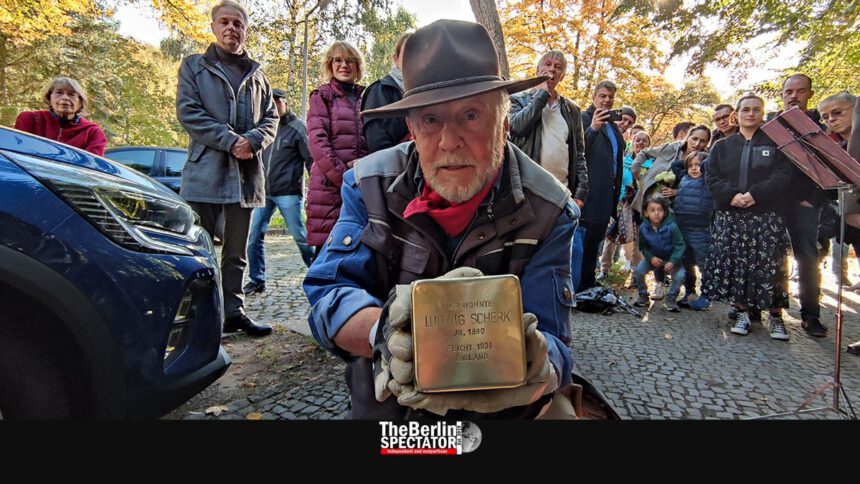
It started in Cologne. The artist Gunter Demnig could not accept the fact that residents did not know people of Romani origin who used to live there were deported and murdered by the Nazis. So, he placed the first Stumbling Block.
Berlin, January 12th, 2021 (The Berlin Spectator) — On December 16th, 1942, Heinrich Himmler, Hitler’s ‘Reichsführer SS’, one of the worst Nazi henchmen, signed the Auschwitz Decree. By doing so, he ordered the deportation of all Sinte and Roma in Germany to concentration camps. The Nazi regime’s goal was to annihilate all of them. Until 1945, up to half a million Gypsies were murdered.
The First Block
Fifty years after the decree was signed, in 1992, the artist Gunter Demnig, a Berliner by birth, made the first Stumbling Block, by carving the first sentences of Himmler’s order onto a concrete cube. Nobody was supposed to forget the Nazis’ systematic murder. Demnig placed the Stumbling Block on the pavement in front of Cologne’s City Hall.
At that moment, he was probably not aware of the fact that he was initiating what would become the largest decentralized memorial in the world. Today, Stumbling Blocks are the one form of commemoration for Holocaust victims everyone notices, including people who do not visit other memorials or Holocaust museums, individuals who did not learn about the Holocaust at school.
The Encounter
According to Gunter Demnig, an encounter with a contemporary witness in Cologne triggered the idea. She was convinced no Sinti or Roma had ever lived in her neighborhood. From that moment onward, Demnig’s idea was to commemorate all Holocaust victims at the locations they had lived at before the Nazis deported and killed them. It was about returning the victims, mostly Jews, to their domiciles symbolically.
In 1994, Demnig had an exhibition of 250 Stumbling Blocks for Sinte and Roma at a church in Cologne. A year later, he placed them all over the city. Today, there are more than 75,000 Stumbling Blocks in Germany, or a total of about 90,000 in Europe. They show where Holocaust victims lived in Berlin, Hamburg, Frankfurt, Munich, Stuttgart, Cologne and much smaller German cities as well as in other European countries.
The Funding
They are cubic concrete blocks that measure 10 by 10 by 10 centimeters (4 by 4 by 4 inches) and feature a brass plaque at the top. The plaque includes the victims’ names, their birth names, birth years, deportation dates and the dates or years of their murder along with the Nazi death camp they were killed at. Stumbling Blocks are being placed right in front of the building the victims lived in, if it still exists. Otherwise they are being placed at the former location of the building.
Stumbling Blocks cost money. The foundation ‘Stiftung – Spuren – Gunter Demnig’ collects donations. For each Stumbling Block, 120 Euro (146 U.S. Dollars or 108 Pounds Sterling in early 2021) are needed. Any individual can sponsor a Stumbling Block. In Berlin, there are several local initiatives that are working on the project. Their members do research, look for the victim’s relatives and deal with the placing of the Stumbling Blocks.
Betty and Frieda Brasch
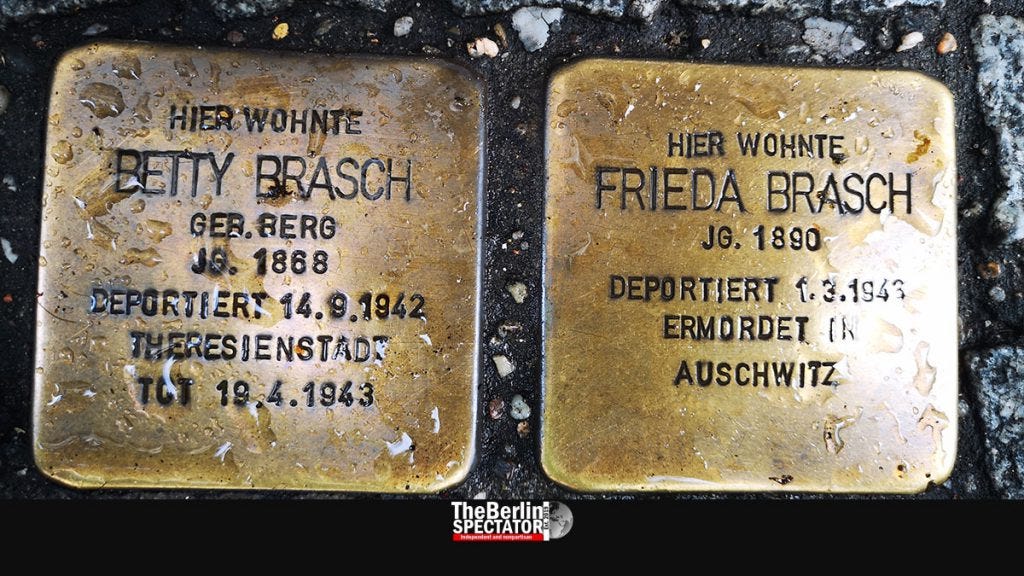
The picture below shows the Stumbling Blocks for Betty and Frieda Brasch who lived at ’22 Kirchstrasse’ in Berlin. Born in 1868, Betty Brasch was 75 years old when the Nazis deported her to Theresienstadt on September 14th, 1942. Seven months later, she was dead. Frieda Brasch was 53 when she was deported to Auschwitz on March 1st, 1943. She was murdered there for one reason only: She was a Jew. Betty and Frieda Brasch are two of millions of Holocaust victims.
The Federal Republic of Germany is a democratic and free country. Awareness about what happened in Nazi Germany, its predecessor country, is important. So is the commemoration of the victims. Especially in big cities like Berlin or Hamburg, absolutely nobody can escape those Stumbling Blocks.