


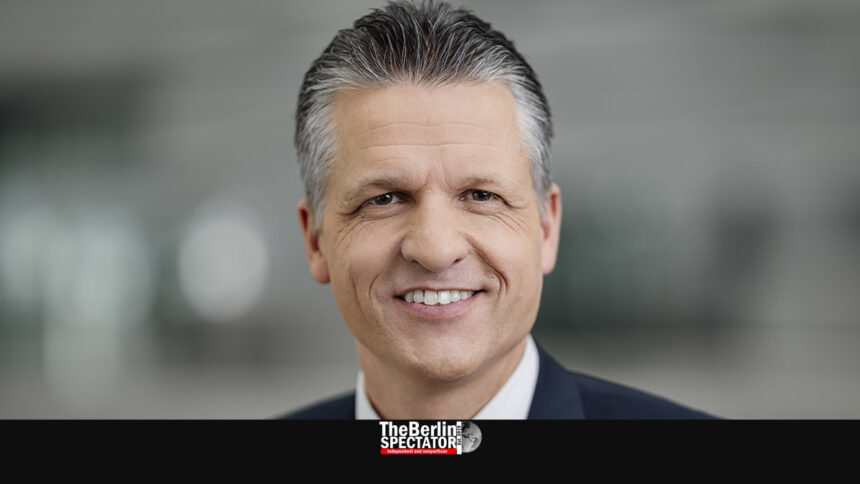
Berlin, July 23rd, 2026 (The Berlin Spectator) – Chancellery Chief of Staff Thorsten Frei, a Christian Democrat, has been put forward to succeed Jens Spahn as chairman of the joint CDU/CSU parliamentary group in the Bundestag. CDU leader Friedrich Merz and CSU leader Markus Söder made the proposal during a video conference of the group’s executive committee, after which all 208 lawmakers were notified by text message. A special session to confirm the choice is scheduled for Wednesday, July 29th.
Announcing his successor at the Chancellery will have to wait, according to government sources.
Merz framed the decision by pointing to Frei’s role in the coalition’s recent legislative successes, telling colleagues that the reforms of recent weeks were partly Frei’s achievement as well. Söder backed the move, recalling a productive working relationship with Frei going back to his time as parliamentary floor manager. Frei previously held that job under Merz during the CDU’s period in opposition.
A Second, More Delicate Decision
Government insiders say attention is deliberately being kept on the parliamentary group post for now, out of respect for the fraction and the significance of the chairmanship. A decision on the Chancellery post will be announced separately, and quickly, once Merz has made up his mind, the sources added.
According to German-language media, several names are circulating for the Chancellery role. Health Minister Nina Warken, who had also been mentioned for the group chairmanship, is currently seen as the frontrunner. She has overseen a well-received reform of Germany’s statutory health insurance system, and her appointment would also blunt criticism that Merz’s inner circle of advisers is exclusively male. CDU Secretary-General Carsten Linnemann has been floated as a possible replacement at the Health Ministry should Warken move.
Deputy group chairman Günter Krings was initially the name most mentioned after Spahn’s resignation — Merz had tried to install him as head of the Konrad Adenauer Foundation last year, only for Krings to lose a contested vote to former CDU chair Annegret Kramp-Karrenbauer — but he is now considered a long shot.
Other names in play include Hendrik Hoppenstedt, a former junior minister for federal-state relations under Angela Merkel who is seen as too closely tied to the Merkel era to be an obvious fit for Merz, and Nathanael Liminski, chief of staff to North Rhine-Westphalia’s state premier Hendrik Wüst, who has built a reputation in Berlin as one of German politics’ most effective operators.
Any swearing-in would likely have to wait until the Bundestag’s first sitting week after the summer recess, beginning September 1st.
Two Key Coalition Posts in Play
The reshuffle touches two of the most important positions in the coalition. The parliamentary group chair effectively controls the votes the government needs to pass legislation, making the role second in importance only to the chancellor himself on the Union side. The Chancellery chief of staff, meanwhile, is responsible for coordinating government business, including with the states — a role in which Frei reportedly struggled to gain full footing, with some in the party privately grumbling that he preferred giving interviews to steering coalition negotiations. During the recent reform package, that coordinating role effectively fell to the parliamentary leadership itself.
Frei’s return to the fraction is widely seen within the conservative CDU as a better fit for his political skills. Interim group chairman Alexander Hoffmann of the CSU said Frei knows the fraction, parliamentary procedure and the current political issues inside and out, adding that he also has excellent ties to the coalition partner, the center-left Social Democrats (SPD). First Parliamentary Floor Manager Steffen Bilger said the proposal had been received warmly within the group.
With Frei, Merz gains a considerably more loyal presence at the top of the fraction than his predecessor. Under Spahn, the parliamentary group had grown more assertive, emerging as something of a power center alongside the Chancellery itself — and lawmakers are expected to want Frei to maintain that posture.
Spahn’s Next Move Uncertain
Spahn resigned over the weekend under mounting pressure from within his own party after he and his husband, Daniel Funke, announced they had become parents via a surrogate in the United States. Surrogacy is illegal in Germany, and the CDU officially opposes legalizing it — a position Spahn himself had previously supported.
Spahn has kept a low profile since stepping down. Merz praised his predecessor’s tenure during the executive committee call, crediting him with building up the parliamentary group during a critical period and playing a significant role in shaping the government’s recent reform agenda. Whether Spahn will attend Wednesday’s group meeting, or whether he intends to give up his Bundestag seat altogether, remains unclear. Merz said this week that he did not know Spahn’s plans and would not offer him advice.
Presidential Succession Also Looms
Merz and Söder may also have discussed, informally, the question of who should succeed Federal President Frank-Walter Steinmeier, whose successor will be elected in January. The CDU/CSU and SPD are expected to hold a majority in the Federal Convention, putting the nomination in the Union’s hands after Steinmeier, a Social Democrat.
Söder has previously suggested Bavaria’s state parliament speaker, Ilse Aigner, for the post. Any formal nomination is not expected before September’s state elections, though observers say it would be surprising if the question weren’t already on both party leaders’ minds.