

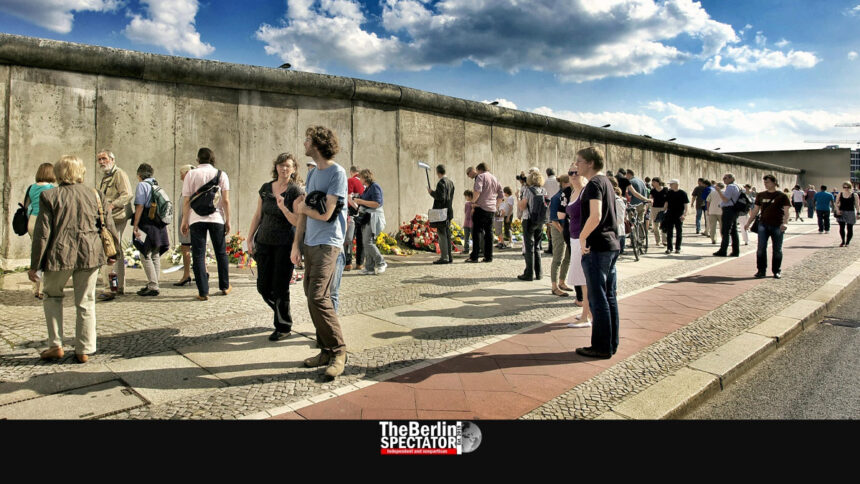
Berlin, August 13th, 2026 (The Berlin Spectator) – Berlin’s Governing Mayor Kai Wegner marked the 65th anniversary of the construction of the Berlin Wall, calling August 13th, 1961 “one of the darkest days in the history of our city.”
In a statement released by the Berlin Senate, Wegner said the Wall’s construction 65 years ago had torn families apart, separated friends, destroyed life plans, and locked millions of people inside the SED dictatorship. He said August 13th was a day to remember the women, men, and children who had lost their lives at “this inhumane border” because they had longed for nothing more than freedom.
Their fate, he said, was a reminder to keep the memory alive, especially for younger generations who had known only a united and free Berlin since the Wall fell in 1989.
Wegner was going to the anniversary with a series of official engagements across the city. Those included a service of remembrance at the Chapel of Reconciliation on Bernauer Strasse and a wreath-laying ceremony at the memorial of the Berlin Wall Memorial site, at the corner of Acker- and Bernauer Strasse.
Wegner was also scheduled to attend a further wreath-laying and moment of silence in memory of the Wall’s victims at the Peter Fechter memorial stele on Zimmerstrasse. That ceremony also marked the 64th anniversary of the death of Peter Fechter, the teenage bricklayer who was shot and left to bleed to death on August 17th, 1962, after attempting to escape to West Berlin.
With the 65th anniversary of the start of the Berlin Wall’s construction falling on August 13th, a temporary memorial site featuring a large-scale installation and an open-air exhibition opened at the Brandenburg Gate on Wednesday. The project, organized by Kulturprojekte Berlin and the Berlin Wall Foundation, was unveiled at a press conference attended by Governing Mayor Kai Wegner and Wolfram Weimer, the federal government’s Commissioner for Culture and the Media.
Does The Berlin Spectator have a newsletter? Sure. Subscribe here.
The program, which illustrates the Wall’s history, commemorates its victims, and reflects on the present, runs from today through the 16th at Brandenburg Gate, at the Berlin Wall Memorial, and other locations across the city.
Brandenburg Gate
The temporary memorial site at Brandenburg Gate addresses the construction of the Wall and its far-reaching consequences through both an installation and an exhibition. The open-air exhibition “Mauerblicke. Berlin 1961–1990” (“Views of the Wall. Berlin 1961–1990”) draws on historical photographs to show different perspectives on the Wall. A 30-meter installation recalls the brutality of the border, while its distinctive material also creates moments of permeability and encounter, opening space for discussion and reflection. Guided tours of the exhibition, conversations with contemporary witnesses, and concerts round out the free program.
Berlin Wall Memorial
The central commemorative event held jointly by the state of Berlin and the federal government takes place at the Berlin Wall Memorial on Bernauer Strasse. The Berlin Wall Foundation is also running a wide-ranging program there that commemorates victims and illustrates history, including a reading of the biographies of all those who died at the Berlin Wall, the exhibition “Wo Kolibris schwimmen” (“Where Hummingbirds Swim”) by artist Marie Jeschke, which examines escapes from East Germany across the Baltic Sea, guided tours of the Parliament of Trees against War and Violence, and workshops for children and adults at the Action Pavilion on Bernauer Strasse.
Citywide Program
Partner institutions across Berlin are hosting further events. The Tränenpalast (“Palace of Tears”) offers tours of the former departure hall at the Friedrichstrasse border crossing. At Berliner Unterwelten e.V., former escape helpers give insight into an original escape tunnel and share their own experiences. The open-air cinema at the former Stasi headquarters is screening “Zwei Leben” (“Two Lives”), among other films, about the double life of a Stasi agent. The Berlin Museum, the Charité, the Stasi Records Archive, the Keibelstrasse learning site, and many other institutions are also taking part.
Border and Ghost Stations
Linking the sites between the Brandenburg Gate and the Berlin Wall Memorial is the history of the former border and “ghost stations.” The S-Bahn lines S1, S2, S25, and S26, which today connect both locations, pass through three former ghost stations — Brandenburg Gate, Oranienburger Strasse, and Nordbahnhof — as well as the border station at Friedrichstrasse. Posters and large-format displays along the route point to the history of the stations and to the division of Berlin underground.
Exhibition modules at the Friedrichstrasse and Nordbahnhof stations offer further insight into their history, turning the route between the two central memorial sites into an invitation to follow that history and rediscover everyday journeys through Berlin in their historical dimension.