

Berlin, August 16th, 2026 (The Berlin Spectator) – A new poll released a little more than five weeks before Berliners head to the polls on September 20th shows the center-right CDU holding a razor-thin lead. The survey, conducted by the Insa Institute on behalf of the tabloid “Bild”, puts the CDU at 20 percent and “Die Linke” close behind at 19 percent.
The extremist right-wing AfD follows in third place with 17 percent, ahead of the Greens at 16 percent and the center-left SPD at 15 percent. Both the FDP and the far-left BSW land at 3 percent apiece, short of the five-percent threshold needed to enter the House of Representatives, while smaller parties combined account for 7 percent.
The result continues a trend seen in recent weeks, in which the CDU, “Die Linke” and the AfD have repeatedly traded places at the top of different surveys, with the Greens never far behind any of them. For the SPD, the new numbers count as a rare bright spot. The party had slipped to as low as 12 or 13 percent in some other recent polls.
No Room for a Two-Party Coalition
The survey confirms something pollsters have been saying for a while: A coalition built from just two parties no longer adds up to a majority in Berlin, a city currently governed by a CDU-SPD administration. The two combinations considered realistic at this stage are a CDU-Greens-SPD alliance or a “Die Linke”-Greens-SPD alliance.
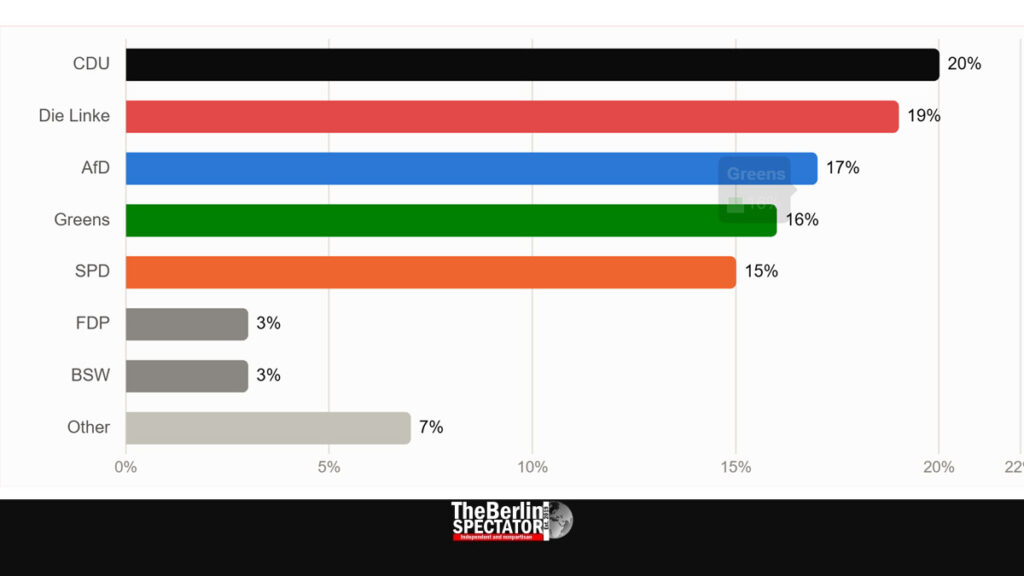
According to Insa, the poll surveyed 1,000 eligible voters between August 7th and 13th, with a margin of error of plus or minus 3.1 percentage points.
As with any election poll, the results come with caveats. Weakening party loyalty and voters making up their minds later and later make it harder for pollsters to properly weight their data. Surveys like this one capture a snapshot of opinion at the moment they were conducted, not a forecast of the actual outcome.
Almost every leading candidate in this race hails from what used to be West Germany, and most of them are relatively young. For the CDU, Finance and Culture Senator Stefan Evers is stepping in after Governing Mayor Kai Wegner’s fall from grace. The SPD passed over former Governing Mayor Franziska Giffey in favor of Steffen Krach, a political scientist and former regional president in Hanover who has been on leave from that post since March to campaign in Berlin.
The Greens are fielding two candidates, as usual, with former Environment Senator Bettina Jarasch as the familiar face and Werner Graf, a Berlin House of Representatives member since 2021, positioned to become Governing Mayor if the party wins. Die Linke’s candidate, Elif Eralp, is a lawyer with Turkish roots who moved to Berlin in 2010.
Check out our piece about the candidates of all major parties here.