
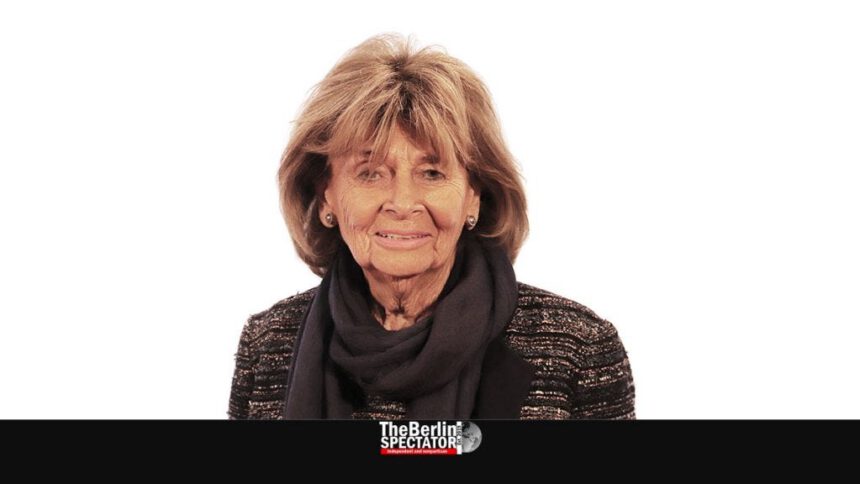
Berlin, August 24th, 2026 (The Berlin Spectator) — Five years ago, on Holocaust Memorial Day, Charlotte Knobloch held a powerful speech at the Bundestag, 77 years after her grandmother, who raised her, was murdered by the Nazis, and 76 years after the Allies finally defeated Nazi Germany and liberated Europe.
In that speech, Charlotte Knobloch told the guests, the MPs, the nation and the world about her life in Nazi Germany. She wept when she spoke about the day her grandmother was deported. In 1938, at age 6, she had cried as well because her friends had not been allowed to play with her anymore, she stated. The only reason was the fact that she is a Jew. In the late 1930s, life had become increasingly difficult, Charlotte Knobloch stated back then, in front of the parliament of Nazi Germany’s free and democratic successor state, the Federal Republic of Germany.
Since, she has been very active. She still heads the Jewish Congregation in Munich and Upper Bavaria. She used to be the President of the Central Council of Jews in Germany and Vice President of the World Jewish Congress. Charlotte Knobloch is one of the most important voices in Germany today.
Lost Fight
At the big event at the Bundestag on January 27th, 2021, Charlotte Knobloch slammed the extremist far-right “Alternative für Deutschland” (AfD) deservedly hard. She said words were the precursor of deeds. Where there was antisemitism, there was room for other forms of hatred as well. Then she turned to the MPs of the AfD: “Maybe you will continue to fight for your Germany, and we will continue to fight for our Germany”, she told them. “You lost your fight 76 years ago.”
Munich has been the center of Charlotte Knobloch’s life most of the time. Ninety years ago today, she was born there. Her father was a Jewish lawyer, her mother converted to Judaism. After her parents divorced, she went to live with her grandmother. When she was deported and later murdered in Theresienstadt, young Charlotte was saved by Kreszentia Hummel, her uncle’s former maid. She told people Charlotte was her ‘illegitimate’ daughter and saved her life. Hummel was added to Yad Vashem’s list of Righteous Among the Nations. This list includes the names of non-Jews who risked their lives during the Holocaust to save Jews. Yad Vashem is Israel’s official memorial to the victims of the Holocaust.
Unworthy Form
In 1945, right after the liberation, Charlotte Neuland, which is her maiden name, returned to Munich with her father. Six years later, she married. A son and two daughters were born. Her husband died in 1990. She founded the Women’s International Zionist Organisation, became very active in other Jewish organizations and headed some of them, including the Central Council. Also she was Vice President of the World Jewish Congress for five years.
Charlotte Knobloch does express her opinions. For instance she has made clear she finds the stumbling blocks Germany uses to commemorate Jews murdered in the Holocaust to be an unworthy form of doing so. One thing is certain: The Jewish community in Munich, with its new community center and synagogue, and that in Germany, are indebted to Charlotte Knobloch. She has contributed so much and still does.
Her latest contribution is her new book “Trotzdem weiter” (“Continuing, in Spite of It All”, German only) which was released last week. “This book results from a realization: I was wrong. We were wrong!”, she stated according to the “Jüdische Allgemeine” weekly and other German publications.
“Acutely Dangerous”
What she means: In 2012, she released her autobiography in which she still sounded optimistic about the future of her country. That has changed: “In 2026, Jew hatred has once again reached a quantitative and qualitative level that is no longer merely ‘alarming’ or a ‘wake-up call,’ but acutely dangerous.” According to her, antisemitism is an existential threat again.
“Politics must clearly articulate how it envisions the future with its Jewish citizens, and for them, in this country. It is not enough for politicians to either stay silent or brush past it with just a few sentences”, Knobloch says.
A few days ago, she also talked about the extremist right-wing party AfD: “Of course, the Nazis of that era looked different, wore uniforms, were organized differently. They made clear what they intended from the very beginning, what their politics would look like. Anyone could have known that.”
“More Radical”
She made clear she does see differences between the AfD and Hitler’s NSDAP, but also similarities: “You cannot equate them, but one should compare them. The NSDAP, too, once started small and tested what was possible. That is exactly what is happening with the AfD: Its politicians are testing what is acceptable. What we see is that they are growing more radical.”
In many respects, there was no difference between the NSDAP before it came to power. “I have experienced many terrible parties [in the Federal Republic]: the NPD, Republikaner and DVU. They came and disappeared again. None was as dangerous as the AfD is”, Charlotte Knobloch states. And she criticizes Germany for not being concerned enough:
“With much of what AfD politicians say, I ask myself: Where is the judiciary? Why is it possible today to incite hatred against people with impunity? In fighting these radicals, we ourselves must resort to radical means. Otherwise we will not succeed.”
According to Knobloch, “everything that could help should be attempted”. What she means: Legal proceedings that might lead to an AfD ban.