

Berlin, September 2nd, 2026 (The Berlin Spectator) – Germany’s federal government is moving ahead with plans for a tax on heavily sugared beverages, even as the shape of the measure and its scope continue to spark debate.
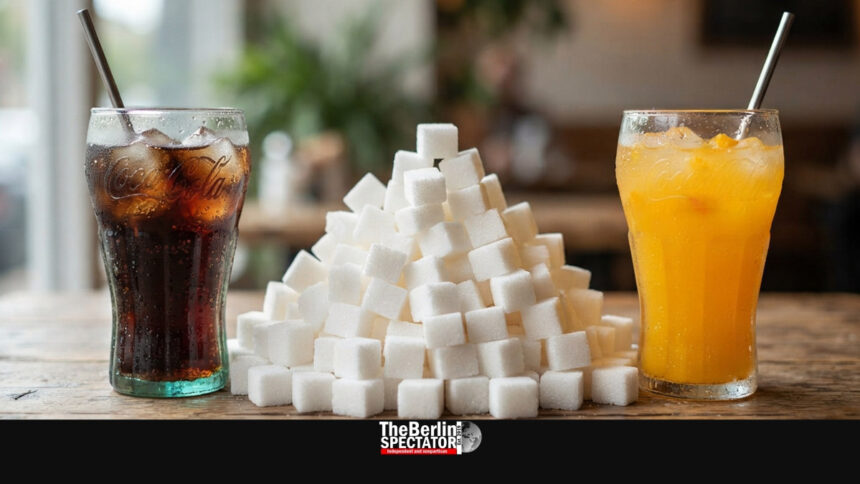
The conservative Christian Democrats (CDU) and the center-left Social Democrats (SPD) agreed to introduce a tax on sugary drinks such as cola and lemonade starting in 2027, as part of a law aimed at stabilizing statutory health insurance contributions. The move follows recommendations from a commission set up by the Health Ministry, which had presented proposals for reform modeled in part on the United Kingdom’s approach.
Under the commission’s proposal, drinks with less than five grams of sugar per 100 milliliters would remain untaxed. Beverages with five to under eight grams would be taxed at 26 cents per liter, while those with eight grams or more would face a levy of 32 cents per liter. The tax rate would be adjusted annually for inflation.
Fruit Juices Exempt
Pure fruit juices and drinks sweetened only with artificial sweeteners would be exempt, and the levy would be collected from manufacturers rather than retailers, in order to maximize the incentive to reformulate recipes with less sugar. The commission recommended a transition period of roughly twelve months before the tax takes effect, to give producers time to adapt.
The government expects the measure to bring in around 450 million Euro annually in its early years, with proceeds earmarked for statutory health insurance. The commission projects the biggest health benefits among children and teenagers as well as socially disadvantaged groups, who on average consume more sugary drinks and respond more strongly to price changes.
Modeling suggests the tax could prevent several thousand new cases of diabetes each year, with savings for statutory health insurers estimated at between 20 million and 170 million euros annually over the medium to long term.
Considerable Controversy
A possible expansion of the tax to include sugar-free light and zero beverages containing sweeteners is off the table, Finance Minister Lars Klingbeil (SPD) and Chancellor Friedrich Merz (CDU) both said. An internal paper from Klingbeil’s ministry that became public on Tuesday had caused considerable controversy. It proposed subjecting not only cola and lemonade but also zero and light beverages, beer mixes, oat drinks and ready-to-drink coffee to the new tax.
Klingbeil dismissed the leaked proposal as unworkable, calling the idea of taxing sugar-free drinks nonsensical and stressing that no such tax would apply to beverages without sugar. Merz backed him fully, adding that the coalition partners had no disagreement on the matter and considered the question settled. The finance minister described the leaked document as an early internal draft rather than a finished position, noting that his staff needed room to discuss and propose ideas that might ultimately be dropped. Merz likewise pushed back against turning routine internal deliberation into a coalition dispute, calling that approach misguided.
Health experts and consumer advocates have long pushed for a sugar tax as a way to curb excessive sugar consumption and reduce obesity and diabetes rates, particularly among children, both through lower consumption and by encouraging manufacturers to reformulate their products with less sugar. The food industry has pushed back against the plan.
Clear Goals
Hesse’s state premier Boris Rhein of the CDU voiced his own objections, arguing that with many people already struggling under high prices, the state should not make food and drinks even more expensive. He called for policymakers to ease the current cost-of-living pressures rather than add to them.
Industry groups renewed their criticism amid the confusion. The Federal Association of the German Food Industry said the debate needed a fresh start, with clear goals, scientific evidence and the economic impact on consumers laid out before any new tax is decided. The German Brewers’ Association warned that a sugar tax would deepen the industry’s existing crisis, noting that many of the country’s 1,400 breweries produce non-alcoholic soft drinks as a response to falling beer consumption.
The consumer organization Foodwatch took the opposite view, urging the government to stop getting bogged down in side debates over sweeteners, non-alcoholic beer or oat milk and instead implement the tax on sugary sodas as quickly as possible.
Steering Effect
SPD health policy expert Christos Pantazis said the goal was a precisely targeted tax with a clear steering effect rather than an ever-expanding levy on all kinds of beverages. He made clear that the intent was to reduce excessive sugar intake, not to dictate how sweet people’s drinks should taste, adding that zero-sugar products would remain untaxed. CDU health expert Simone Borchardt had previously voiced the same opposition to taxing zero-sugar beverages.
Where the wider public stands on the issue is less clear-cut. According to a YouGov poll conducted on behalf of the German Press Agency (dpa), 43 percent of respondents supported a tax on sugar-sweetened drinks, while 44 percent said there should be no additional beverage tax at all. Some 17 percent favored taxing drinks containing artificial sweeteners. Multiple answers were allowed in the representative survey, which polled 4,280 people in Germany aged 18 and older on August 26th.