


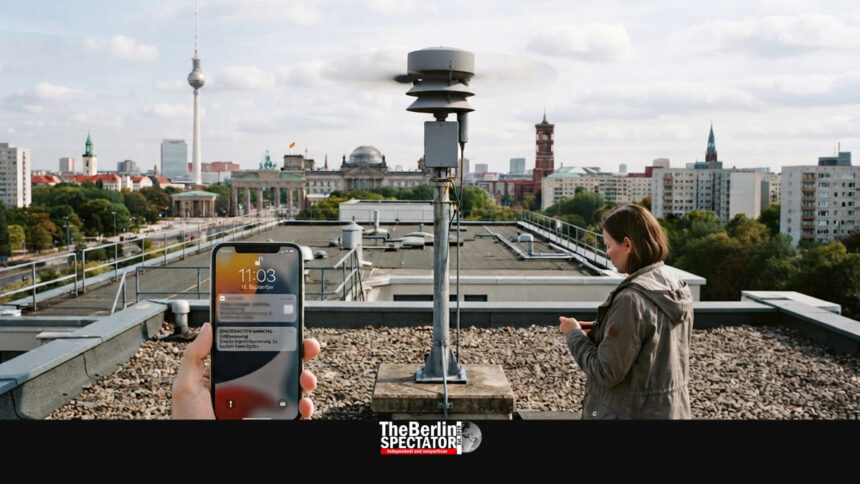
Berlin, September 9th, 2026 (The Berlin Spectator) – Germany’s national warning systems will be tested again this week. On Thursday, September 10th, the country holds its annual “Warntag”, an exercise coordinated by the federal government, the states and local authorities to check whether emergency alerts reach the public reliably.
When Does It Happen?
The test warning goes out nationwide at around 11 a.m. All-clear signals follow at approximately 11:45 a.m. Anyone receiving an alert that day should not be concerned. It is part of a planned drill and does not indicate an actual emergency.
Why Germany Holds a Warning Day
According to the Federal Office of Civil Protection and Disaster Assistance (BBK), the exercise has two main goals. First, it tests the technical resilience of the country’s warning infrastructure. Second, it familiarizes the public with the various channels through which warnings are issued.
The BBK argues that once people know how the system works, they can react faster and more effectively in a genuine emergency. The drill also helps authorities identify technical or organizational weak points so procedures can be refined before a real crisis hits.
How Warnings Reach the Public
Alerts will be distributed through several channels simultaneously. These include cell broadcast messages sent directly to smartphones, dedicated warning apps such as NINA and KatWarn, radio and television broadcasts, websites and social media, digital displays and, in many areas, sirens and loudspeaker vehicles. Not every warning method is available everywhere. Sirens, for instance, are not installed in all municipalities.
Cell broadcast is the mechanism that pushes messages straight to mobile phones within a defined area, without requiring users to have installed a separate app. Residents who use warning apps are advised to check that notifications are switched on and that their current location is enabled, so alerts arrive regardless of which regions they have subscribed to.
Understanding the Sirens
Where sirens are used, two distinct tones apply. A one-minute wailing tone, rising and falling, signals a local hazard and urges people to seek information through the media. A one-minute continuous tone signals the all-clear. The Interior Ministry advises anyone who hears a siren to pay attention and follow up through radio, warning apps or official websites, and to check in with neighbors or family members if needed.
What’s New This Year
For the first time, the all-clear itself will be transmitted via cell broadcast. That capability was only introduced on November 25th, 2025, so it was not yet available during last year’s Warning Day on September 11th. The BBK notes that all-clear messages are automatically issued at the lowest alert level to reduce noise disruption, even though the general principle is that warnings are lifted through the same channel and severity level used to issue them.
Missed the Alert?
Anyone who does not receive any warning at all is asked to notify the authorities. The BBK will run a nationwide survey from Thursday, September 10th, through the 17th, gathering feedback on how well the system performed.