

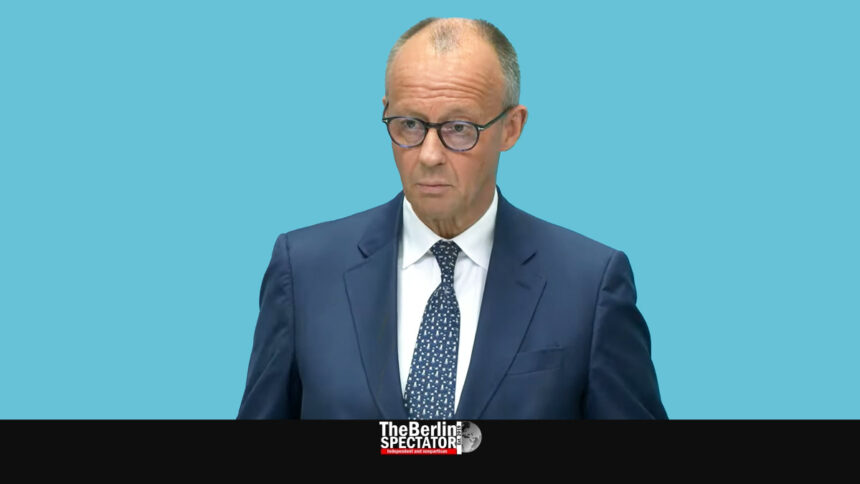
Berlin, October 5th, 2026 (The Berlin Spectator) – Chancellor Friedrich Merz (CDU) showed solidarity with Ukraine on a visit to Kyiv during this past weekend, and he issued a direct appeal to Russian President Vladimir Putin. “Mr. Putin, stop this senseless war”, Merz said in front of the ruins of the Academy of Sciences, which was destroyed in a drone attack only a few days ago. He added that he was ready to talk, but that the “barbaric attacks” on Ukraine’s civilian population had to end.
Russia did not let up while the Chancellor was in town. A drone struck the Northern Bridge over the Dnipro River, and a column of smoke was visible from afar. At least two people were injured, according to official reports. Merz was at the German embassy about five kilometers away at the time. Drone alerts sounded five times in the first five hours of his stay alone, and six times over the course of the visit. Merz said he never had to go to a shelter and that he did not see any personal danger for his delegation or himself. The sirens also went off while he and Ukrainian President Volodymyr Zelensky inspected what remains of the historic academy building. “These are daily war crimes”, Merz said there.
Moscow had tried to scare off the visitors. Only hours before the Chancellor’s train arrived, the Russian Foreign Ministry warned foreign diplomats and guests to leave Kyiv, citing upcoming strikes. It advised them to stay away from military facilities and government buildings. During the visit, the Russian Defense Ministry announced even harder attacks on Kyiv and other parts of Ukraine. It described them as a response to Zelensky’s threats to hit more military sites and arms factories inside Russia. Russia started this war. Merz said the visit showed that Germany would not be intimidated, neither by the warnings nor by the attack that took place during his stay.
Drones Delivery
The Chancellor came with concrete assistance. Economy Minister Katherina Reiche and ten business leaders from the defense and energy sectors joined him. Germany will soon begin delivering thousands of interceptor drones, designed to fight the fast jet-powered attack drones that Russia now uses in large numbers. Berlin also wants to speed up the production of long-range weapons that Ukraine can use against supply lines behind the front in Russia. A total of one billion Euro from already approved budget funds will be released for this purpose. Another 350 million Euro will go toward repairing and rebuilding destroyed power plants. The two sides also signed 14 agreements between companies, which the German delegation valued at 6.6 billion Euro. Most of them concern military equipment.
Zelensky thanked Merz and said Germany was consistently showing leadership in protecting Ukrainian lives from Russian attacks. Russia, he said, must be stopped jointly. Germany is by now the largest supporter of Ukraine in its defensive struggle, which has lasted more than four and a half years. Merz’s core message to Ukrainians was that they can keep counting on German help.
The trip followed a major speech on Thursday in Münster, where Merz received the Westphalian Peace Prize. There he warned that if Germany and Europe faltered, Ukraine would falter as well. In Kyiv he repeated his argument to critics of the aid at home. Supporting Ukraine was in Germany’s own deep interest, he said, because Russia’s war machine would turn against Germany and its allies sooner or later if Moscow was not stopped.
Unconditional Ceasefire
Chancellor Merz traveled to Kyiv for the first time in May of last year, just four days after being sworn in. He was joined by French President Emmanuel Macron, then British Prime Minister Keir Starmer and Polish Prime Minister Donald Tusk. The four leaders demanded an unconditional ceasefire from Russia. Nothing came of it, and later diplomatic efforts also fizzled out at first.
This time, Merz is betting on sustained military pressure to bring Russia to the negotiating table. Foreign Minister Johann Wadephul recently made the first German attempt in years to reestablish contact with Moscow, meeting Russian Foreign Minister Sergey Lavrov in New York. The outcome was sobering. Lavrov later dismissed the conversation as having produced nothing new.
Moscow’s reaction to the Kyiv trip was predictably derisive. Foreign Ministry spokeswoman Maria Zakharova told the tabloid Komsomolskaya Pravda that “murderers return to the scene of the crime”. She suggested that Merz was trying to polish his deteriorating image after a series of lost elections and disputes within the governing coalition.
Domestic Issues
That brings the focus back to Germany, where the chancellor’s domestic position is shaky. In an interview with ARD’s “Bericht aus Berlin”, conducted from Kyiv, Merz urged his coalition of CDU, CSU and SPD to stay united. “We must remain together in government. We must move the country forward”, he said. He added that the coalition needed to use the big opportunities it has together, and that he was firmly determined to do so. Merz also argued that all of Europe depended on stability in Germany.
His main concern is the planned reform of the social security systems. Merz wants the coalition to make the necessary decisions by the end of the year, above all on the statutory pension insurance. The proposals, he said, are as well prepared as anything Germany has seen in the last 30 years. The SPD has recently voiced criticism of the plan to end early retirement without deductions after 45 contribution years.
The pressure comes from the ballot box. Four weeks ago, the extremist right-wing AfD won the state election in Saxony-Anhalt by a wide margin ahead of the CDU, and Merz came under heavy fire within his own party. On September 20th, the CDU dropped out of the state parliament in Mecklenburg-Western Pomerania. In Berlin, the extremist left-wing “Die Linke” displaced the CDU as the strongest force in the city’s parliament. A poll by Insa for the tabloid “Bild”, published on Saturday, put the AfD at 30 percent nationwide for the first time, with the Union at 18 percent. According to last week’s ARD “Deutschlandtrend”, only one in ten Germans is satisfied or very satisfied with Merz’s work.
The coalition is also struggling with other reform projects. The cabinet approved a bill to stabilize long-term care insurance after the CDU, CSU and SPD wrestled over its content until the last moment. SPD parliamentary group leader Matthias Miersch said on ZDF’s “Berlin direkt” that arguing over the best path is part of the process, and that he is very sure the coalition will master these challenges. He said it was good that an “orgy of cuts” in long-term care insurance had been prevented. In upcoming talks, his party wants structural changes and more fairness, for example a financial equalization between private and public care insurance.