


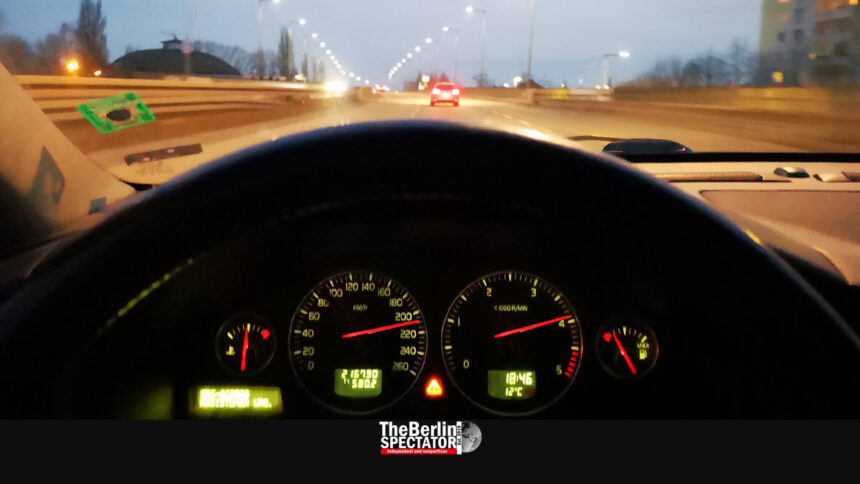
Berlin, August 20th, 2026 (The Berlin Spectator) — So, your Aston Martin is pawing the ground in its garage? Your 911 feels like overtaking some Ferraris? Your 7-series wants to show what it is made of? Go for it. You have the right to torture that engine as much as you want. Enter the Autobahn, hit the kickdown and race as long as you still can. Reach incredible speeds.
Our prediction according to which the Autobahn race would finally end in 2021, when the Greens formed a government coalition with the center-left SPD and the center-right FDP, was wrong. Many of us thought the Greens would likely not sign any coalition agreement without getting one of their main demands fulfilled: a speed limit.
Whatever anyone says about the Greens, they are right about at least one thing (unless they trade their core demands for ministries in Berlin). This is one of them. Not having an Autobahn speed limit is just not appropriate or suitable anymore. The world is changing. And this should apply to the Autobahn as well.
Favorite Project
Cruising along the German Autobahn at a European speed of 130 km/h (81 mph), which is the maximum in many European countries, is what Germans should be doing right now, in order to get used to what hopefully will be coming sooner rather than later. At first, they will feel they are as slow as snails. That is because some hotshot will overtake them at 200 km/h (124 mph) every few seconds.
Does The Berlin Spectator have a newsletter? Sure. You can subscribe here.
The auto industry’s lobby and their helpers have managed to avoid a speed limit, so far. There is a reason for their opposition to the measure: German auto makers like Audi, BMW, Mercedes-Benz, Porsche and Volkswagen build the best cars in the world many of which are fast as hell. Quite a few models are so fast they are being limited to 250 km/h (155 mph) electronically. As a sports car manufacturer, Porsche refrains from doing so, meaning 911s, Panameras and Cayennes are even faster, depending on the engine the owner chooses.
The discussion about an Autobahn speed limit is not new. In the past, the auto industry has argued Germany was the testing ground for their vehicles. A speed limit would hurt exports. And if there is anything no Berlin government ever wanted, it is being responsible for decreasing vehicle exports. Germany’s prosperity depends on the auto industry. Both are in danger right now.
Shaky Case
But the case industry lobbyists make is shaky, especially today, also because all nations they export their cars to have speed limits. In the United States, where prosperous individuals buy BMWs, Mercedes and Porsches like crazy, 55 mph (88 km/h) was the usual limit a while ago. They buy those German cars for their comfort, their reliability, their sleek design and their prestige.
The fact of the matter is that the German speed lobby is running out of convincing arguments these days. “I like racing down the Autobahn” does not seem to be a position which leads anywhere. And the export argument has become rather ridiculous.
Traffic Flow
On the other hand, there are good arguments for a speed limit:
- A vehicle which travels at 130 km/h (81 mph) will consume half the gasoline or Diesel compared to one which races down the road at 200 km/h (124 mph). This also means it will have half the CO2 emissions. Up to 3 million tons of CO2 emissions could be saved.
- Accidents at 200 km/h are always deadly. At 130 km/h, there might still be a chance.
- A speed limit would create a more even traffic flow on the Autobahn, and therefore a less stressful experience. A less dangerous one too.
- Electric vehicles substantially decrease their range at high speeds. Since their share is increasing, letting drivers travel at exaggerated speeds makes even less sense.
Moral Victory
In the past, the Greens’ attempts to get a speed limit were fought off. In the 1970s, they demanded a 100 km/h (62 mph) limit. This would still have been a lot faster than anyone was allowed to go in the United States of America at the time. Later, they went for 120 and 130 km/h.
In 2019, the Greens tried to push a speed limit through the Bundestag. They failed. But Germans who still resist and call the Greens a “party of bans” know the race will be over at some point, even though they might not admit it. On top of it all, 56 to 64 percent of all Germans support a speed limit, as polling results show.
Even though the Greens’ last attempt failed, they had a moral victory, on a path which will definitely lead to an Autobahn speed limit. Until it finally happens, Germany will continue to work on climate protection at 150 mph.