

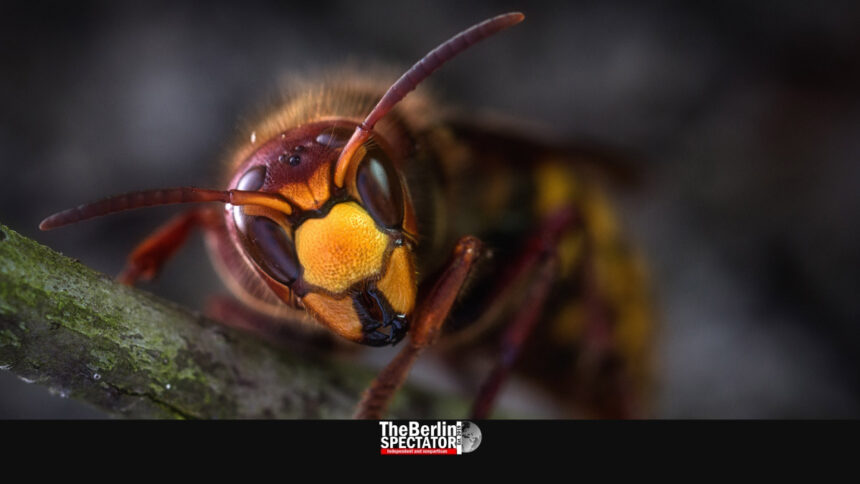
Berlin, September 5th, 2026 (The Berlin Spectator) – Following the discovery of a single dead Asian hornet on Delbrückstraße in Neukölln, the nature conservation group NABU is asking the public to report sightings of the invasive species (Vespa velutina nigrithorax). Reports, ideally including a photo or video, can be sent to NABU. The e-mail address address: kontakt@hymenopterendienst.de
According to NABU, the best chance of spotting the insects is around ivy, which is now beginning to bloom. Ivy blossoms attract numerous late-flying insects, from wild bees and wasps to hornets, including the Asian hornet.
Native to Southeast Asia, the Asian hornet was first recorded in Berlin in 2023. After the nest was removed in time, the species had not been found in the city again until now. This year’s nest discoveries in Eisenhüttenstadt and Leipzig, however, point to the successful spread of the invasive species, NABU said. In areas of high density, the hornets can cover up to 80 percent of their protein needs by preying on honeybees, while in rural areas they primarily hunt wasps.
Significant Economic Damage
With as many as twelve nests per square kilometer possible, the insects can cause significant economic damage, particularly to urban beekeepers. Their impact on other insect species remains unclear. For humans, the hornets, which typically nest high in tree canopies, generally pose little danger, though nests have also been found in hedges and under manhole covers.
NABU noted that Asian hornets are not more aggressive or more prone to stinging than their European relatives, and urged people not to kill any suspected specimen, since it is often mistaken for the native and strictly protected European hornet.
NABU said the two species are relatively easy to distinguish. The Asian hornet is mostly dark colored, with notably yellow legs and a broad orange band on its abdomen, and it is somewhat smaller than the European hornet. The European hornet, by contrast, has a mostly yellow abdomen and is also active at night.