


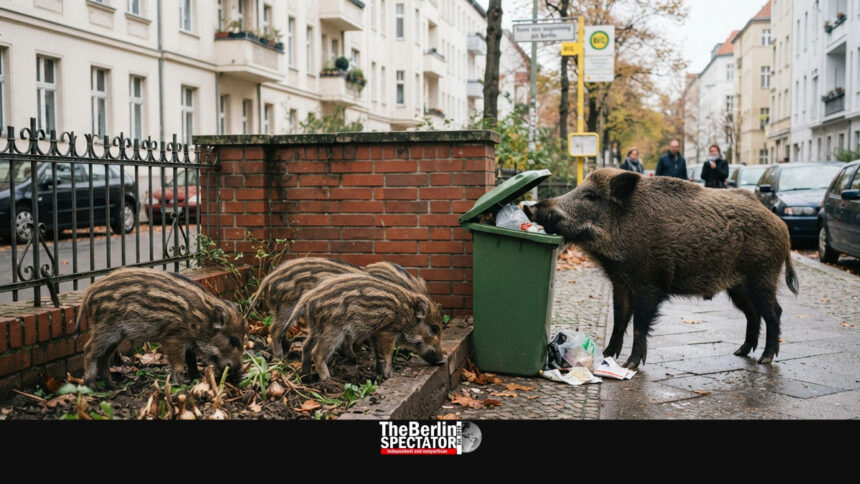
Berlin, September 18th, 2026 (The Berlin Spectator) – A dry summer has pushed wild boars out of Berlin’s forests and into residential gardens across the city, according to a report by public broadcaster RBB. Wildlife officials say the animals are finding far more food in watered lawns and green spaces than in the parched woodland at the city’s edges, and sightings have increased noticeably in districts such as Steglitz-Zehlendorf and Spandau in recent weeks.
The scale of the damage became clear to Klaus Kühn and his wife when they returned from a weekend trip in late August to find their 900 square meter garden in Berlin-Zehlendorf torn apart overnight. A wildlife camera on their terrace had captured a large sow and later an entire group of boars pushing through a garden fence until the gaps were wide enough to pass through. By morning the lawn looked as if it had been dug up entirely, and a bin of bird feed had been crushed and eaten.
According to Derk Ehlert, a wildlife expert with Berlin’s Senate Department for the Environment, the animals have been increasingly present in residential areas since 2024, and some now stay permanently rather than passing through. He said settled areas offer bushes, open lawns and watered ground that make for rich foraging conditions, describing the appeal to the animals as significant. In Spandau’s Neustadt neighborhood, a group of about six boars, including one nicknamed “Pünktchen” for its spotted coat, has been seen crossing the same route through the streets nearly every day at midday, apparently untroubled by residents, dogs or cameras.
Ample Habitat
Wild boar populations in Berlin have risen over recent decades, helped by milder winters that improve survival and reproduction rates. Roughly 40 percent of the city’s area consists of marsh, meadow, farmland and forest, giving the animals ample habitat to draw on when food in the woods runs short. Officials note that the city’s volunteer hunters are permitted to use firearms within city limits only in exceptional cases, and that current reproduction rates among boars are high enough that hunters would need to remove more than a third of the population each year just to keep numbers stable.
Increasing the hunting pressure is not necessarily the answer, experts caution. A long term study cited by RBB found that heavy hunting pressure can cause female boars to reach sexual maturity earlier and produce more offspring, which may end up increasing population growth rather than slowing it. Alternatives such as contraceptive treatments exist, but they generally require injecting each animal individually, which is largely impractical in open terrain. A version that could be mixed into feed remains in the research stage.
Residents in the affected neighborhoods report rising frustration. Sylvia Warnke, who lives in the Waldsiedlung area between Argentinische Allee and Quermatenweg, said boars now appear almost every evening, breaking through wooden fences and knocking over trash cans, including a garden gate that had stood for thirty years. Attacks on people remain extremely rare, according to a spokesperson for Berlin’s city forestry service, though an unleashed dog that encounters a full grown boar will almost always come off worse.
Officials recommend that residents avoid leaving food out for the animals, keep pets fed indoors, secure trash bins, and above all install sturdy fencing, since property owners are responsible for their own protection and the state does not compensate for damage caused by wild boars, which are legally considered ownerless animals. Kühn, for his part, said the experience has not turned him against the animals. He plans to install a reinforced metal fence anchored into the ground, at an estimated cost of 2,000 to 3,000 euros, before reseeding the lawn with his sons and friends in the coming days.