


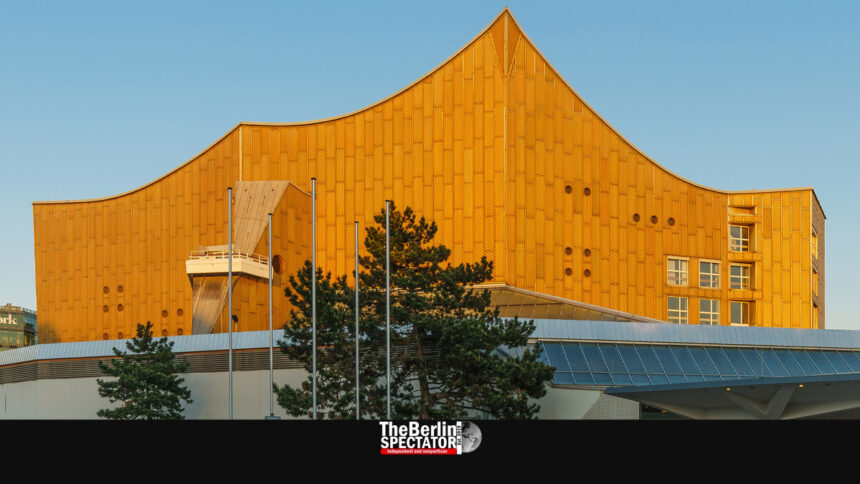
Berlin, September 30th, 2026 (The Berlin Spectator) – The Berliner Philharmonie, one of the German capital’s best known buildings, has to be renovated at a cost of roughly 800 million Euro (907 million U.S. Dollars or 687 million Pounds Sterling). This is the result of a feasibility study commissioned by the Berlin Philharmonic. The hall has not undergone a fundamental overhaul since it opened in 1963, said the orchestra’s general manager Andrea Zietzschmann, according to German-language media. Naturally, she said, this is an enormous investment.
The work is expected to begin in 2032 and could keep the building closed until 2040. During that time, the orchestra would need a substitute venue. According to the study, former Tempelhof Airport would be suitable. Converting it is estimated to cost a lot of money as well, which brings the total to more than one billion Euro.
The problems at the Philharmonie are numerous. Fire protection no longer meets today’s standards, and the climate control systems and cabling are outdated. Clogged pipes also cause the sanitary facilities to overflow at times. The orchestra said it will no longer be able to guarantee trouble-free daily operations from 2032 or 2033 at the latest.
Rapid Rise
Financing is only partly settled. Through the capital financing agreement, the federal government pledged up to 225 million Euro. Zietzschmann said the state of Berlin has set aside 350 million Euro in its investment budget. That brings the total close to 600 million Euro, which she called a very good start. She now wants the next Berlin state government to make a quick decision. A ruling is needed within the next six months, she said, so that the schedule does not slip further.
Of the estimated renovation costs, 436 million Euro are earmarked for the Great Hall designed by architect Hans Scharoun. Another 307 million are planned for the smaller Chamber Music Hall, which opened in 1987 based on plans by Edgar Wisniewski. According to the study, the cost is comparable to the construction of the Elbphilharmonie in Hamburg, which opened in 2017. The Philharmonie’s team stresses, however, that construction costs have risen considerably since then.
Zietzschmann favors Hangars 1 to 3 at Tempelhof. “That would simply be a fantastic place for a project like this”, she said. Other options under discussion include the former International Congress Centre (ICC) and a new building on an open site.
Major Projects
Musician Philipp Bohnen, a member of the Philharmonic’s executive board responsible for media, described the hall as the orchestra’s instrument. “The acoustics we have here are sensational and unique in the world”, he said. The musicians look at the temporary move with great concern. “We hope that we can get this hall back with exactly this acoustic quality and exactly this beauty”, Bohnen said. The interim venue must also offer excellent acoustics, he added, especially since a major generational change is expected during the closure. Many musicians could have spent years in the orchestra without ever having played in its home, which he called strange.
The Philharmonic’s chief conductor is Kirill Petrenko. The orchestra counts among the best in the world.
The renovation adds to a series of major construction projects in Berlin. The Pergamon Museum is being renovated, with the first sections set to reopen next summer. The State Library is to close for more than a decade for renovation work. Near the Philharmonie, the new Museum Berlin Modern is currently under construction.
Since the reunification, was there ever a time when Berlin was not a giant construction site?