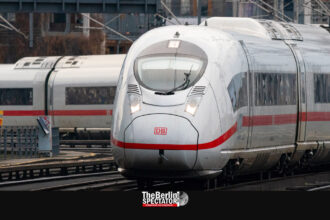

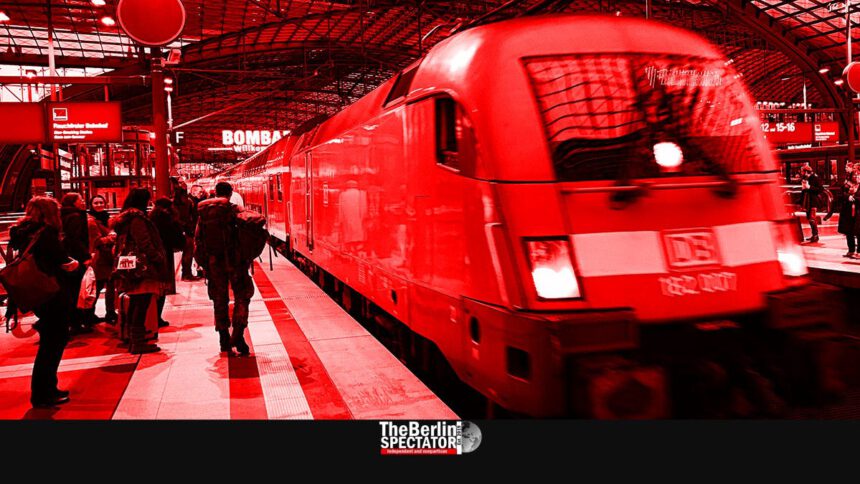
Berlin, October 15th, 2026 (The Berlin Spectator) – Starting today, consuming alcohol is no longer permitted at any of Deutsche Bahn’s (DB) roughly 5,700 stations across Germany. The ban applies wherever DB’s house rules are in force, which includes platforms, access areas and station buildings. In some municipalities, it also covers forecourts owned by the company.
There are exceptions. Shops inside stations may continue to sell alcohol, and restaurants and bars located there may still serve it. Exceptions may also apply where station buildings are not owned by DB.
The company said the measure responds to suggestions from travelers, employees, railway staff of other operators, cities, municipalities and tenants who want a calmer, cleaner and safer environment. A DB spokeswoman told the broadcaster RBB that the rule is meant to make a stay at the stations more pleasant.
Support for Ban
One trigger for the decision was an incident in the state of Baden-Württemberg. In July, a 26-year-old DB security employee was allegedly hit and kicked by a 36-year-old passenger during a ticket check on a regional train, according to prosecutors. During the scuffle, a door gave way and the employee fell through a gap out of the moving train. The passenger is said to have been intoxicated.
The ban is not entirely new. It has applied for some time at nearly 40 large stations, among them the central stations in Cologne, Kiel, Heidelberg, Munich, Hamburg and Berlin. In the capital, it has been in force at Zoo station and Ostbahnhof since May, and at Hauptbahnhof and Gesundbrunnen since September 1st. DB says the experiences have been positive. According to the company, there is less litter and fewer conflicts, and both travelers and employees feel more comfortable. DB also said that the cleaning effort has declined and that about 80 percent of respondents in a survey support the ban.
Enforcement is the responsibility of DB itself, based on its house rules. Security staff are to approach violators during their regular patrols and will first inform people about the changed rules. Announcements and notices are meant to raise awareness. Offenders can be expelled from a station, and repeat violators may receive a ban from entering. The Federal Police can also be called in to help, which DB says is already common practice at stations where the rule applies. The company stressed that it intends to proceed with good judgment and a sense of proportion.
Serious Test
The ban applies every day, including on days with major events, said DB spokeswoman Anja Bröker. This is likely to be put to a serious test on Bundesliga soccer match days, when fans often consume beer on the way to the stadium. Even then, DB says it will rely on tact and discretion.
Mirko Schwärzel of the national management of the Bahnhofsmission, a charity that assists travelers in need at stations, supports the initiative in principle. He cautioned, however, that enforcement must not lead to unequal treatment or stigmatization. “The rules must then apply to everyone”, he said, adding that partygoers and soccer fans must be treated like homeless people. Schwärzel also warned that the problem could simply shift to the areas surrounding the stations.
Trains themselves are not covered. Passengers on DB trains may generally still drink alcohol, and the company sells it in the bistro cars of its long-distance trains. Bringing one’s own is also permitted, provided it is done in a reasonable manner and does not disturb fellow passengers. A DB spokesman said in late August that there are no plans to change this for long-distance service. In regional transport, there is no nationwide rule. Transport associations in cities such as Hamburg, Cologne, Munich and Nuremberg prohibit alcohol consumption on regional trains altogether.
Berlin and Brandenburg
Brandenburg wants to go further. Infrastructure Minister Robert Crumbach (SPD) welcomed the new rule at stations, saying it was “right”, and announced that he would push for a ban on drinking alcohol on local public transport trains as well. He also said that funding for the “Safety and Cleanliness” program of Berlin’s S-Bahn has been secured beyond this year by Berlin and Brandenburg. The program provides for additional security staff on trains, including at night, and expanded cleaning services.
Berlin’s public transport operator BVG has no such blanket ban so far. The RBB quoted a company spokesperson who said it regularly examined which additional measures made sense, and that it was monitoring developments surrounding the alcohol ban closely. On BVG vehicles, the rules of the regional transport association VBB already prohibit eating and drinking open food and beverages. People under heavy influence of alcohol or other intoxicating substances can be excluded from transport, which BVG says it enforces consistently and with good judgment.