

Berlin, October 28th, 2026 (The Berlin Spectator) – April 15th, 2023, was a big day. The last three German nuclear power plants (NPP) were switched off back then. Today, three and a half years later, Germany is still looking for a nuclear waste depository it badly needs.
In 2011, three meltdowns in Fukushima (Japan) made Chancellor Angela Merkel change her mind about an energy source that was supposed to be the safest of them all. It was not her first shift of opinion in this context.
West Germans who switched on their TV sets 37 years before the final shutdown, on April 26th, 1986, were told about an accident at the Chernobyl nuclear power plant in the Soviet Union. Their Interior Minister at the time, the late Friedrich Zimmermann, spread inaccurate information according to which the disaster near Kyiv did not pose any threat to the population in Germany. Only a day later, people in the Federal Republic were asked to stay indoors as much as possible and close their windows. Being outdoors in the rain was supposed to be avoided.
The explosion and meltdown that took place only 1,391 kilometers (865 miles) from Hamburg, namely in Ukraine, would definitely affect all of Europe. While Germans were worrying about their health, firefighters and workers who tried to extinguish the flames at the Chernobyl reactor were dying. It was the first complete meltdown of an NPP, the kind of event that was supposed to take place once every one million years, according to pro-nuclear scientists.
Disturbing TV Footage
Did the terrible event in Chernobyl have any consequences for the West German nuclear power policy? No. The energy industry was building new NPPs, and the Bonn government supported those projects, including the construction of the plant in Brokdorf near Hamburg. The arguments opponents of nuclear power kept on repeating were simply ignored. Protesters who demanded an end to nuclear energy in West Germany were sprayed with irritant gas and kept away from the construction site in Brokdorf with water cannons. Six months after the Chernobyl disaster, the Brokdorf NPP was fired up for the first time.
Seven years and one month earlier, a reactor in the United States of America partially melted down. The fact that the accident at Three Mile Island, located in Dauphin County, Pennsylvania, was not a lot worse had to do with pure luck. As it turned out, major disasters in NPPs did not happen every one million, but every eight years. Still, governments all over the world ignored this slight difference, and many still do today.
Thirty-two years after the Three Mile Island accident, and 25 years after the disaster in Chernobyl, Angela Merkel switched on her TV set. As the Chancellor of the Federal Republic of Germany, a pretty demanding job, she did not really have the time to watch soap operas. What Mrs. Merkel watched on March 11th, 2011, was disturbing, to say the least. The former Environment Minister witnessed explosions and meltdowns in as many as three Japanese reactors. So, instead of one meltdown in one million years, there were a total of four and a half of them in 32 years.
Clean and Safe
This time, the government of the Federal Republic of Germany did care. During her first grand coalition with the Social Democrats, Angela Merkel had agreed to a a phasing out of nuclear energy. It was a decision taken by her Social-Democratic predecessor Gerhard Schröder and the Greens a few years prior to the triple disaster in Fukushima. Then, in a government coalition she ran with the center-right party FDP, there was a phase-out of the phase-out, meaning nuclear energy was clean and safe again, all of a sudden. But when that footage from Fukushima flickered across the Chancellor’s screen, she had enough and took yet another 180-degree turn.
Does The Berlin Spectator offer a newsletter? Sure. Subscribe to it here.
Thanks to Angela Merkel, and mainly to those who fought nuclear power for decades, the last few NPPs in Germany were supposed to be switched off in 2022. The final phase-out took place on that special day in April of 2023, after a prolongation that became necessary thanks to Vladimir Putin’s aggression and its implications for Germany’s power generation.
But, of course, the end of nuclear energy in Germany was not the end of all the problems. First of all, some of Germany’s neighbors rely on nuclear power. The number of NPPs France is operating is higher than that of croissants on a typical breakfast table at Élysée Palace. By the way: Radioactivity set free during meltdowns does not stop at borders.
Drowning Containers
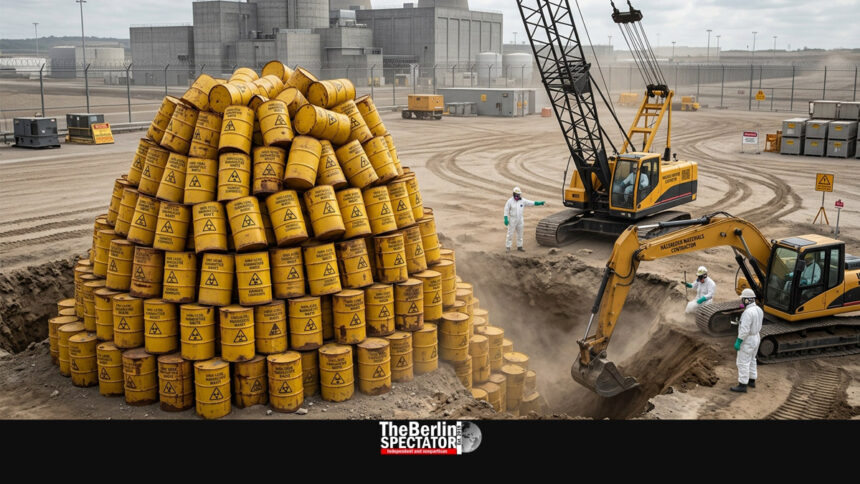
Secondly, the problem of nuclear waste has still not been resolved, just as opponents of nuclear energy had predicted 50 years ago. What a surprise. Yes, nuclear waste remains an issue even after a country shuts down all of its nuclear power plants. To this day, the Federal Republic does not have a final disposal site for its most dangerous nuclear waste. But experts are looking for one.
What they need is a disposal site that is safe for one million years, due to the long half-life period of the radioactive material involved.
In Germany, a so-called “temporary nuclear waste storage facilities” that was supposed to offer this kind of safe environment, the Asse II cave, almost drowned in groundwater after a few years. The consequence was that dozens of containers with low-level radioactive waste were affected. Yes, even low-level nuclear trash is dangerous. And the kind of barrels it was stored in do rust.
External Energy
By the way: How do you strip down a nuclear power plant? Well, first you compensate the operators by sending them truckloads of cash. Then you pull down all non-radioactive parts of the plant, including the turbine, the administration building and the shed which accommodates lawn mowers and brooms. No, you won’t need those anymore.
Losing the nuclear fuel rods and the reactor pressure vessel is a little more difficult. First, you wait for several years, until the radioactivity has declined a little. Then you take it all apart and squeeze the parts into containers you do not have a safe place for.
The next problem: Even before you dismantle the reactor, you will need a lot of external energy to cool it down. That is because the plant will not produce its own electricity anymore. But the reactor core will still need to be cooled down for years. This is how you prevent a meltdown in your own backyard.
Dismantling Effort
Today, Germany is still working on dismantling NPPs. This includes the reactors Neckarwestheim 2, Emsland and Isar 2, which were the last ones to be shut down. Guess what: Even NPPs that were switched off years earlier are still being stripped down, including Philippsburg 1 and 2 as well as Grafenrheinfeld and Neckarwestheim 1.
And they are looking for a safe nuclear waste site. After years of surveys and drilling holes into the ground, the experts in charge have now narrowed down suitable locations to five percent of Germany. The Federal Company for Radioactive Waste Disposal (BGE) will propose a site in those areas, but it will take decades until a final decision can be taken.
First, the BGE ruled out locations due to possible earthquakes or volcanism. Then, they looked into many other criteria. Four out of sixteen federal states will definitely not accommodate the nuclear waste depository, namely Hesse, Rhineland-Palatinate, Saarland and Saxony. Berlin, another state, can also sit back and relax without worrying. Where could this city state have put nuclear waste, anyway? On Kurfürstendamm? Or at the Berghain club? Saarland was ruled out six years ago, Rhineland-Palatinate last year. Berlin, Hesse and Saxony got their all-clear just now. Whew.
Granite, Salt and Clay
Efforts to check geological data and other criteria are continuing as we speak. According to the experts involved, granite, salt and clay are the safest materials for a nuclear waste site. They are the ones that should be found in the ground before anyone starts digging. But there are lots of exclusion criteria that could rule out any site even if it is full of granite, salt or clay.
Wherever it is, the nuclear waste depository needs to be set up under an extremely thick layer of rock. At least 300 meters of stone are supposed to protect us from the radioactive material. And there should not be any water in the area.
After a lengthy inspection period and a million screening processes, the BGE is supposed to propose locations. Once those have been checked by experts, the Berlin Bundestag will decide how to proceed. By 2050, a depository should be available for Germany’s 27,000 cubic meters of high-level radioactive waste.