

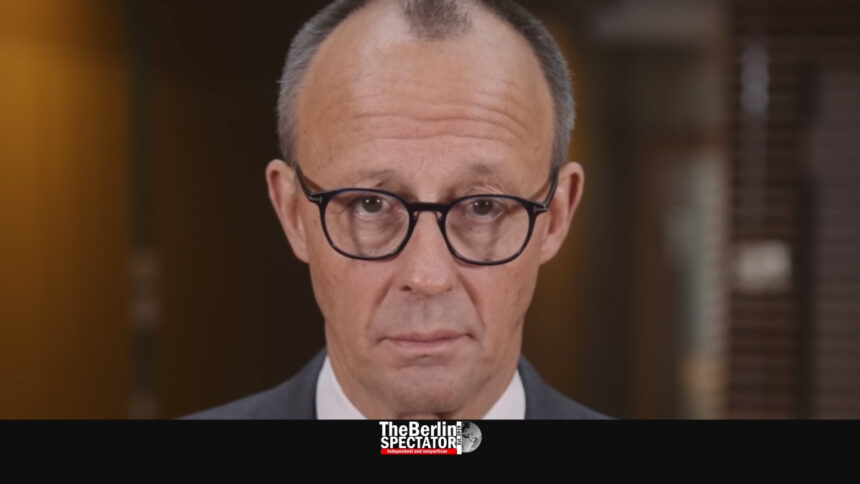
Berlin, November 19th, 2026 (The Berlin Spectator) – The timing is the message. Only a few hours after U.S. President Donald Trump, Chinese leader Xi Jinping and Russian President Vladimir Putin were scheduled to sit down together in Shenzhen, Chancellor Friedrich Merz (CDU) receives about 30 heads of state and government at the Chancellery to talk about the war in Ukraine.
According to German-language media, Berlin government circles say the sequence allows the allies to react “quickly, jointly and well prepared” to whatever comes out of China. The meeting in Shenzhen, held on the sidelines of the APEC summit, was meant to focus on shrinking the world’s nuclear arsenals, but Ukraine could also come up.
That possibility worries Ukrainian President Volodymyr Zelenskyy, who has cautioned against a “second Yalta.” He refers to the 1945 conference on the Crimean peninsula, where the victorious powers decided how to reorder Europe after World War II. Kyiv fears that major powers could again settle its fate without it.
Most Prominent Meeting
The gathering in Berlin is one of the largest of its kind in Germany in decades. It is the most prominent meeting so far of the Coalition of the Willing, which was formed in early 2025 and now counts nearly 40 members, ranging from Japan and Poland to Canada. They supply weapons, humanitarian aid or financial support to Ukraine.
In December 2025, the group agreed to build a multinational force that would help secure a possible ceasefire between Ukraine and Russia. A first exercise involving roughly 2,800 troops from eleven countries is currently under way in Poland, in the airspace above Romania and in the western Black Sea. The German armed forces are taking part.
Merz co-hosts the event with French President Emmanuel Macron and British Prime Minister Andy Burnham. Thirty-seven countries are sending delegations, most of them led by their top officials. Zelenskyy, who was in Berlin just over two weeks ago, is expected as well. Washington is represented by envoys Steve Witkoff and Jared Kushner, who mediate in the direct talks between Ukraine and Russia. Those negotiations resumed in Abu Dhabi last week after a lengthy pause.
Security Guarantees
The German hosts have set three priorities under the motto “Together for Peace in Ukraine and European Security.” The first is money. Merz’s team wants a pledge to fund Ukraine next year, when the European Union faces a gap of 45 billion Euro. The European Commission has proposed a way to close it, yet four member states have so far refused to contribute. The second is a seat at the negotiating table for the Europeans. The United States and Ukraine back the idea, while Moscow has sent mixed signals. The third is security guarantees for Kyiv, including through the multinational force. How they would work in practice remains unclear.
The program begins at 1:30 p.m. with a preliminary meeting of Merz, Macron and Burnham with Zelenskyy. The three countries, known as the E3, accompany the talks between Kyiv and Moscow for the Europeans together with Italy, Poland and the EU institutions. The other participants arrive from 2 p.m. for the main session on the Chancellery’s first floor. A joint news conference with Merz, Macron, Burnham, Zelenskyy, Witkoff and Kushner is planned for about 5:15 p.m.
Merz also has a keepsake for his guests. Each of them is to receive “a little chunk” of the Berlin Wall, which divided the city for 28 years. The chancellor wants to illustrate what unity and determination can achieve. He thereby picks up a thread from Zelenskyy’s address to the Bundestag in March 2022, a few weeks after Russia’s invasion. Zelenskyy spoke of a wall in the middle of Europe that grew with every bomb and every postponed decision, and he urged then-Chancellor Olaf Scholz (SPD) to tear it down. The appeal echoed Ronald Reagan’s 1987 demand in Berlin that Mikhail Gorbachev bring down the Wall. Germany has since become Ukraine’s most important supporter.