


Berlin, July 12th, 2026 (The Berlin Spectator) – Berlin’s Christian Democrats (CDU) have settled on a new face to lead them into the September 20th state elections, just hours after Governing Mayor Kai Wegner abruptly abandoned his own bid for the top spot amid a widening scandal over false statements he made during January’s mass power outage.
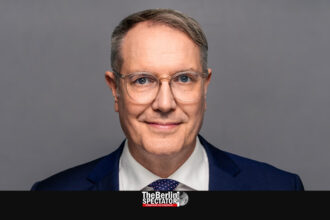
Finance Senator Stefan Evers was put forward as the party’s new lead candidate on Friday evening by a vote of the CDU’s district chairs. Evers said afterward that he was taking on the candidacy — and, on an interim basis, the state party chairmanship — under what he called extraordinarily difficult circumstances. Formal confirmation from the CDU’s state executive board is expected as early as Monday, though party insiders consider approval a near-certainty.
Evers currently serves on the district list in Treptow-Köpenick, where he already holds the second slot, meaning his shift to the top of the ticket poses no logistical hurdle ahead of the state election authority’s July 14th candidate-filing deadline. Unlike CDU parties in many other German states, Berlin’s Christian Democrats run on twelve separate district lists rather than a single statewide slate, so Wegner’s exit and Evers’ elevation are part of a symbolic rather than a formal restructuring.
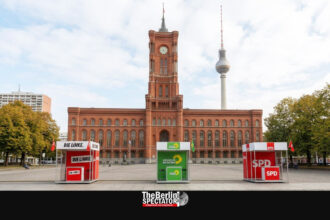
Campaign posters can go up across the city starting August 2nd, by which point Wegner’s public presence in the race will be considerably diminished. As recently as June 9th, he had been reconfirmed as lead candidate at a party convention with nearly 93 percent support — a result now rendered moot.
An Uphill Battle
Evers takes over a party in freefall. The CDU has slid to fourth place in recent polling, trailing the far-left “Die Linke”, the Greens, and the extremist right-wing Alternative for Germany (AfD) with just 17 percent support, while the governing coalition with the center-left Social Democrats (SPD) has lacked a working majority for some time. Compounding the challenge, Evers is not yet a well-known figure citywide — a significant liability for any candidate hoping to close the gap before election day.
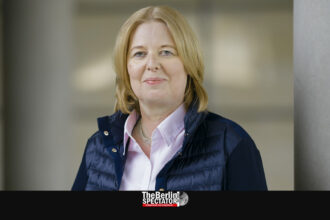
Political scientist Julia Reuschenbach told public broadcaster RBB that the candidate switch does the party no favors, calling it a burden that will dominate discussion at campaign events. She described the race as now “completely open,” with no party clearly in front and no single figure commanding broad popularity. Wegner, she noted, had been a well-known quantity in the city, but many voters had grown dissatisfied with his record. According to German-language media, she also pointed out that the summer recess now underway leaves many Berliners tuned out of politics, making it harder still for Evers to build name recognition once campaigning resumes, while a sharpening polarization between the CDU and the Left Party points toward what she called an unusually harsh and uncomfortable contest.
Opposition figures were quick to pounce. Green Party state chair Nina Stahr accused the CDU of using Evers’ nomination to simulate a fresh start while dodging accountability for three years of CDU governance, arguing that his budget policy had plunged Berlin into uncertainty and left chaos among social service providers, academia, and the cultural sector.
The Scandal That Forced Wegner Out
Wegner’s Friday afternoon withdrawal came as he faced the near-certain publication of fresh revelations by the “Tagesspiegel” daily concerning his conduct during January’s blackout crisis — reporting he appears to have moved to get ahead of by stepping down before it broke.
According to the report, the Federal Chancellery unexpectedly turned over documents Friday in an ongoing case before the Berlin Administrative Court indicating that Chancellor Friedrich Merz never personally spoke with Wegner at any point during the power outage, neither in person nor by phone. That statement directly contradicts what Wegner had claimed at the time: in a January 5th broadcast interview with RBB, he said he had spoken with Merz “once again” the previous day regarding the response to the blackout, in addition to describing conversations with the federal interior minister and involvement of Germany’s domestic intelligence service and federal police.
The newspaper had sought clarification on the alleged Wegner-Merz contacts for weeks, filing an emergency request under German press-law disclosure rules after the Chancellery repeatedly declined to answer without providing a clear justification. Berlin’s own state chancellery had previously indicated that a personal phone call between the two men took place on January 4th, the second day of the blackout — a claim the Chancellery’s new statement now appears to contradict.
The “Tagesspiegel” further reported that the Chancellery had told the paper back on January 9 that Merz held “several conversations,” including a personal one with Wegner, on the first day of the outage, January 3rd — and continued to repeat that account to inquiring media for weeks afterwards. The government later revised its position, saying Merz had merely been “included” in communications that day and that no personal conversation had taken place, attributing the discrepancy to a “communication misunderstanding.”
The newly disclosed inconsistencies raise fresh doubts about Wegner’s repeated insistence that no one was deliberately misled during the affair — and, the newspaper noted, raise separate questions about whether officials within the Chancellery itself worked to shield Wegner’s account for months. Government lawyers have denied any coordinated effort between the Chancellery and the Berlin state chancellery to sustain Wegner’s version of events, calling such suggestions unfounded.
Wegner had also previously come under fire for concealing that he played tennis during the crisis, misrepresenting his schedule by claiming he had been “on the phone all day” on January 3rd, and, per an earlier “Tagesspiegel” report, for having made no calls at all to relevant authorities on the morning the blackout began, contrary to his own public account.