


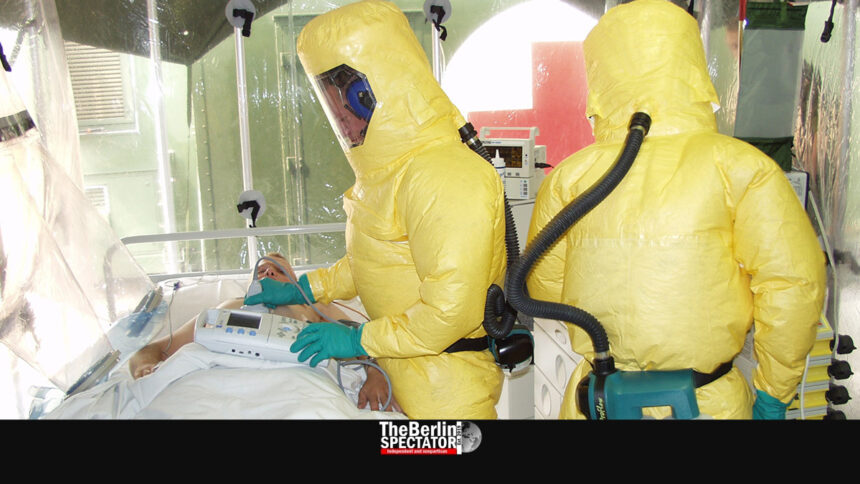
Berlin, July 13th, 2026 (The Berlin Spectator) – A second American citizen infected with Ebola has arrived in Germany for treatment. From Frankfurt Airport he was transferred to Frankfurt University Hospital’s special isolation unit. The patient is currently stable, according to Timo Wolf, head of the facility’s high-security isolation ward, who was quoted by German-language media. He said the person had been receiving care since three o’clock in the morning.
The hospital has declined to release details about the patient’s age, gender, or precise symptoms, citing privacy considerations. Wolf said only that the patient is presenting symptoms consistent with Ebola infection and that the illness has not progressed since arrival.
Treatment so far has involved fluids and nutritional support, with additional measures being adjusted according to the patient’s condition. Hospital director Jürgen Graf emphasized that the public faces no risk whatsoever, noting that the isolation ward is built with multiple layers of security to prevent any contact between the patient and the outside environment, and that staff are fully protected from infection.
Employee of Humanitarian Organization
Germany’s Federal Ministry of Health confirmed the overnight transfer, and the U.S. Center for Disease Control and Prevention had previously reported that the infected American was employed by a humanitarian organization in the Democratic Republic of Congo. The patient tested positive for the Bundibugyo strain of the virus, a variant currently driving an outbreak in the country and one for which no vaccine or approved therapy currently exists.
Does The Berlin Spectator have a newsletter? Sure. You can subscribe to it here.
This marks the second time in roughly two months that an American infected with Ebola has been flown to Germany for treatment. The first patient, a U.S. doctor, was admitted to Berlin’s Charité hospital on May 20th. At one point, his condition was described as life-threatening, but he is far better now. After just over two weeks of care, he was released. His wife and four children were also brought to the Charité as high-risk contacts and quarantined separately within the unit, though none developed symptoms.
Ebola spreads through direct physical contact and contact with bodily fluids, making it especially difficult to contain in the eastern Congo, where health workers have struggled to keep pace with the current outbreak. Officials say case numbers are climbing faster than in any previous Ebola outbreak on record. The deadliest epidemic to date, which struck West Africa in 2014 and 2015, killed more than 11,000 people. Three patients from that outbreak were also brought to Germany for treatment, one of whom, a United Nations worker treated in Leipzig, did not survive.
Negative Test Results
The virus reached Europe for the first time in late June, when a doctor working for a humanitarian organization in eastern Congo tested positive after returning to France. He was later released following isolation and negative test results, having shown no symptoms.
The Congo outbreak has now claimed around 650 confirmed lives, with at least 1,830 people infected, according to health officials tracking the crisis.