

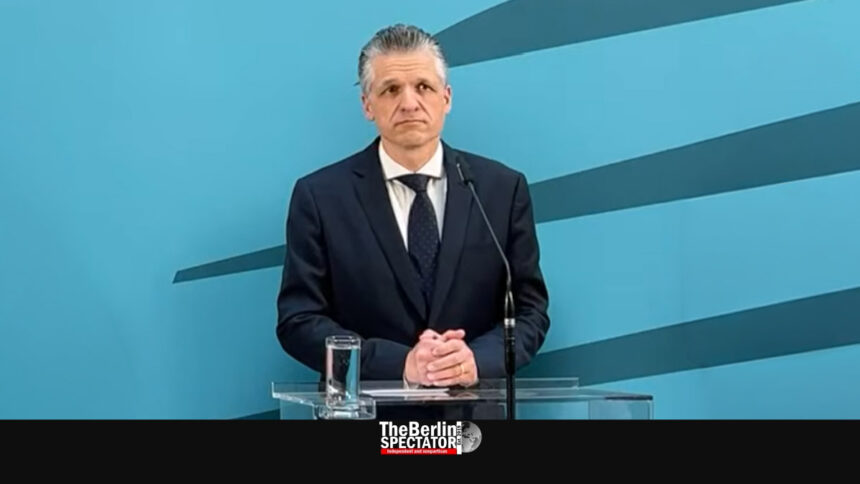
Berlin, August 3rd, 2026 (The Berlin Spectator) – One week after the Islamist terror attack on the fringes of Christopher Street Day in Berlin, lawmakers from the conservative CDU/CSU bloc are signaling that stricter security legislation could come quickly. Thorsten Frei, the parliamentary group’s new chairman, told the “Bild am Sonntag” weekly he was confident that Federal Interior Minister Alexander Dobrindt (CSU) and Federal Justice Minister Stefanie Hubig (SPD) would present proposals within weeks, possibly as early as August.
Frei told the publication his party had shown in the past that deliberation did not have to mean endless delay, and that lawmakers could move quickly and implement changes when necessary.
A Berlin-born man suspected of Islamist extremism drove a car into several people just over a week ago and is believed to have attacked others with a machete. A woman from Poland was killed and 31 people were injured. The 21-year-old suspect, identified as Abdul B., initially fled but was tracked down by police the following day and shot dead after allegedly attacking officers. He had been classified by police as a potential threat and had received a juvenile sentence that had not yet become legally final.
CDU/CSU Proposals
Interior Minister Dobrindt has called for wider use of electronic ankle monitors and a nationwide, standardized rule allowing preventive detention for individuals classified as potential threats. He also described the application of juvenile criminal law to adult suspects in this category as unacceptable.
Matthias Miersch, chairman of the SPD’s parliamentary group, indicated he was open to a tougher approach toward individuals flagged as potential threats. He told the Funke media group that Germany clearly had a problem with Islamist extremism, adding that authorities needed to scrutinize certain associations and groups more closely and better monitor flagged individuals, while acknowledging that lawmakers could not dictate how prosecutors and courts handle every individual case.
Miersch pointed to preventive detention as one option, though he noted that this falls under the jurisdiction of Germany’s states. He said the federal government needed to work with the states to find a unified rule and legal framework for such detention. Rules on electronic ankle monitors also vary by state and are rarely used so far, he added.
In the specific case of the Berlin attack, Miersch said the real failure lay in insufficient information sharing between security agencies and the judiciary, and that this was where he expected concrete proposals from the interior minister.
Sense of Security
According to a survey by pollster Civey, roughly four in ten Germans say their sense of security has declined since the attack, with 38 percent describing the drop as clear or moderate. A separate representative survey by pollster Insa for “Bild am Sonntag” found that one in two respondents sees a particularly strong need for action on domestic security and migration.
Despite the attack, around 300,000 people took part in a Pride parade in Hamburg on Saturday under the motto “Queer in solidarity. Taking a stand – for a future without fear.”
A parade of 60 trucks serving as mobile stages for companies, associations, political parties and the Protestant church moved through the city center. Around 260,000 people had attended the same event last year. Pride parades also took place in Bonn and other German cities, as well as abroad in Amsterdam, Stockholm and Brighton.