

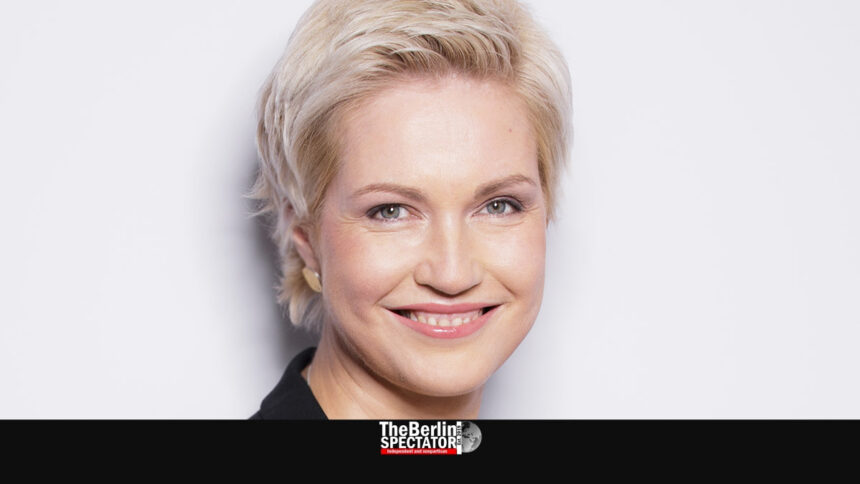
Berlin, August 9th, 2026 (The Berlin Spectator) – Under clear skies, Schwesig unveiled the SPD’s campaign posters in Schwerin earlier this week, marking the official start of the party’s push ahead of the September 20th vote. The party’s parliamentary group leader in the state legislature, Julian Barlen, declared the “hot phase” of the campaign underway at the event, held within view of Schwerin Castle, where Schwesig hopes to return as head of government after the election. Polls currently place the SPD in second, well behind the extremist right-wing Alternative for Germany (AfD).
The gap is quite big. A survey published July 9th by Infratest Dimap for the NDR, based on fieldwork from July 2nd to 6th, put the AfD at 36 percent, with the SPD trailing at 29 percent. The center-right CDU has collapsed to just 9 percent, behind the far-left Die Linke at 12 percent. The center-left Greens stood at 5 percent, the newer extremist and pro-Putin Bündnis Sahra Wagenknecht (BSW) at 4 percent, and the center-right FDP too low to register separately. That would leave the AfD and SPD together commanding roughly two-thirds of the electorate, squeezing the traditional coalition options that have governed the state for decades.
Schwesig cast the vote as a fundamental choice for the region. The question, she said, was whether she could continue delivering stable, reliable, democratic governance as premier, or whether the AfD takes over the government instead. “Things will get worse for people in this state,” she warned. Her pitch centers on a promise to boost small and mid-sized businesses.
Campaign Season Brings Costly Pledges
Schwesig, who has governed from Schwerin since 2017, is entering the race with a string of subsidy promises. The discounted Deutschlandticket, a monthly subscription for all regional trains and local transport in Germany, currently available to pensioners and apprentices, would be extended to young people more broadly under her plan. The state also wants to help local clubs and associations cover music licensing costs at events.
Once again, Schwesig sought to position herself as a state leader distinct from the federal government, even though her own party sits in the governing coalition in Berlin. She announced she would block the federal pension reform in the Bundesrat and pushed back on Economy Minister Katherina Reiche, who has said electricity prices won’t fall before 2030. “That’s completely unacceptable,” Schwesig said.
In Saxony-Anhalt, where state elections are scheduled for September 6th, the AfD might even get an outright majority, meaning it might be able to govern on its own. Up north in Mecklenburg-Hither Pomerania, on the other hand, democratic parties could still be able to form an anti-AfD government coalition. Like Mecklenburg-Hither Pomerania, Berlin also has state elections on September 20th. Here, the AfD has doubled its support since the last elections in 2023, according to the latest polls, but it is still not strong enough to govern. Berlin is the only federal state in the eastern part of Germany in which the right-wing extremists will most likely not win the election.