

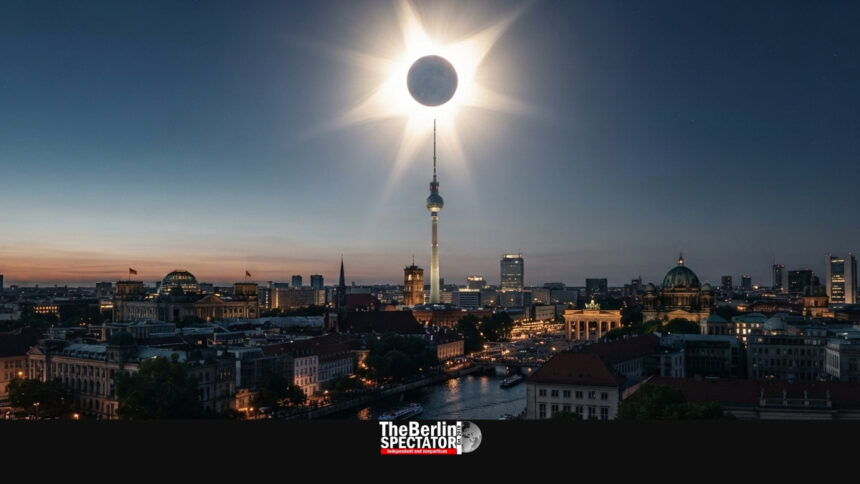
Berlin, August 10th, 2026 (The Berlin Spectator) – Skywatchers across Germany are gearing up for a rare astronomical lineup this month, headlined by a total solar eclipse on August 12th that will darken parts of the Northern Hemisphere.
The path of totality will stretch from the Arctic across the North Atlantic and eastern Greenland, over Iceland and Spain, and on to the Balearic Islands and the western Mediterranean. Germany itself lies outside that path, but a partial eclipse will still be visible nationwide. In most parts of the country, the spectacle begins around 7:20 p.m. and ends near sunset at about 9 p.m., with the moon covering between 84 and 92 percent of the sun.
Anyone hoping to see it should never look directly at the sun without approved eclipse glasses, experts warn. Sunglasses or smoked glass offer no real protection. For children in particular, the safer option is projection, using a small mirror or a simple pinhole box to cast the sun’s image onto a surface rather than viewing it head-on.
Germany last saw a solar eclipse of this scale from its southern regions back in August of 1999. The next chance to witness true totality from the country’s southwestern tip will not come until September 3rd, 2081, when only a fourth to a third of everyone alive today will still be there.
More Highlights
The eclipse is not the only highlight overhead this month. The Perseid meteor shower reaches its peak between the 9th and 13th, with the busiest night falling between the 12th and 13th, when observers could spot up to 100 meteors an hour. Since the peak coincides with the new moon, there will be no moonlight to interfere with viewing. The best window is between 11 p.m. and 4 a.m., when the shower’s particles, remnants of comet 109P/Swift-Tuttle, burn up in the atmosphere at roughly 60 kilometers per second, or about 216,000 kilometers an hour. The shower gets its name simply from the point in the sky, in the constellation Perseus, from which the meteors appear to radiate.
Later in the month, on August 28th, a nearly total lunar eclipse will unfold in the early morning hours. The moon enters Earth’s shadow at 4:34 a.m. and exits at 7:52 a.m., with the deepest point of the eclipse at 6:13 a.m., when 94 percent of the moon’s visible disk will sit inside the shadow. Only the first half of the event will be observable from Germany, since the moon sets shortly after the midpoint is reached. Full moon itself occurs at 6:19 a.m. on the 28th, in the constellation Aquarius. The moon’s distance from Earth will also swing considerably this month, from about 363,300 kilometers at its closest approach on the 10th to roughly 404,600 kilometers at its farthest on the 22nd.
Does The Berlin Spectator have a newsletter? Sure. Subscribe here.
Among the planets, Venus is fading from view as an evening star, setting earlier each night through the month, down to around 9 p.m. by the end of August, just half an hour after twilight ends. Saturn, by contrast, becomes easier to spot as August progresses, rising by mid-evening in the constellation Pisces, roughly 45 minutes before midnight at the start of the month and by 9:17 p.m. by its close. The ringed planet is about ten times the diameter of Earth, and its rapid rotation, a single Saturn day lasts just ten and a half hours, gives it a noticeably flattened shape, with its polar diameter about a ninth shorter than its equatorial one. A full orbit around the sun takes nearly 30 years, and its largest moon, Titan, can already be picked out with a pair of binoculars.
Progressive Rise
Mercury remains visible low in the early morning sky until mid-August, best glimpsed around 20 minutes after it rises at 4:55 a.m. on the 15th, its last easy viewing day this month. Mars, meanwhile, crosses from Taurus into Gemini on the 12th and rises progressively earlier through August, from around 2 a.m. to 1:30 a.m. by month’s end. Jupiter joins the pre-dawn sky in the second half of August in the constellation Cancer, and on the 15th it will appear in a close pairing with Mercury, the solar system’s largest and smallest planets briefly sitting side by side.
For those looking up after dark, the Summer Triangle dominates the southern sky, anchored by Vega near the zenith in Lyra, Deneb marking the tail of Cygnus the swan, and Altair in Aquila. To the east of Cygnus sits the small but distinct constellation Delphinus. Arcturus hangs low in the west while the Great Square of Pegasus, the signature constellation of autumn, climbs in the east. The Big Dipper sinks toward the northwest horizon, and Cassiopeia gains height in the northeast. The sun itself, meanwhile, is tracking through Cancer before moving into Leo on the 11th, passing near the star Regulus on the 23rd and entering Virgo the same day, as daylight hours shrink by nearly two hours over the course of the month.
Beyond the physics, researchers say there is something deeper behind humanity’s enduring fascination with solar eclipses. Berlin-based psychologist Peter Walschburger describes the experience as a controlled brush with catastrophe. People know the sun will return, he said, which allows them to enjoy “a small doomsday for the thrill of it” without genuine danger.
Darkness in Daytime
For centuries, before science could explain what was happening, sudden darkness in daytime was widely read as an omen, tied to wars, plagues and disasters across many cultures, according to Walschburger. He points to how closely early societies tracked the sky for practical reasons, from predicting weather to marking the seasons through star patterns and lunar cycles, and notes that in many belief systems the heavens were seen as home to gods with human-like traits, making sudden disruptions feel socially significant as well as physically alarming. The sun especially was often worshipped as a life-giving deity, personified in ancient Egypt by the god Ra.
Modern light pollution, however, is steadily eroding the night sky’s power to inspire, and interest in stargazing has declined outside of eclipses and auroras simply because the stars are no longer visible in so many places, Thimm notes. Truly dark skies, like those above Chile’s Atacama Desert, remain rare, and even there the growing number of satellites is starting to interfere, drawing the eye away from the stars toward fast-moving points of light. Researchers warn that this shift is not just an aesthetic loss but a scientific one, with satellite trails increasingly disrupting astronomical images and destroying usable data on a large scale. With satellite numbers expected to keep climbing in the coming years, the untouched night sky once familiar to earlier generations is, by most accounts, a thing of the past.