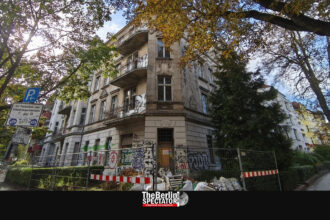


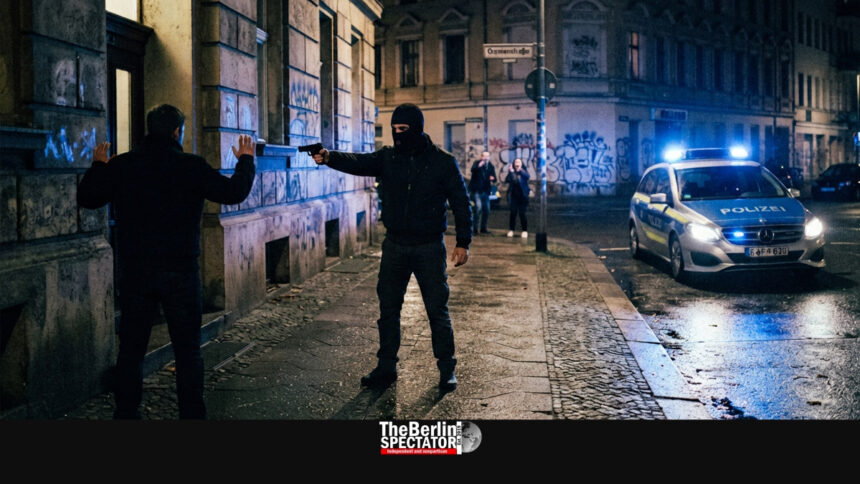
Berlin, August 15th, 2026 (The Berlin Spectator) – Three nights, three shootings, one of them fatal: That is the recent run of events that has put gun violence back at the center of public debate in the German capital. Prosecutors and the police say it fits a pattern they have been watching grow for some time.
A week ago on Friday, a 22-year-old was shot and wounded while sitting outside a café in Kreuzberg’s Graefekiez neighborhood. Hours later, officers were photographing bullet holes at a hair salon and a bar in Marzahn-Hellersdorf. Then, overnight into Monday, a man was shot dead at Bahnhof Zoo, one of Berlin’s busiest transit hubs. A fourth incident followed early Thursday, when gunfire hit the window of a restaurant in Pankow.
Stephan Weh, chairman of the Berlin branch of the police union GdP, was quoted by German-language media. He called the run of incidents a worrying development that his organization has flagged for months. Already this spring, the GdP warned that in Berlin there is hardly a night without someone reaching for a gun (or a knife).
Thorsten Cloidt, the senior public prosecutor who oversees organized crime cases in the capital, put it more starkly still. What worried him most, he said, was the risk that bystanders with nothing to do with the underlying conflicts could get hurt, a danger he believes has grown as more people in Berlin carry firearms.
Not All Shootings Are Alike
The incidents driving these numbers come from very different sources. Some are disputes that spiral out of control, cases where a gun is drawn today in situations that might once have involved a knife. Others trace back to family conflicts or perceived insults to someone’s honor, or to turf battles within the drug trade.
A separate and recurring category is extortion targeting Turkish-Kurdish business owners, whose restaurants and shops have repeatedly come under fire, allegedly at the hands of Turkish-Kurdish organized crime figures.
That last category, in particular, prompted police and prosecutors to stand up two dedicated units. One, run by police, is called Ferrum, Latin for iron. The other, housed within the prosecutor’s office, is Telum, Latin for weapon. Between them they have sent more than 50 suspects to pretrial detention, and investigators say they are still hunting additional suspects. By the 13th of August, authorities had issued 68 arrest warrants in connection with the crackdown.
A Slow Grind Through the Courts
The scale of the two units’ work is considerable, even if convictions remain few so far. Roughly nine months after Ferrum’s launch, the unit has opened more than 600 investigations, according to a police spokeswoman who was also quoted by German newspapers. Officers have checked more than 3,800 vehicles and 866 businesses, and around 280 people have been briefly taken into custody as part of the operation.
On the prosecution side, Telum had received 197 case files by the 4th of August, but in the roughly five months since it was formed, only eleven of those cases have actually led to charges being filed. Cloidt described the strategy in blunt terms, saying the aim is to pull as many people as possible out of circulation while working to understand the criminal structures behind them, adding that the effort amounts to nothing less than a marathon.
One trend concerns him in particular: The people being drawn into this world are getting younger, often recruited online by people who give little thought to what happens next, he said.
The Numbers Behind the Headlines
Berlin police logged 1,119 cases involving the use of a firearm in 2025, a category that includes threats made without a shot fired, marking a 68 percent jump from the year before. Officials caution that part of that increase reflects a stricter, more precise system for recording weapons offenses that took effect in 2025, not necessarily a one-to-one rise in actual incidents. So far this year, Berlin has already recorded 62 offenses involving a live firearm, as of the 5th of August.
Zoom out to the national level, and the picture looks somewhat different. The Federal Association of German Detectives, or BDK, reported that threats made with a firearm rose by 12.7 percent nationwide last year, reaching 5,281 cases. Actual shootings, however, declined by 8.7 percent to 4,360 cases.
BDK national chairman Dirk Peglow said the national figures do not point to a spike comparable to what Berlin has experienced, though he warned against reading that as reassurance. The number of weapons offenses nationwide has climbed steadily every year since 2021, he noted, citing the federal government’s annual report on weapons-related crime.
Where the Guns Come From
Behind much of this sits a more basic problem: supply. Peglow argued that the more illegal firearms are in circulation, the faster conflicts tend to escalate and the more severe the consequences become when they do.
Berlin, several experts agree, has an outsized share of that supply. The city’s interior administration says most of the pistols seized by police trace back to illegal factories, largely in the Czech Republic but above all in Turkey. In early 2024, Berlin’s state criminal police uncovered a German-Turkish gang that was converting legally available blank-firing guns into functioning firearms and selling them on. Investigators say they have also occasionally recovered weapons made using 3D printers.
For Cloidt, choking off that supply chain into Berlin is one of the central goals now, and he credits additional staffing with helping police and prosecutors apply more pressure in recent months. But he is not under any illusions about how long the fight will take.