

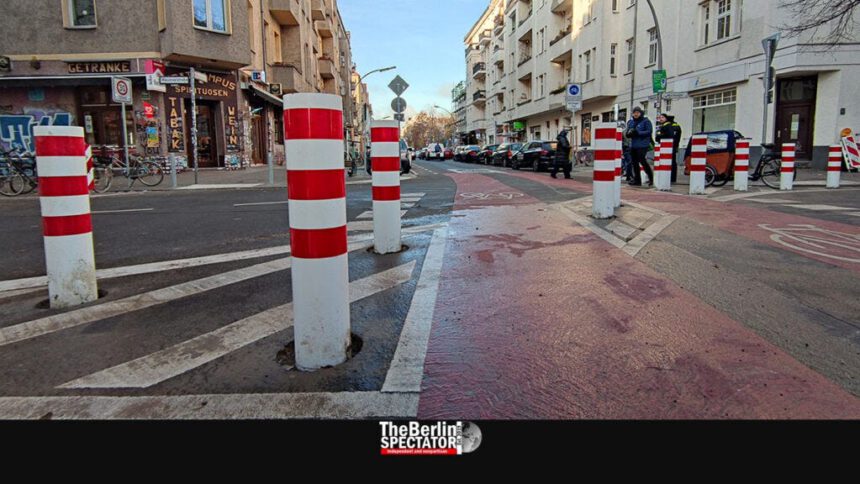
Berlin, August 30th, 2026 (The Berlin Spectator) – Bollards installed to slow traffic in Berlin’s residential neighborhoods, known locally as “Kiezblocks”, may soon become harder to justify. Transport Senator Ute Bonde (CDU) has introduced a new administrative directive that tightens the rules for when such barriers can be used. By doing so, she hands the city-state government more say over decisions that used to rest largely with individual districts.
According to local German-language media, inclunding the RBB as well as the “Morgenpost” and “Tagesspiegel dalies, the move follows repeated friction between the CDU and traffic-calming advocates. The party and its transport senator have criticized bollards for years, and things boiled over in the district of Mitte, where the city’s transport administration halted a Kiezblock project altogether. That standoff has since been resolved: Instead of physical barriers, four neighborhoods in Mitte will now be calmed using one-way streets.
Districts Lose Some Autonomy
Bonde announced the policy shift just days ago, and the draft directive was sent to the responsible district councilors on Wednesday. Its central message: Road closures using bollards should be a last resort, not a first option.
Ordinarily, Berlin’s twelve districts control decisions on side streets, while the Senate oversees the city’s major arterial roads. But the new rules widen the Senate’s reach. If a district’s traffic-calming plan could plausibly affect the broader road network, public transit, or commercial traffic, the responsible Senate transport department must now be notified early. This is a threshold Bonde’s administration expects to apply in nearly every case.
For projects likely to have more than a minor impact, the bar rises further: Districts will need to secure formal agreement from the Senate’s mobility department to protect city-wide interests. In effect, the transport administration would gain final say over whether bollards go in at all.

“Britzer Garten”: Berlin’s Exceptionally Beautiful Park

“Tori-Katsu”: Berlin’s Most Legendary Japanese “Bird Cutlet” Place

“I’m Not in Love”: 10cc to Perform in Germany
Weighing the Trade-Offs
The directive doesn’t stop at bollards. It also applies to other traffic-calming measures, including bike lanes and one-way streets, all of which must now meet a proportionality standard, meaning the mildest effective option must be chosen. Districts will be required to document a full evaluation process, weighing not just benefits for local residents but also the needs of commercial traffic, street cleaning services, emergency responders and police. Potential downsides for neighboring areas, such as displaced traffic bringing more noise or exhaust, must be factored in and formally recorded as well.
Bollards specifically face an even higher bar. They may only be authorized as a last resort, once it’s clear no equally effective alternative exists, and only after formal justification is submitted to, and approved by, the Senate Administration of Transport. Emergency services also get an effective veto: If the fire department or police raise concerns, barriers will generally be ruled out.
While the new standard is designed primarily for future projects, it could also reach existing bollards. Under the directive, previously installed barriers may be reassessed under the new principles whenever local conditions change significantly or renewal work is due.
Timing Questioned
Asked in the House of Representatives’ mobility committee whether introducing such a directive so close to the upcoming election still made sense, Bonde defended the timing as “absolutely routine administrative business”, arguing that the vote shouldn’t bring government work to a standstill. The draft will next go before Berlin’s Council of Mayors for review.
The Berlin state elections take place on September 20th, 2026. According to the results of the latest polls, a continuation of the CDU-SPD coalition is unlikely, since the two parties will probably not have a majority.