


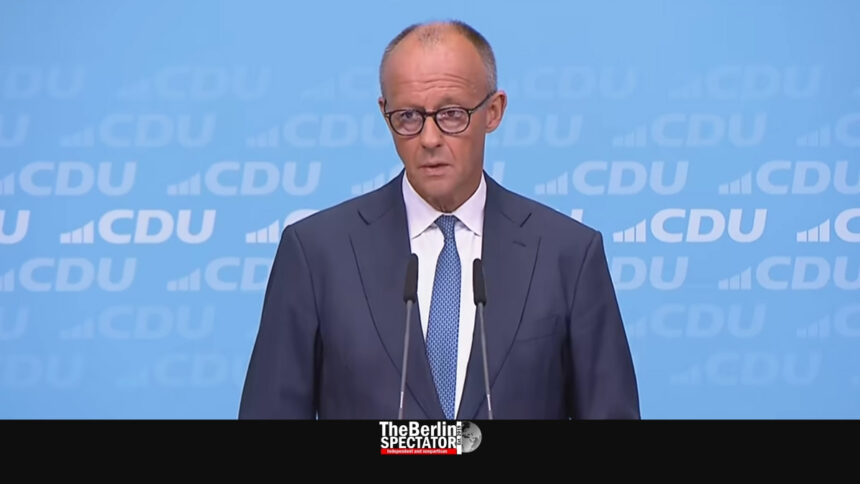
Berlin, September 14th, 2026 (The Berlin Spectator) – Chancellor Friedrich Merz and his CDU are facing a rough stretch, with the extremist right-wing AfD breathing down their necks and another possible election setback looming in just a week in Mecklenburg-Hither Pomerania.
An online survey by pollster Insa, commissioned by “Bild”, found that only 14 percent of people in Germany still consider Merz the right person to lead the government, while 78 percent disagree. Even a majority of CDU and CSU voters no longer back him.
A separate Insa poll for Bild painted an equally grim picture for the coalition as a whole. The AfD climbed to 29 percent, up one point from the previous week, while the CDU and CSU stayed flat at 20 percent, nine points behind. The SPD came in at 13 percent.
A government spokesperson dismissed speculation about a possible CDU minority government under Merz as entirely made up. That came after “Die Zeit” reported, citing several sources close to the chancellor, that a minority government was at least being considered as a scenario.
Merz Promises Better Communication
Following a crushing defeat in Saxony-Anhalt, where the AfD won more than twice as many votes as the CDU, Merz admitted mistakes and pledged to do a better job explaining his government’s policies, saying people needed to be reached on an emotional level too.
But in a Bundestag speech on Wednesday, Merz spent most of his time attacking the AfD instead, accusing the party of pursuing what amounted to “ethnic cleansing” based on origin and skin color through its use of the term “remigration”.
A week before state elections in Mecklenburg-Vorpommern and the city state of Berlin, senior CDU and CSU figures are not openly questioning Merz, though CSU leader Markus Söder’s defense of the chancellor has been notably unenthusiastic. Asked in a “Bild” interview whether Merz was still the right man for the job, Söder replied only that Merz stood behind the reforms.
Frustration Brewing in Saxony
Pressed further, the Bavarian state premier suggested that any alternative would face the same problems, adding that the CSU would not bring the chancellor down and that he held no responsibility for the CDU since he was not its chairman.
CDU politicians in Saxony have made no secret of their dissatisfaction with Merz and are calling for change. Bundestag member Florian Oest called for a new reform agenda, arguing that whatever strengthens the economy should count as socially responsible. He told the “Handelsblatt” daily Merz himself needed to determine whether he had the strength to drive that shift, adding that a CDU chancellor needed to give the country direction and solve its problems.
After the CDU’s poor result in Saxony-Anhalt, the party’s district chairs in Saxony, Oest among them, sent Merz a letter demanding swift talks on a CDU relaunch.
CDU Heavyweight Attacks the SPD
Tensions are also visible within Merz’s own party in the capital. Christian von Stetten, who chairs the CDU/CSU parliamentary group’s influential Mittelstand circle, angered coalition partner SPD with a sharp attack on its leadership.
He told “Bild” that Labor Minister Bärbel Bas of the SPD had become untenable, accusing her of blocking urgently needed reforms for months. He also criticized SPD co-leader and Vice Chancellor Lars Klingbeil’s draft budget for next year as unacceptable, arguing that Klingbeil had failed to implement necessary spending cuts and instead proposed new taxes alongside record levels of new debt.
Klingbeil Pushes Back
Klingbeil rejected the criticism, saying Germany was going through difficult times and that the government needed to hold together. He accused parts of the CDU and CSU of undermining the coalition, pointing out that a second majority existed in the Bundestag made up of the CDU, CSU and AfD together, something he said he did not want. Klingbeil stated he hoped most in the CDU and CSU did not want this kind of coalition either.
Von Stetten’s broadside drew criticism even from within his own party. According to German-language media, Hendrik Hoppenstedt, the CDU/CSU parliamentary group’s chief whip, stated publicly airing coalition disputes helped no one except those looking to raise their own profile. He said the constant public shaming of individuals and initiatives needed to stop.
More Election Trouble Ahead
While Merz is traveling in the Arctic, more election results are on their way. Local elections took place in Lower Saxony yesterday. According to the latest numbers available, Merz’ CDU got 27.7 percent, the center-left SPD 24.5, the extremist center-right AfT 16.5, the Greens 13.6 and the far-Left “Die Linke” 5.9 percent.
The CDU does have reason for cautious optimism about the Berlin state election, where it could defeat the extremist far-left Die Linke and claim the mayor’s office.
But in Mecklenburg-Vorpommern, the CDU is bracing for what could be its worst state election result yet, having recently fallen to just 7 percent in polls. The AfD leads there, though SPD state premier Manuela Schwesig has been closing the gap in recent weeks.
Smaller parties, including the Greens and now the CDU as well, risk being squeezed out entirely as the two frontrunners dominate the race, potentially missing the threshold to enter the state parliament altogether.
Campaign Strategy
The CDU’s Secretary General Franziska Hoppermann accused Schwesig of running a campaign centered too heavily on herself, weakening the political center in the process. She said Schwesig was putting her party’s interests above those of her state, and that her personalized campaign strategy, aimed at sidelining the CDU, ultimately benefited the AfD, calling the approach irresponsible.
A few years ago, a scenario in which the chancellor’s own party is appealing to a Social Democrat to leave it a few more votes would have seemed unthinkable.