

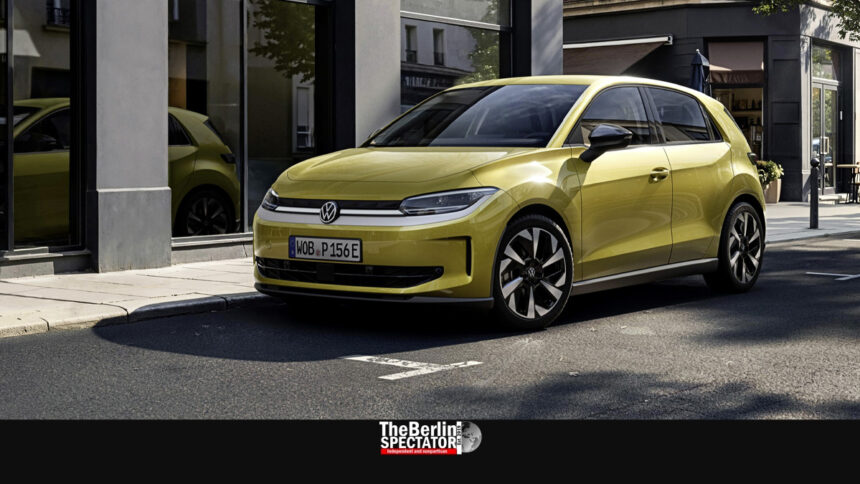
Berlin, September 14th, 2026 (The Berlin Spectator) – Volkswagen says it has now received over 30,000 orders for its fully electric Polo model, a figure the company says has clearly exceeded its initial expectations, particularly in Germany. The car has been available to order since late April, though dealerships only started displaying the ID. Polo in their showrooms a few days ago.
The base version of the E-Polo costs just under 25,000 euros, but initially only a better-equipped variant with a larger battery and a price well above 30,000 euros could be ordered. Customers have been able to order the cheaper, less powerful base version since July.
The car is built at VW’s plant in Martorell, near Barcelona. A company spokeswoman was quoted by German-language media. He said high demand combined with production capacity that was originally planned for the longer term was now causing delivery times to stretch out. VW is working to ramp up production step by step, though the spokeswoman did not specify current wait times, saying delivery dates depended on how a vehicle was configured. Preconfigured cars, on the other hand, can already be bought from VW dealers with no wait at all.
Family of Four Small EVs
The ID. Polo shares its underlying platform with three sibling models, the VW ID. Cross, the Škoda Epiq and the Cupra Raval. Combined, the four cars have now attracted more than 100,000 pre-orders. All four are also built in Spain for cost reasons.
With this lineup, Volkswagen is aiming to break into the entry-level electric segment. A cheaper model still to come, currently going by the working title ID. Every1, is expected in 2027 at around 20,000 euros as a successor to the VW Up, which was discontinued in 2023. That car will be manufactured in Portugal.
German Job Cuts Hit Home: Auto Industry Openings Sink to New Low
Carless or Careless?
‘Classic Remise’: Home for Berlin’s Most Beautiful Cars
Shared Demand
VW brand chief Thomas Schäfer said the level of interest showed the new vehicle family was meeting the expectations of many customers. According to Schäfer, the four models were developed together while preserving each brand’s distinct character and drawing on the benefits of shared development. The cars reportedly share more than 80 percent of their components and technology, while differing in areas like design, driving feel and specific features.
Volkswagen is currently grappling with falling sales. Global deliveries across all of its brands dropped by 6.3 percent in the first half of the year, to just over 4.1 million vehicles, and electric vehicle sales fell as well. In Europe, however, VW managed to grow pure EV sales by 8.4 percent to 377,000 vehicles, and the company’s order backlog for electric cars in Europe has grown significantly since the start of the year.
Launch Needs to Land
Industry analyst Stefan Bratzel, director of the Center of Automotive Management in Bergisch Gladbach, called the ID. Polo an important model for Volkswagen, saying the company’s shot in the small electric car segment “must land” now. He noted that quality and overall impression at VW have improved again after past shortcomings.
Bratzel added that the ID. Polo arrives late but possibly still in time, as the broader electric vehicle market is picking up speed. What will matter most, he said, is whether customers accept the car’s value for money given intensifying competition from Chinese automakers.