


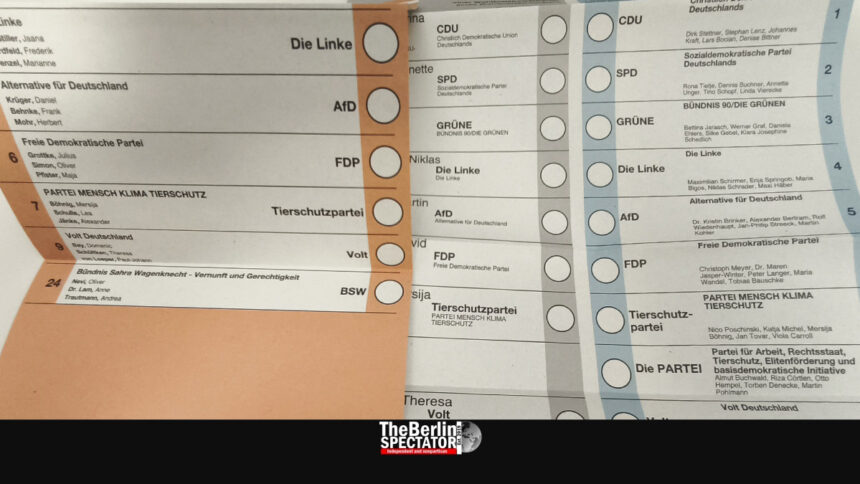
Berlin, September 20th, 2026 (The Berlin Spectator) – In Mecklenburg-Hither Pomerania, a neck-and-neck race between the center-left SPD and the extremist far-right AfD is about to end. Once the results are in tonight, a big question will be answered: Can democrats in eastern German states still win?
In the past few weeks, Mecklenburg’s Minister President (governor) Manuela Schwesig has shown a lot of stamina. According to the latest polls, she even managed to overtake the AfD by one percent. Only a couple of months ago, things had looked hopeless for the SPD.
The AfD seems to be afraid its recently predicted win is in danger. So, the extremists, who support Vladimir Putin, tolerate Nazis in their ranks and want Germany to leave both the European Union and NATO, sent Alice Weidel, the party’s co-chair, to Schwerin. “Who is Manuela Schwesig?”, she shouted during a campaign event. Then, she accused her of having supported the federal government’s policies during the Covid crisis.
Girls and Women
Like many of her AfD colleagues, Weidel still claims the measures Germany took against the virus and for the protection of its citizens were crimes. Her party also disputes the fact that Covid vaccines had a positive effect, just like other extremist far-right parties in Europe and North America.
Manuela Schwesig used the last hours of her campaign to explain to voters how the AfD would damage Mecklenburg-Hither Pomerania and that the extremists’ policies would hurt girls and women. She asked the state’s 1.3 million eligible voters to support her today.
In the federal city state of Berlin, the situation is different. The extremist party which might (or might not) take over Red City Hall is located on the very left of the political spectrum. “Die Linke” wants to get rid of the Office for the Protection of the Constitution, the authority that is looking into some of its members. This party was rocked by several antisemitism scandals in the past days, weeks and months. It harbors terrorism supporters.
Radical Policies
According to the latest polls, “Die Linke” is one of the strongest parties, even though (or because) it announced several radical policies in case it wins and runs the next government coalition. Those include defunding the police and expropriating real estate companies.
The conservative CDU also has a chance to become the strongest party. A win would increase its chances to be able to set up a government coalition with the Greens and the Social Democrats, two center-left parties that seem to prefer to govern with “Die Linke”, in spite of its extremist approach.
In Berlin, 2.5 million inhabitants are eligible to vote. The ongoing housing crisis is one of the most relevant subjects that are being discussed because it affects many Berliners. Different approaches to resolving the problem have been discussed publicly by the candidates at several campaign events.
Zero Chances
The AfD is strong as well, but it does not get as much support in Berlin as it does in all other eastern German states. Since nobody wants to cooperate with the far right, its chances to be involved in the next government stand at zero percent.
Today’s election results in Berlin and Mecklenburg-Hither Pomerania may have implications for Chancellor Friedrich Merz’ political career. Changing the head of government is being discussed even in his own party, the CDU.
In both states, polling stations open at 8:00 a.m. and close at 6:00 p.m. CEST.
Expect the first prediction on The Berlin Spectator at 6:01 p.m. and the first results about an hour later.