

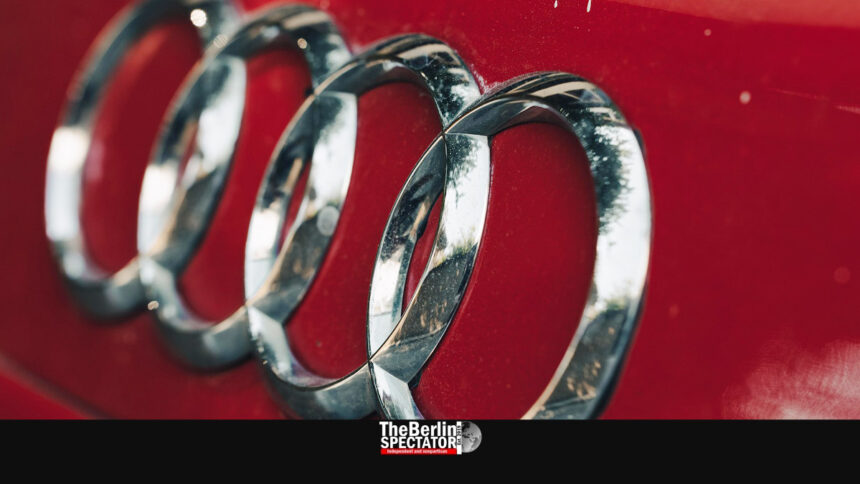
Berlin, October 31st, 2026 (The Berlin Spectator) – Audi barely stayed out of the red in the third quarter, according to a report by the German news agency dpa. After taxes, the Ingolstadt-based carmaker earned just 95 million Euro, down from 718 million Euro in the same period last year. The sub-group, which also includes Lamborghini, Bentley, and Ducati, is sinking deeper into financial trouble.
Over the first nine months, Audi made a profit of 1.22 billion Euro on revenue of 42 billion Euro. Both figures are sharply lower than a year earlier. Because of the poor third quarter, the company has also adjusted its full-year forecast downward. Chief Financial Officer Jürgen Rittersberger said the new forecast implies that the fourth quarter will be better.
Audi blamed the weak results on several factors. “Business performance was weighed down in particular by the market slump in China, especially for vehicles with combustion engines, by rising competitive intensity, and by increasing export pressure from Chinese manufacturers on the European market”, the company said. It also cited uncertainty over the situation in the Middle East and the resulting rise in energy costs, as well as US tariffs.
Model Changes
German automakers as a whole are facing this crisis, but Audi is hit particularly hard, in part because it has no plant of its own in the United States and is in the middle of model changes for key vehicles. By comparison, Mercedes earned 1.52 billion Euro in the third quarter. BMW will present its figures next week.
“The key figures clearly show that the need for action at Audi is high and cannot be postponed”, Rittersberger said. “Above all in the third quarter, the environment has become considerably tougher once more. Our measures are working, but because of the enormous competitive pressure we have to intensify them.” He said the company is relying on consistent cost discipline, less complexity, and more efficient structures.
Audi remained vague about what this means for its German sites. It said it had set important measures in motion with the future agreement concluded last year, which included cutting thousands of jobs in Germany. Further steps are to be developed together with the general works council. Talks about additional savings are ongoing, and the closure of the Neckarsulm plant is even being discussed. In early October, Audi invoked a so-called bad weather clause from 2019. It obliges management and the works council to negotiate savings measures when key economic conditions deteriorate significantly.
Döllner and Trump
Döllner, meanwhile, is dealing with fallout from a surprise appearance alongside Trump last weekend. The president announced Audi’s plans to build a plant in the state of Georgia at a campaign event, then called Döllner onto the stage, where the Audi chief thanked Trump for his support. Criticism has continued since then and includes calls for Döllner to resign. Most observers acknowledge that a US plant makes sense for Audi. The main issue is the timing, just before the important midterm elections on November 3. Critics accuse Döllner of violating Audi’s own rules, which rule out such appearances.
Döllner has defended the appearance as being in the company’s interest. During talks about the plant, Audi was asked “to present our plans publicly together with the President of the United States of America”, he said. He added that such an invitation is not declined, out of respect for the office.
Rittersberger gave few details about the conditions for the planned plant on Friday. Many factors played a role in choosing Georgia, he said, from infrastructure to the workforce, but also the available incentives. This suggests that larger sums could be involved. He did not comment on whether the deal would affect the tariffs Audi pays in the United States before production starts.