


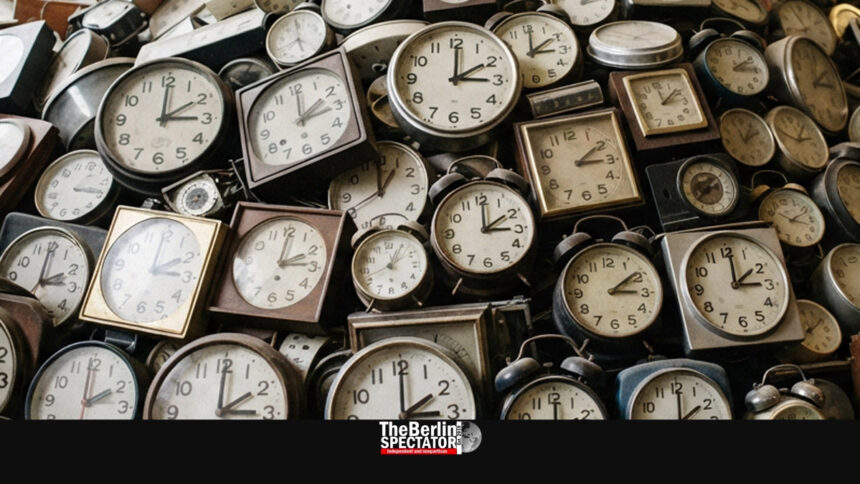
Naples, October 10th, 2026 (The Berlin Spectator) – Seven years ago, the European Union wanted to get rid of those annoying changes between regular time and daylight saving time. Since then, the member states have not managed to agree on the question of what time should apply permanently. Some governments wanted to set clocks to summer time (daylight saving time) forever, which is what Turkey did in 2016. Others insist on being on regular time (winter time).
Because there is no agreement, Germany will continue to switch the time back and forth twice a year. To many Germans and other Europeans, this is annoying, also because they never know whether to set their clocks back or forward by an hour. Also, those frequent time changes influence their sleep. Do you want jet lag without traveling? Change the time.
On Sunday, October 25th, 2026, at 3 a.m., we will be turning our kitchen clocks and watches back to 2 a.m.. And no, there is no need to get up at 3 a.m. in order to do so. You can either set your clock beforehand, on Saturday evening, or once you get up on Sunday. Smartphones and computers do the time switch themselves anyway.
Navajo Nation
In 1980, those time changes were resumed in Germany. The idea was to make the most of the daylight time and to save energy. But experts dispute the existence of the latter effect. At the same time (!!), they do say our biorhythm suffers.
The Americans want to get rid of their time changes too. In Washington, D.C., the House of Representatives already passed the Sunshine Protection Act, a law with this purpose, on July 15th, while the Senate has not. President Donald Trump has stated he wants the act to pass.
Until then, the U.S. does go through time changes too, but a week later than Europe. This means that between October 25th and November 1st, the time difference between Berlin and the U.S. East Coast will be five hours instead of six.
In the U.S., two out of 50 states do not change the time: Arizona and Hawaii. In Arizona, there is one exception: The Navajo Nation is part of those annoying time changes.