
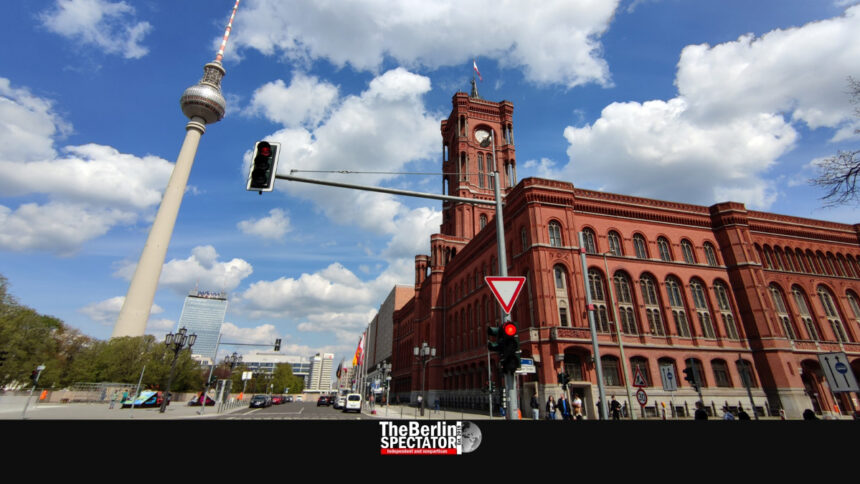
Berlin, October 18th, 2026 (The Berlin Spectator) – Four weeks after the state election, the far-left “Die Linke”, the left-wing Greens and the center-left SPD want to start formal coalition negotiations in Berlin. The three parties concluded their exploratory talks on Saturday evening. Their party bodies still have to approve the next step, and negotiations could begin in early November. The paper, which runs to about 30 pages including annexes, is titled “More Together, More Berlin.”
The most prominent item is a plan to socialize large private housing holdings. Landlords owning more than 10,000 apartments in the city would be expropriated with compensation, but only for the units above that threshold. According to Elif Eralp, who co-chairs the Left Party’s group in the state parliament, five big corporations would be affected, among them Vonovia.
About 160,000 apartments would end up in municipal ownership. Eralp said the goal is to stop rents from rising further. The parties want to present a bill in mid-2028, which would take effect one year after passage. Compensation would be capped at 16 billion Euro, an amount Eralp described as “very realistic.” The law is to be reviewed by the constitutional court in the meantime, and lawsuits are considered a certainty.
Rent Increases
Other housing plans include a cap of two percent per year on rent increases in the city’s 440,000 municipal apartments and a construction program for 100,000 affordable units, backed by 100,000 building permits by 2031. The parties also want a rent oversight body and a special unit at the public prosecutor’s office to go after excessive rents. The former Tempelhof airfield is to stay free of development.
Beyond housing, the paper promises one free bulky-waste pickup per household each year and cleaner parks and playgrounds. To adapt to a warmer climate, the city is to add trees, benches and fountains and turn itself into a “sponge city” that retains rainwater and unseals surfaces. In transportation, the parties plan more bike lanes, dedicated lanes and signal priority for buses and trams, and calmer streets, including school streets. The social ticket for public transit, which now costs 27.50 Euro a month, is to get cheaper, and the Autobahn A100 will not be extended.
In education, the coalition hopes to create more community schools and keep education free from daycare through university. Free student tickets and free lunches through sixth grade would stay, while cell phones would be banned in elementary schools. An independent office would handle complaints about discrimination and bullying, and the education administration would end its cooperation agreement with the German armed forces.
Ban Zones
On security, the parties rule out cuts to police staffing and want to keep the domestic intelligence agency in its current form, with more transparency and parliamentary oversight. Knife and weapons ban zones and video surveillance are to be reviewed in 2028.
The paper further envisions a culture funding law, 16 free museum Sundays a year and a culture card for young people. Another section pledges firm action against antisemitism, anti-Roma racism, anti-Muslim and anti-Black racism and hostility toward queer people.
The parties also plan a law to support democracy initiatives, neighborhood canteens with inexpensive meals, and voting rights at the municipal and state levels for everyone after five years of residence in Germany. On finances, they want a consolidation strategy through 2031 that combines a spending cap, higher revenues, prioritized outlays and the use of borrowing leeway.
Antisemitic Incidents
Even before the talks began last Thursday, the three parties agreed on how to deal with antisemitic incidents within “Die Linke”’s ranks. They committed together to protecting Jewish life, to Israel’s right to exist and to a two-state solution that secures Israel’s safety while allowing Palestinians self-determination.
Before and during the exploratory talks, a series of antisemitism scandals had rocked “Die Linke”. For this reason, the three parties held talks on this subject before they moved on to talks about other subjects.
Eralp wants to become the first Left Party head of government in the German capital. In the state election on September 20th, her party finished first with 25.7 percent. The conservative CDU followed with 18.8 percent, ahead of the extremist right-wing AfD at 16.3 percent, the Greens at 14.3 percent and the SPD at 12.1 percent. The CDU/SPD coalition in power so far lost its majority.
Clans and Islamists
CDU state chairman Stefan Evers, who also leads his party’s group in the state parliament, called the paper “a declaration of surrender by the SPD and the Greens to a radical ‘Die Linke’ that is antisemitic in parts,” as he put it. He accused the two parties of signing “despite nationwide resistance within their own ranks,” and said the deal was “a breach of the dam” that shifts Germany’s political landscape toward the extremes.
Evers argued that the Left Party prevailed on its central demands, above all the socialization of housing, which would cost billions “without creating a single new apartment.” Berlin lacked hundreds of thousands of homes, he said, and investors would be scared off while new bureaucracy was built up. On public safety, he complained that the paper had no answer on fighting crime, strengthening the police and protecting residents from “criminal clans and Islamists.”
Germany’s Chancellor Friedrich Merz (CDU) had also weighed in. Addressing the Junge Union’s national convention in Bonn on Saturday, he urged the SPD and the Greens to abandon the course, saying that anyone seeking to strengthen the political center must not talk to “left-wing radicals”.