

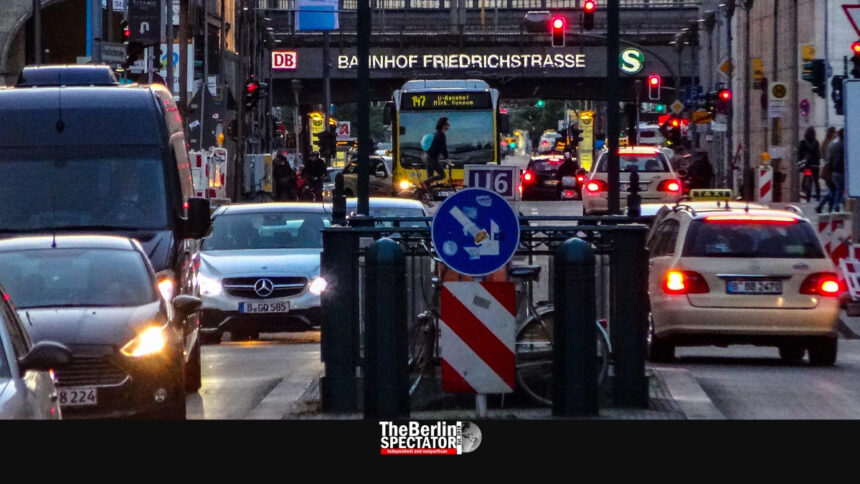
June 17th, 2026 (The Berlin Spectator) – Berliners are getting rid of their private vehicles. According to an exclusive report by the “Tagesspiegel” daily, approximately one in four Berliners owns a car (the exact number: 275 in 1000) This is a historic low. The total number of private vehicles registered in Berlin, a city of 3.9 million inhabitants, is 1,074,696, the report goes on to say.
Of course, there are differences within Berlin. In the Gluten-free borough Friedrichshain-Kreuzberg and the central Mitte district, less than 18 percent of all residents own those fish cans on wheels, while more than a third of the inhabitants in the southern Steglitz-Zehlendorf district do have shiny cars they call their own.
Let’s get to those obvious big questions: Why do Berliners seem to be in the process of getting rid of their cars? How are they travelling back and forth in the city? Well, many residents reject the concept of moving around in a private vehicle with an energy-sucking engine.
Bicycle vs. Public Transport
Every single day, 76,400 Berliners ride their bicycle, according to the environmental organization BUND. This number seems low considering the size of this city. So, what does everyone else do? They hit the public transport. In the entire area covered by the VBB, a linked transport system for Berlin and its outskirts in neighboring Brandenburg state, 4.3 million passengers use U-Bahn and S-Bahn trains as well as trams and buses every single day.
There is yet another way to go from A to B, to C and back to A. It is called walking. This is being achieved by sliding one foot forward, then the other foot, and then foot no. 1 again. Doing this continuously makes people move.
In all of Germany, there are almost 50 million cars or 590 per 1000 inhabitants. But this includes vehicles registered by authorities and companies. Some more useless numbers, anyone? My shoe size is 45.
Automobiles Win
It is not a surprise that the Berlin Greens are satisfied with the development in Berlin. Their traffic expert Antje Kapek says: “The times of the automobile are over. People increasingly use other means of transport.” This perception skills level is impressive.
But, whatever the numbers look like, the automobile does have a future in Berlin. That is because the “Carless Berlin” initiative just failed. With a referendum, the initiators wanted to ban most private vehicles from the city, but they did not manage to collect the 175,000 signatures they would have needed, probably because their car broke down when they transported the few signatures they did get. In this case, being carless was careless. Over and out.