

Polls suggest the far-right Alternative for Germany (AfD) could roughly double its share of the vote in Berlin’s September state election, potentially growing from the 17 seats it won in 2023 to a significantly larger presence in the Abgeordnetenhaus, the city’s state parliament. A recent poll conducted for public broadcaster RBB put the party at 18 percent, up sharply from the 9.1 percent it received two years ago. A closer look at the party’s state list, first compiled last October, shows that several of the candidates likely to benefit from that surge have track records marked by extremist language, according to a review by the “Tagesspiegel” daily.
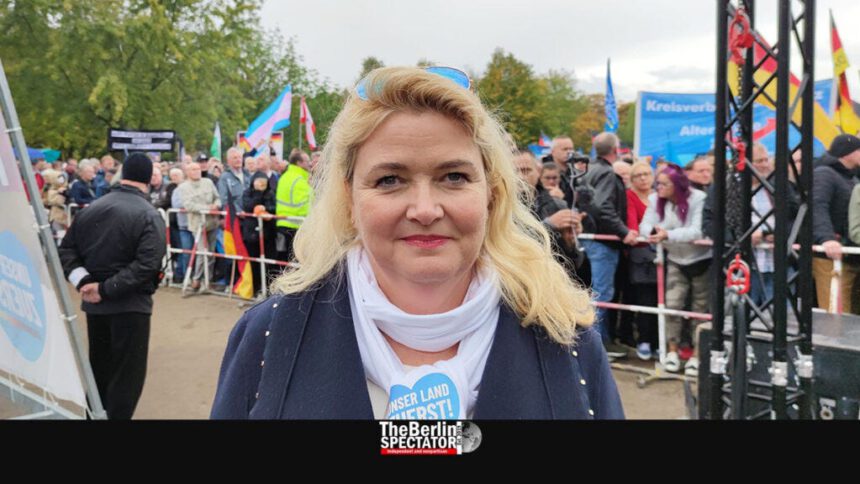
Leading the list is Kristin Brinker, the party’s state and parliamentary group chair since 2021, who is running for the top job for a third time. Brinker has long cultivated an image as a representative of the AfD’s more moderate, conservative-liberal wing — though political scientists disagree on whether such a wing meaningfully exists within the party at all. Her own rise to power complicates the narrative: She was elected state chair five years ago with the backing of members of the party’s now formally disbanded “Wing” faction, which German domestic intelligence had classified as right-wing extremist. Brinker has repeatedly distanced herself after being linked to extremist company, including a 2023 gathering at the home of a former Berlin CDU senator that was attended by prominent figures of the New Right such as Götz Kubitschek and Maximilian Krah. Brinker later claimed she had not known who would be there and left early because she was “shocked by the audience” — an account that both Krah and Kubitschek publicly disputed, saying she had stayed and enjoyed herself.
Also on the list is Martin Kohler, who has led the AfD’s youth wing in Berlin — now rebranded “Generation Germany” — for several years and is running in Charlottenburg-Wilmersdorf. Kohler belongs to a fraternity, Burschenschaft Gothia, that the “Tagesspiegel” describes as sitting at the far-right edge and whose Berlin HQ has reportedly served as a retreat for members of the identitarian movement. In 2017, Kohler and a fellow AfD youth official posted a photo grinning alongside Aiman Mazyek, then head of Germany’s Central Council of Muslims, whom they had spotted by chance on a flight, captioning it with a joke about discussing “the state of the Islamization of the West.” One commenter responded, “No one can hear him scream above the clouds” — a comment his travel companion liked.
Jeannette Auricht, a sitting member of the Abgeordnetenhaus since 2016 running in Marzahn-Hellersdorf, was close to the AfD’s disbanded far-right “Wing” faction and has long been associated with party figure Björn Höcke, one of the most extremist party leaders. On Telegram, she suggested that it had apparently “already become reality that migrant rapists have the right to rape without punishment.”
Julian Adrat, a candidate for the central Mitte district, has claimed that “racism against white people” is being enforced “from the very top” and suggested elderly Germans in nursing homes are being “mass-abused by Africans and Arabs.” He posted on Twitter/X that “transgenderism needs to be eradicated.” Amid the Epstein scandal, he wrote that he wasn’t bothered by “billionaires having sex with minors on private jets” — a comment that drew criticism even within his own party. A German court has separately barred him from repeating a homophobic claim about Tokio Hotel singer Bill Kaulitz.
David Eckert, a social scientist and Bundestag staffer for the AfD parliamentary group, has claimed Germany is trapped in a “left-green stranglehold” and that mainstream parties like the CDU and SPD are increasingly “a case for the domestic intelligence agency.” Eckert himself has drawn the attention of that same agency, including for describing German streets as degenerating into an “open-air brothel for immigrant rapists.” After a 2018 assault attributed to an asylum seeker, he wrote on Facebook that Germans faced only two options: adapt to “Abdullah’s culture” and start stabbing people themselves, or send “Abdullah and his filthy culture” back to where they came from.
Further down the list is Andreas Quint, a little-known local politician from Charlottenburg-Wilmersdorf, who is mainly known for attending demonstrations with homemade signs and posting AI-generated propaganda videos. In mid-June, he shared a video suggesting an “Umvolkung” — a Nazi-era term describing the forced ethnic replacement of populations in conquered territory — was underway and intentional. He has also shared an article on Germans allegedly tortured to death in Polish camps and a YouTube video claiming Russian President Vladimir Putin intends to “liberate East Germans.”