

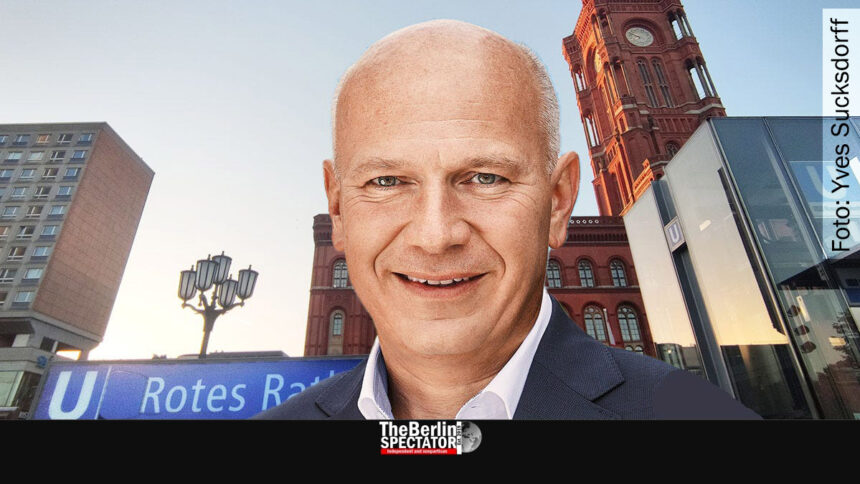
Berlin, July 9th, 2026 (The Berlin Spectator) — Harald Burkart, chairman of the Junge Union in Berlin, has called on Governing Mayor Kai Wegner to abandon his bid to lead the Christian Democrats (CDU) into September’s state election. Wegner should make clear “unmistakably” that he will not run again for the office, Burkart told the German-language news outlet “The Pioneer”, arguing that stepping aside would serve both the city’s and the party’s interests. He suggested the conservative CDU instead nominate a candidate whose personal integrity is beyond question.
The renewed pressure follows a report by the “Tagesspiegel” daily which cited information from the Berlin Senate Chancellery indicating that Wegner did not, in fact, hold any official calls on the morning of January 3rd regarding the city’s massive power outage, contradicting his earlier account. According to the Chancellery, no phone call took place before 12:45 p.m. that day. Instead, communication occurred via text message. At 12:45 p.m., Wegner spoke by phone with Economics Senator Franziska Giffey of the Social Democrats (SPD).
That timeline conflicts with statements Wegner made in a “Welt TV” interview on January 7th, when he said he began making calls at 8:08 a.m., speaking with crisis teams and the power grid operator.
Doubts about that account had already been building. In March, Wegner told the tabloid “B.Z.” that he had made “communicative mistakes” and apologized to Berliners, though he did not mention any official call that morning — a version of events that lined up with the paper’s own reporting at the time.
On Wednesday, Wegner addressed the discrepancy directly on X, saying his early-January statements had created an impression he still regrets. He said he made two phone calls before 1 p.m. on January 3rd and otherwise communicated by text — a version he said he had already shared with “Bild” and “B.Z.” back in March, along with his apology. He added that learning from mistakes and doing better going forward was what mattered most to him now. He also pointed out that Berlin resolved the power crisis considerably faster than initially expected, calling that the more important takeaway and thanking everyone involved.
The Berlin Spectator does have a newsletter. You can subscribe here.
Wegner had already come under fire during the days-long blackout which began after a suspected arson attack by left-wing extremists on a cable bridge left roughly 100,000 people in southwestern Berlin without power, in some cases for days, after it emerged he had played an hour-long tennis match around midday on the first day of the crisis without disclosing it. Exactly who he was in contact with, and when, during those early hours remains murky to this day.
Burkart argued that the documented contradiction strikes at the heart of political leadership: credibility. He linked the CDU’s slide in the polls in part to a broader credibility problem at the top of the party, suggesting Wegner’s departure could free the party to campaign on substance — housing, the economy, and public safety.
The center-left SPD’s lead candidate Steffen Krach was more blunt, telling the “Spiegel” news magazine that basic decency would call for Wegner to withdraw, though he said he suspected it would ultimately fall to Berlin voters to make that decision themselves on September 20th, the date of the state election. Krach has ruled out any post-election cooperation with him.
Recent polling underscores the CDU’s difficulties. An Infratest dimap survey conducted in early July put the (far) Left Party in front with 20 percent, followed by the Greens at 19 percent and the extremist right-wing AfD at 18 percent. The CDU trailed in fourth place with 17 percent, down sharply from the roughly 28 percent it won in the 2023 election. The SPD, the CDU’s junior coalition partner, polled at 13 percent — a combined result that would leave the current CDU-SPD coalition without a governing majority.