

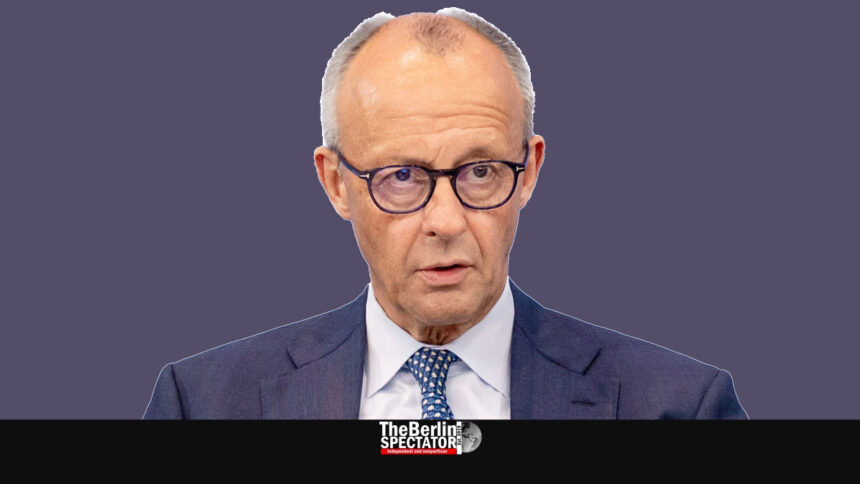
Berlin, July 20th, 2026 (The Berlin Spectator) – Chancellor Friedrich Merz used his annual ZDF “summer interview” broadcast to address the fallout from Jens Spahn’s resignation as CDU/CSU parliamentary group leader — a topic that dominated an interview originally expected to focus on his government’s reform agenda.
Merz acknowledged he had not grasped how explosive the surrogacy issue would become. When Spahn first told him that he and his husband, Daniel Funke, had had a child via a surrogate mother in the United States — a practice banned in Germany — Merz said his first thought was for the wellbeing of the child. He did not inform other party members at the time, saying he wanted to leave that decision to Spahn himself.
Asked how he reacted upon learning of the arrangement, Merz recalled hoping simply that Spahn would handle the disclosure well. The scale of the backlash within the CDU, he admitted, caught him off guard: “I did not expect that to happen on such a scale.”
Extent of the Damage
He suggested Spahn himself bore some responsibility for how the episode unfolded, noting it “probably also had something to do with his person and with the communication.” Merz was particularly critical of the timing, saying Spahn had informed the party leadership only “very, very late”, leaving no room for a calmer, more considered response.
It was only on Saturday, Merz said, that the extent of the damage to the CDU became “abundantly clear” to him, which is when he moved to act — a reference to reports in “Bild” and “Spiegel” that he had personally urged Spahn to step down. Spahn, 46, announced his resignation the same day.
Pressed on whether a broader cabinet reshuffle might follow, Merz said the situation “could be an opportunity to reconsider the composition of the federal government”, though he stressed he was speaking hypothetically. He declined to confirm widespread speculation that his chief of staff, Thorsten Frei, is the frontrunner to succeed Spahn, saying he was hearing that claim for the first time from the interviewer. Merz said the succession question would be discussed with CDU/CSU party bodies in the coming days.
The Only Female Contender
Health Minister Nina Warken has also been mentioned in media reports as a possible contender — notably the only woman whose name has come up in the speculation. Warken has overseen statutory health insurance reform and is now taking on long-term care reform, for which only a draft bill currently exists. Given her current portfolio and the largely male field of other candidates, sources within the CDU consider her succession unlikely.
Merz was also asked about the near-total absence of women among his closest aides in the Chancellery. He pointed to Bundestag President Julia Klöckner as an example of a CDU politician already holding a top post and said the share of women in leadership positions within the party had improved. “I am doing everything to make that even better,” he said.
Confronted over comments widely seen as accusing Germans of laziness, Merz rejected the characterization. “I never accused anyone of personal laziness,” he said, adding that his point was narrower, namely that the number of hours worked in Germany is currently too low. He argued that productivity and economic output needed to improve and said this was an issue the country “must tackle.”
Strong Prospects
When asked whether he was disparaging the very people keeping the country running, Merz insisted he did not intend to offend anyone personally. “I am trying to describe a problem we have, and I am trying to develop a solution from that description of the problem. And of course that only works with people,” he said, adding that he was well aware of how much people in hospitals, care homes and elsewhere contribute. “But I am also saying: Overall, we simply need to deliver higher output in this country. And I stand by that.”
Journalist Diana Zimmermann also pressed Merz on his tone, citing his recent remark that chronic complainers and professional critics should “step aside.” Merz called the comment taken out of context, explaining it was an inversion of a George Bernard Shaw quote. He said he was simply tired of what he called “endless griping” and of Germany constantly being “talked down and run into the ground,” pointing instead to the country’s strong prospects and a rising number of new business formations.
Looking toward upcoming state elections in eastern Germany, Merz warned against the country “slipping away” from the political mainstream, citing a recent scene in Saxony-Anhalt in which the extremist right-wing AfD’s top candidate joined Tino Chrupalla and other party representatives in singing the East German national anthem at a campaign event. “We will convince people that this is the wrong path”, the Chancellor stated, a reference to polls showing the AfD with a commanding lead in Saxony-Anhalt.