

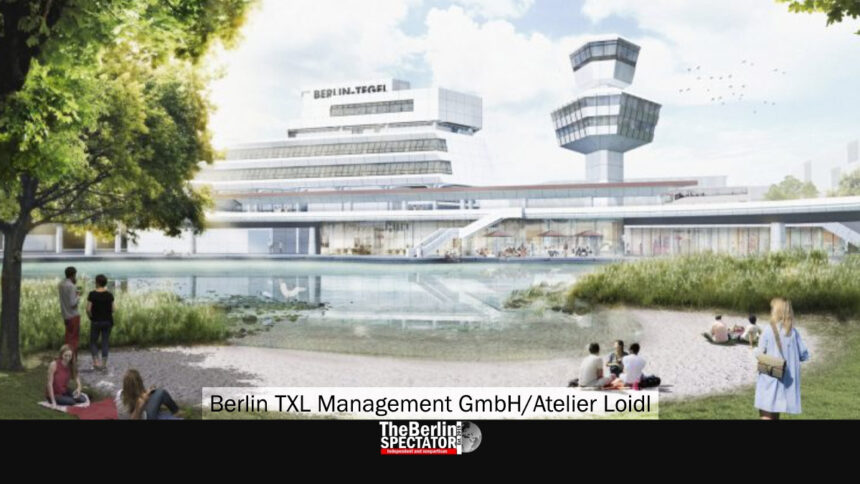
Berlin, September 4th, 2026 (The Berlin Spectator) – Nearly six years after the last plane took off from Tegel Airport, the site is entering its next chapter. On the eastern edge of the former airfield, construction is about to begin on the Schumacher Quartier, a new residential district planned for more than 10,000 people. City leaders marked the occasion this week with a groundbreaking ceremony, unrolling the district’s master plan on site.
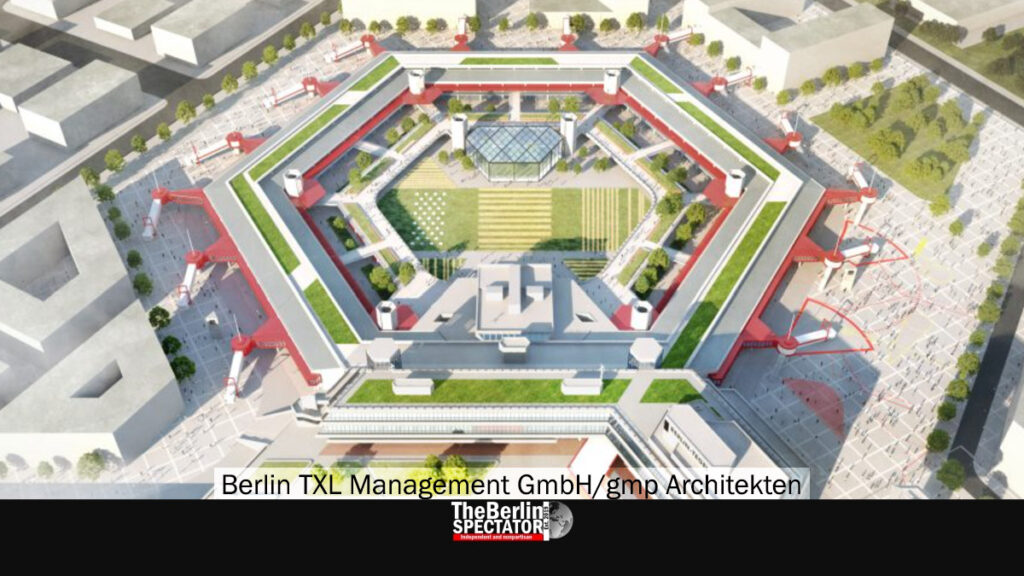
The roughly 500-hectare Berlin TXL site is being developed in three parts. Alongside the Schumacher Quartier, the plan includes the Urban Tech Republic, a research and industrial park focused on urban technologies, and the Tegeler Stadtheide, a 190-hectare landscape and nature park being developed by the state-owned company Grün Berlin. Combined, the area covers roughly five square kilometers, or the equivalent of about 700 soccer fields.
A Long Road To The First Shovel
The idea dates back to 2008, when Berlin opened up public debate over what to do with the airport site once flights stopped. What followed was more than a decade of planning: workshop processes with international teams of architects and urban planners, formal approval of the land use plan by Berlin’s House of Representatives in 2011, a binding master plan passed by the Senate in 2013, and years of participatory planning that included ten public site conferences.
Overseeing the process has been Berlin TXL Management GmbH, a company owned by the state of Berlin as well. It was founded in 2011 under the name Tegel Projekt GmbH with the task of steering redevelopment of the former airport. In 2021, once the city handed over full responsibility for the site, the company took charge of actually building both the Urban Tech Republic and the Schumacher Quartier, and preparatory construction work got underway that same year.
The company, which employs around 120 people, owns most of the land within the Urban Tech Republic and is also responsible for attracting investors, leasing space, and marketing the project. The last aircraft left Tegel in 2020, and demining and site preparation followed in the years after.
5,000 Homes, With Affordability Built In
The Schumacher Quartier is planned to eventually hold more than 5,000 apartments on 46 hectares, with an additional 4,000 units planned in the adjacent Cité Pasteur and TXL Nord areas. Between 35 and 40 percent of units are meant to be subsidized, keeping them affordable. State-owned housing companies Degewo and Gesobau will build the bulk of the homes, with cooperatives and private building groups getting a chance to apply for building plots starting in 2028.

Tegel Airport: Sixty Years Later, the Last Flight is Gone
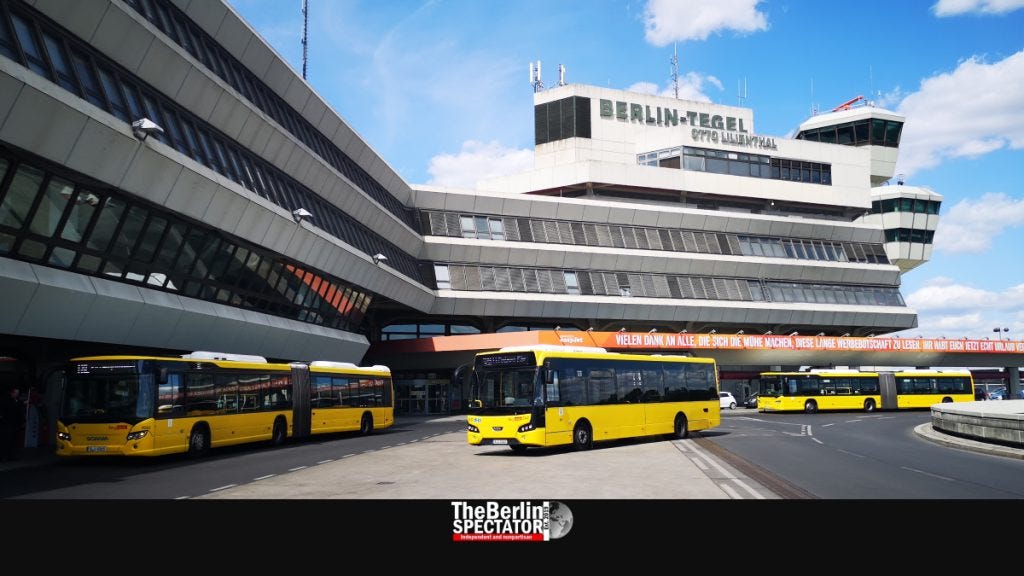
“Goodbye Tegel”: The End of Berlin’s Last Airport
The first construction phase, led by Degewo, will bring 327 apartments, 15 commercial units, and a daycare center. Actual construction is due to begin in November, with Gesobau following roughly a year later. City officials expect the first completed apartments in 2028, with move-ins starting in 2029.
Sustainability runs through much of the design. A significant share of the district is planned to be built from wood, recycled material from the demolished airport is meant to find new use on site, and the neighborhood is designed to be largely car-free, with evaporation beds built in as part of its climate-adapted, water-sensitive planning approach known as a “sponge city.”
Officials Call It A Flagship
Speaking at the groundbreaking, Governing Mayor Kai Wegner (CDU) called the milestone “long overdue.” Reinickendorf district mayor Emine Demirbüken-Wegner (CDU) went further, describing the project as a flagship not just for Germany but for Europe, citing its combination of research, business, and housing on one site, alongside the neighboring Berlin University of Applied Sciences (BHT) campus and the Urban Tech Republic.
Urban Development Senator Christian Gaebler (SPD) pointed to a shift in how Berliners view the site. “People used to envy us the airport so close to the city,” he said. “Now they envy us the large development area we have close to the city instead.”
One piece of infrastructure will lag behind, however. Frank Wolters, managing director of Berlin TXL Management, confirmed that the planned tram connection to the Schumacher Quartier is unlikely to be finished before 2034, five years after the first residents are expected to move in.
Wegner also used the event to highlight his coalition’s housing initiatives, including new laws meant to speed up and simplify construction. By the end of the current legislative period, he said, Berlin will have built roughly 80,000 new apartments, enough housing for a population close to that of Heidelberg.