

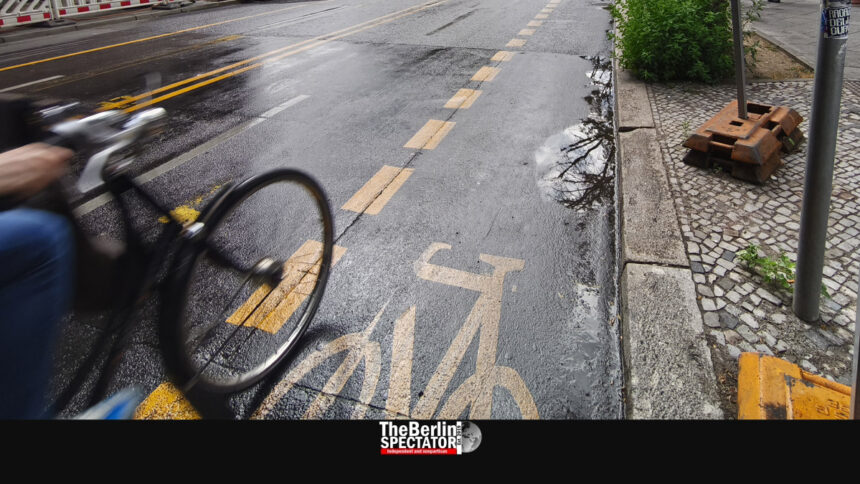
Berlin, July 24th, 2026 (The Berlin Spectator) – A years-long dispute over a pop-up bike lane on Berlin’s Kantstrasse is heading toward a new showdown, after the city’s transport authority formally put the lane’s removal out to tender this week — and an environmental group vowed to take the matter to court.
Berlin’s Transport Senator Ute Bonde, a Christian Democrat (CDU), announced this week that removal of the provisional lane in Charlottenburg would happen on short notice, according to the “Tagesspiegel” daily which interviewed her. A day later, the state-owned infrastructure company Infravelo published the tender. Companies have until August 4th to apply, with work slated to begin September 1st — just weeks before Berlin’s state parliament election later that month.
According to the tender documents, the existing bike infrastructure and traffic signage are to be removed and replaced with a bus lane that cyclists may also use, in line with newly ordered traffic signage plans. Because parts of the roadway also need repair, the project is expected to take roughly a year to complete.
Reckless, Dangerous and Illegal
Whether that will actually be the final word remains uncertain. The German Environmental Aid organization, known by its German acronym DUH, announced on Wednesday that it plans to sue once the lane is actually removed. DUH department head Robin Kulpa told the “Tagesspiegel” that a lawsuit could not be filed pre-emptively, since traffic-law orders can only be challenged once implemented. But he suggested the senator could spare herself the trouble, warning that pushing ahead risked wasting millions of Euro in public funds only to be overruled by an administrative court weeks later.
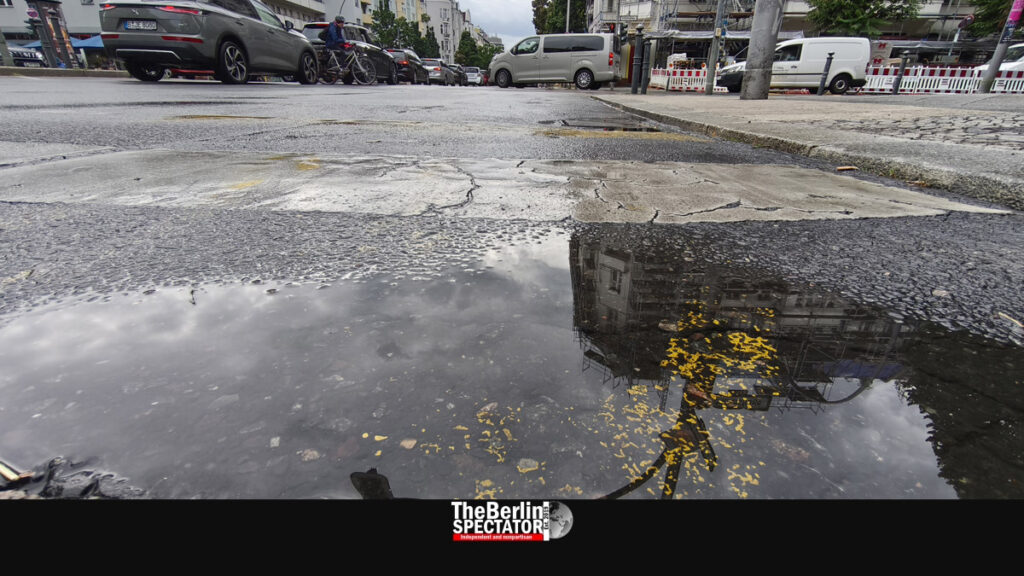
The DUH described the move as an unlawful campaign maneuver by Berlin’s Christian Democrats ahead of the election, and noted it had commissioned a legal opinion back in 2025 concluding that removing the lane would be impermissible given the volume of cyclist traffic, and that the newly planned shared bus-and-bike lane would be too narrow for both. Cycling activist Heinrich Strössenreuther was blunter still, branding the senator’s approach as reckless, dangerous and illegal.
Cyclist numbers along the corridor have roughly tripled since the lane was installed in 2020 during the pandemic, per DUH figures. At the time, it was Berlin’s longest pop-up bike lane and drew nationwide attention. Bonde, for her part, argued in the newspaper interview that a major street doesn’t necessarily need its own bike lane, suggesting cyclists could simply use the parallel Pestalozzistraße instead.
Partly Landscaped Median
The transport authority had already outlined, back in June 2025, how Kantstraße would be reconfigured: Cars and delivery vehicles would use the curbside lane, a bus lane open to cyclists would sit alongside it, and one traffic lane in each direction would remain, separated by a narrow, partly landscaped median. Berlin’s public transit operator BVG and passenger advocacy groups welcomed the planned removal, since it would give BVG buses a dedicated lane of their own along the stretch between Joachimsthaler Strasse and Wilmersdorfer Strasse.
Responsibility for removing the lane was originally meant to fall to the Charlottenburg-Wilmersdorf district authority, and Bonde had written to district officials requesting swift, cooperative implementation to finally resolve what she called a prolonged provisional arrangement. The district pushed back, however: District councilor Oliver Schruoffeneger of the Greens criticized the senate’s directive for lacking any usable detail, saying it hardly reflected proper administrative process, and accused Bonde of trying to make a political example of cyclists by forcing them to navigate unprotected between moving traffic, maneuvering delivery vehicles and drivers hunting for parking.
Does The Berlin Spectator have a newsletter? Sure. You can subscribe to it here.
The 2020 arrangement — bike lane on the right, bus lane in the middle, car lane on the left — had originally been intended as permanent and was considered ready for implementation. The dispute only began after Berlin’s 2023 change in government, when the CDU scrapped those plans in order to preserve street parking.
Flower Pots on Friedrichstrasse
According to the “Tagesspiegel”, the transport authority has also continued to cite the fire department’s concerns, arguing that the bike lane prevents ladder trucks from reaching upper floors of buildings along the street. But documents obtained by the Greens reportedly show that objection has since been debunked by traffic planners, who noted that the trucks’ support arms only need to extend toward the building side of the street.
Arguments about bike lanes and bicycle streets are common in Berlin. A few years ago, one of those was fought out within the “red-red-green” state government coalition, when the Greens insisted on turning Friedrichstrasse into a bicyle street without motorized vehicles, against the will of the Goverfning Mayor and shop owners affected by the decision. They even set up large flowerpots. Once the CDU took over Red City Hall, the project was dumped.