
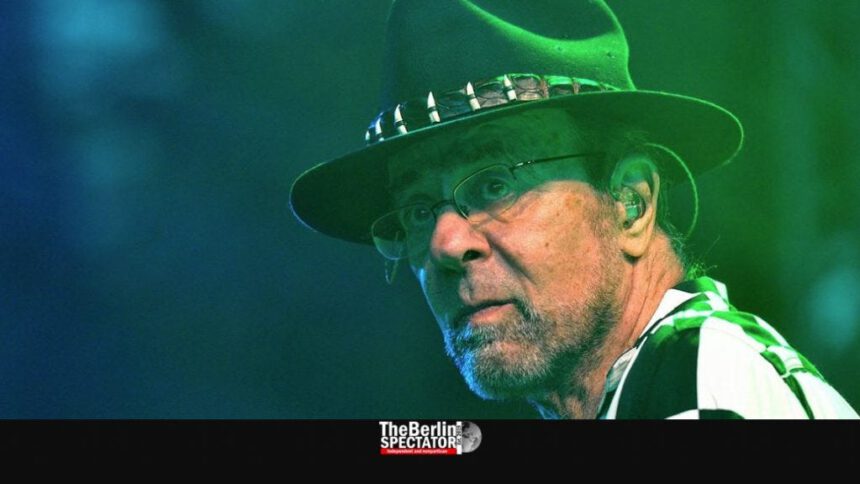
Berlin, August 16th, 2027 (The Berlin Spectator) – Manfred Sepse Lubowitz, whose parents were Jews from Lithuania, grew up in South Africa under the racist policies of the Pretoria regime known as Apartheid. Neither they nor he himself had any idea that he would conquer the world with catchy Rock hits. Soon, he will be hitting lots of German stages yet again, at age 85 and 86.
He laid the groundwork for his future life’s work while studying music at the University of the Witwatersrand. But there was a problem: racism. In an interview I recently conducted for the “Jüdische Allgemeine” weekly, Lubowitz said: “I hated South Africa. I hated that people accepted the idea that other human beings were inferior.”
In 1961, he had had enough. He left South Africa and has lived in Britain ever since, where he initially took a job writing for a publication called “Jazz News.” Because his name was too long, he chose the pseudonym Manfred Mann. That name became a brand associated with compelling Rock hits. But anyone who thinks Mann looks back fondly on those early years would be wrong.
Musicians vs. Used Car Salesmen
“I have absolutely no nostalgia for the sixties,” the musician said. “Of course I know there are people who are disappointed to hear that.” But Lubowitz has his reasons: “The parties were generally boring, because everyone was aware of which celebrities were there. But musicians aren’t really any more interesting than used car salesmen. We’re just capable of playing instruments, and we hear things differently.”
In the sixties, the decade in which Mann, as bandleader and keyboardist, recorded major hits such as Bob Dylan’s “Mighty Quinn,” there was a whole host of other problems: “The concerts were terrible, the sound systems were awful, and screaming girls drowned out the music we were playing. The working conditions were just that bad”, he told me back then.
Mann describes himself as a secular Jew. “I don’t have anything against a minimum of Jewish tradition. That can be good, but if you believe too strongly in something, it can backfire.” For Mann, it’s clear that music comes first.
Bruce Springsteen Interpretations
A good 60 years ago, Mann founded the Mann-Hugg Blues Brothers together with multi-instrumentalist Mike Hugg. The next band was simply called Manfred Mann. Despite its hits, its founder disbanded it as early as 1969. But Manfred Mann wouldn’t be Manfred Mann if he hadn’t immediately put together the next group, namely Manfred Mann Chapter Three, a project known for experimental Jazz-Rock.
Improvisation is the aspect that keeps the now-elderly Rock star interested in continuing to play his many hits: “I play solos on stage and improvise. But maybe that’s not jazz, more a kind of crossover synthesizer playing.”
Later, the rocker founded Manfred Mann’s Earth Band. With this outfit, too, he landed one hit after another — cover songs, in fact. “Spirit in the Night” and “Blinded by the Light” were written by Bruce Springsteen, “Demolition Man” came from The Police, and “Davy’s on the Road Again” from The Band. The fact that few original compositions made Mann’s list of hits, and that he sang lead on only nine songs himself, did nothing to diminish the group’s popularity.
“Tribal Connection”
Audiences flocked to see them everywhere. That remains true in Germany to this day.
In the “Jüdische Allgemeine” interview I did in 2023, Manfred Mann said his German audience wasn’t very different from fans in other countries. “Americans clap on two and four, while Germans clap on one and three. The Americans are the ones who do it right.” Generally speaking, the audience has gotten older, “like all of us.”
Among the countless countries where Manfred Mann’s Earth Band has performed over the past decades is Israel. “Our audience there consists mainly of Russian Jews. But to me, a concert is a concert. I don’t feel any closer connection, because those concerts weren’t any different from shows we’ve done elsewhere.” What matters, he says, is whether the band plays well and whether the audience’s expectations are met. “My ‘tribal connection’ mattered far less at the concerts in Israel than the music did.”
After well over six decades on stage, Manfred Mann remains modest: “I’m an unusual synthesizer player, not the best, but I have a certain style. Although I’m not sure whether I’ve influenced younger generations of musicians.” Asked how he still manages to bring Rock and action to the stage at his age, Mann answers simply: “I do balance exercises.”
Manfred Mann will be performing in Hanau on September 12th, 2027. An additional 27 gigs will be happening in Aschaffenburg, Magdeburg, Beverungen, Schwerte, Köln, Stuttgart, Bad Kissingen, Neustadt, Osnabrück, Coesfeld, Krefeld, Memmingen, Augsburg, München, Wiesbaden, Duisburg, Bremen, Chemnitz, Leipzig, Jena, Neu-Ulm and Arbon. In Hamburg, Nuremberg, Ingelheim, Worpswede and Oldenburg, Mann’s upcoming shows are already sold out. All dates and tickets can be found here.