


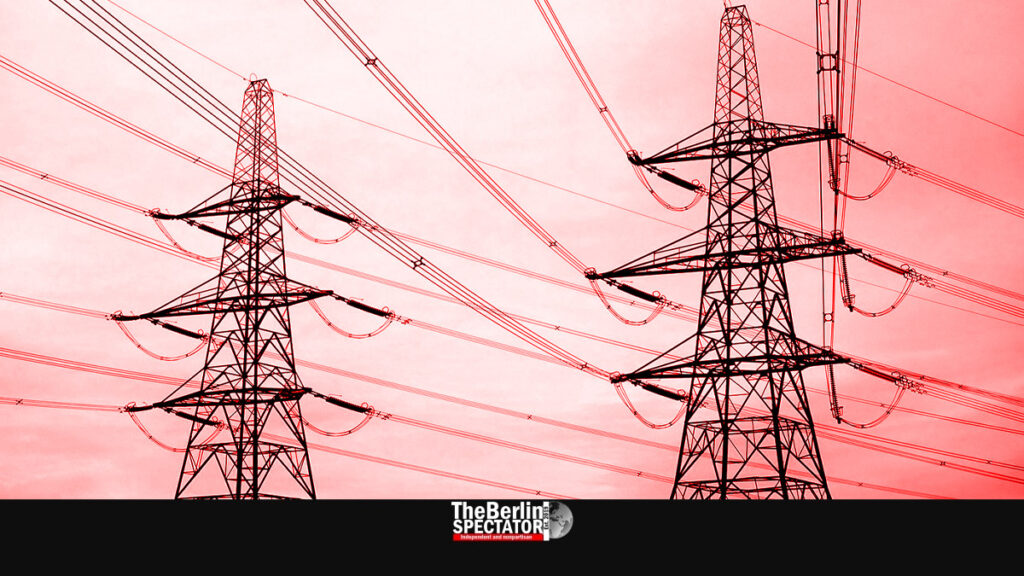
Berlin, September 6th, 2026 (The Berlin Spectator) – German police are intensifying their search for a man suspected of carrying out a string of sabotage attacks on the country’s electricity network. The incidents have hit North Rhine-Westphalia, Brandenburg, and most recently Saxony, all regions where lignite coal is still mined and burned for power.
Police and prosecutors in Brandenburg and North Rhine-Westphalia issued a joint appeal Friday afternoon, releasing two photos of the 48-year-old suspect and asking the public for tips.
Officers had found explosives at the suspect’s apartment in Gevelsberg, North Rhine-Westphalia, on Friday. Later that day, a special police unit stormed a truck that had apparently been converted into a camper, parked in a forest near Niederzier, roughly 100 kilometers away. The man was not found inside.
The investigation was triggered by two letters claiming responsibility, sent to several media outlets. Federal Interior Minister Alexander Dobrindt of the CSU said the details revealed in the letters clearly point to knowledge only the perpetrator would have.
Suspected Motive
Dobrindt said the likely motive was “climate terrorism” carried out by a lone individual. One of the letters reportedly states that generating electricity from fossil fuels is a crime.
North Rhine-Westphalia’s Interior Minister Herbert Reul of the CDU pushed back hard on that reasoning, saying that anyone who endangers hospital power supplies in the name of climate protection is not saving anything but putting lives at risk. No ideology, he added, justifies this kind of act.
Investigators have noted that the affected sites all lie close to active lignite mining areas. According to the industry association Debriv, open-pit coal mining in Germany continues in North Rhine-Westphalia, in southern Brandenburg and Saxony-Anhalt, and in eastern and western Saxony.
First Incident: Southern Brandenburg
The wave of attacks began Tuesday morning in southern Brandenburg. According to German-language publications, more than 20 homemade rocket devices were fired toward high-voltage lines at the Turnow-Preilack substation, near the Jänschwalde power plant, in an apparent attempt to send conductive material into the lines. Two short circuits resulted, though the grid operator confirmed no power outage occurred. Police are investigating the case, among other things, as the formation of a terrorist organization.
Second Incident: Near Cologne
That same evening, a substation in Bergheim, near Cologne, suffered a disruption. Launch devices and pyrotechnics were again found at the scene. Energy company RWE Power reported that five lignite-fired power units at its Niederaußem and Neurath sites were knocked offline. Most came back online shortly after, though one is not expected to resume operation until the following week. The general power supply, RWE said, was never at risk.
Further Incidents in North Rhine-Westphalia
On Thursday evening, a passerby spotted suspected launch devices at a substation in Dormagen, between Cologne and Düsseldorf, and alerted police. Following a lead from one of the letters, police also searched the area around the Weisweiler power plant near Aachen on Friday.
Friday evening brought a large police operation at a power facility in Hamm, with numerous patrol cars and a helicopter deployed near a stretch of rural road by a forest. A police spokesperson later clarified that the facility in question was a former installation that had been out of service for some time.
New Case in Saxony
Police also uncovered twelve explosive devices near high-voltage lines in eastern Saxony. Security officials said the devices were designed to damage the lines by triggering a short circuit. They were discovered south of the Bärwalde substation near Lippen and east of the Graustein substation near Schleife, both in the Lusatian lignite region near the Brandenburg border.
A major police operation had already taken place in the region on Friday, prompted by information shared across agencies and a tip from an alert resident. Police and the Dresden public prosecutor’s office said they are now examining a possible connection to the earlier cases in Brandenburg and North Rhine-Westphalia. The operation is ongoing.
Calls to Better Protect Infrastructure
Interior Minister Reul called for stronger protection of critical infrastructure in response to the attacks, saying this requires clear legal authority along with modern technology such as cameras, sensors, and alarm systems.
Critical infrastructure refers broadly to sectors whose disruption or failure could trigger supply shortages, threaten public safety, or cause other serious consequences, including energy, information technology, transportation, health care, water, food supply, finance and insurance, government administration, and media.
“We’re Making It Too Easy for Attackers”
Christoph Müller, head of transmission grid operator Amprion, argued that current transparency rules work against grid security. He told the Rheinische Post that utility companies are required to publish extensive data about power and gas networks, making it unnecessarily easy for attackers, regardless of their motive, to plan such acts. He called for looser transparency requirements and permission to regularly monitor lines by drone, as well as the right for companies to use cameras to observe not just their own premises but the surrounding area.
Amprion is one of four major transmission grid operators in Germany, active mainly in the west and southwest. The company says its network spans roughly 11,000 kilometers of high-voltage lines from the North Sea to the Alps, crossing seven federal states, including North Rhine-Westphalia.