


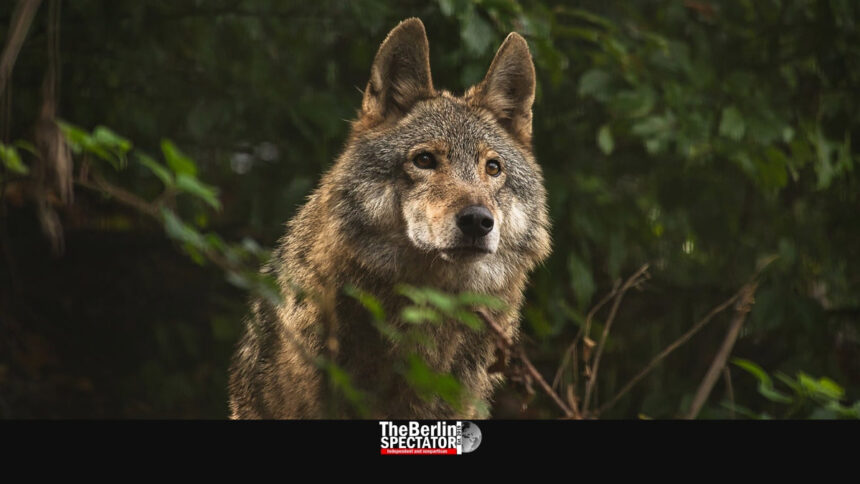
Berlin, November 12th, 2026 (The Berlin Spectator) – Brandenburg will make it easier to shoot wolves that attack farm animals. The state government presented its new wolf management plan on Wednesday in Potsdam, according to local media. A general order implementing the plan is set to take effect on November 19th. It will allow up to ten wolves per year to be killed in so-called intervention zones surrounding a location where livestock were attacked. Brandenburg is the third German state to adopt a new approach to wolf management, following Hesse and Lower Saxony.
Agriculture and Environment Minister Hanka Mittelstädt (SPD) stressed that wolves remain a protected species. Where they get past adequate herd protection, however, the animals can be removed, meaning killed by hunters. Mittelstädt, who is a hunter herself, said she would shoot a wolf personally if it became necessary. Each year, authorities will set the maximum number of wolves that may be killed in areas with herd protection after confirmed damage. The animal that is shot does not have to be the one that caused the harm. Once the cap is reached, districts may order additional kills.
Does The Berlin Spectator offer a newsletter? Sure. Subscribe to it here.
According to the ministry, Brandenburg is currently home to at least 50 wolf packs with five to ten animals each, nine pairs and three territorial loners. The first pack in recent times was documented there about 16 years ago. Frank Plücken, who heads the ministry’s hunting department, estimated the total population at 700 to 900 animals. Under the previous rules, 15 wolves were cleared for shooting in recent years, but only five were actually killed. Plücken said Brandenburg was long the leading wolf state in Germany, but Lower Saxony now holds that position.
Effective and Practical
Attacks on livestock have dropped considerably in Brandenburg. Officials recorded 358 cases in 2023 and 178 in 2025. Through the end of September this year, the count stood at 133. Most incidents occurred in areas without herd protection. Since 2016, the state has provided roughly 7.8 million euros for protective measures and paid about 1.2 million euros in compensation for killed animals.
The State Hunting Association called the cap too low and pushed for a stronger reduction of the wolf population. Its president, Dirk-Henner Wellershoff, described the plan as a “first step”, according to the radio and TV broadcaster RBB, but one that falls well short. He said the state needs management that prevents damage instead of reacting to it, and that removing individual problem animals is not enough.
Brandenburg Eases Rules for Shooting Wolves

Wild Boars Invade Berlin Gardens

Asian Hornet Sighting in Berlin’s Neukölln District
The European Union downgraded the wolf’s protection status in 2025. Since April 2nd of this year, changes to the Federal Hunting Act and the Federal Nature Conservation Act have placed the animal under federal hunting law. The state says it will continuously review how effective and practical the new measures are.
Nationwide, wolf attacks on livestock up fivefold in ten years
Wolves killed 3,783 farm and enclosure animals in Germany last year, five times as many as in 2015, when the figure was 737. This was reported by the Federal Center for Agriculture (BZL), which relied on data from the federal documentation and advisory center on wolves (DBBW). Sheep made up the vast majority of victims with 3,167 animals. Wolves also killed 303 enclosed deer, 166 cattle and 110 goats. Horses and alpacas were among the victims as well, with 37 animals in total.
Lower Saxony recorded the most livestock kills last year with 970, up from 237 a decade earlier. According to the BZL, the state also has more resident wolves than any other in Germany.
The latest figures do show a decline, however. Compared with 2024, the number of wolf attacks on livestock fell by 11 percent nationwide, and the number of animals harmed dropped by 13 percent, the DBBW said in its report on prevention and livestock damage. This put the damage level below that of 2022. The trends differ widely between states and can vary even within a single one.