



Berlin, July 13th, 2026 (The Berlin Spectator) – There are plenty of reasons to develop worries, including Vladimir Putin’s war of aggression against Ukraine, the situation in the Middle East and the rise of the extremist right-wing AfD. On top of it all, there is the oak processionary moth. Its name may sound cute, but it isn’t.
Germany’s recent stretch of hot, dry weather has been good news for beachgoers and gardens alike—but it has also given an unwelcome boost to one of the country’s most disliked insects, namely that moth with the long name. In German, it is know as the Eichenprozessionsspinner. Authorities in several states are now dealing with a wave of infestations that has triggered closures, pesticide operations, and public health warnings.
The moth, scientifically known as Thaumetopoea processionea, thrives in warm, dry conditions, according to Germany’s Federal Environment Agency, the Umweltbundesamt. Native to southeastern Europe, the species was rare in Germany just a few decades ago. It has since spread steadily northward, a trend the agency links to climate change and increasingly mild spring temperatures.
Not Just a Nuisance
The moth itself, a grayish-brown nightflyer with a wingspan of roughly one to one-and-a-half inches, poses relatively little threat to humans. Its caterpillars are another story. Once they reach their third larval stage, they carry tens of thousands of microscopic, barbed hairs loaded with a urticating toxin. Contact with the hairs, whether direct, airborne, or even through standing water such as garden ponds, can trigger painful skin rashes, eye irritation, and respiratory problems, including asthma attacks. Sensitivity tends to worsen with repeated exposure, and the toxin can remain active for years after the hairs have detached from a caterpillar or an abandoned nest.
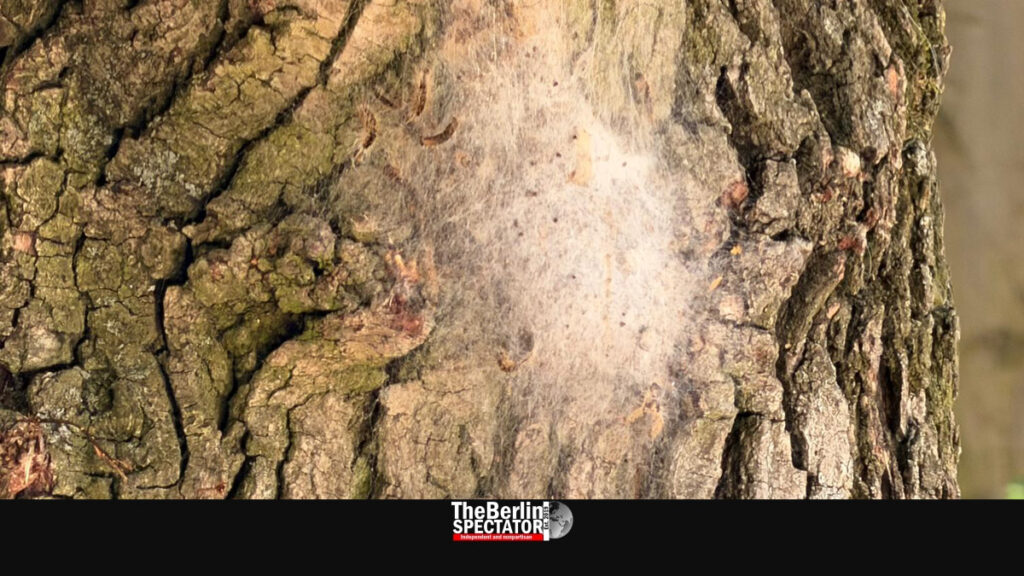
The insects are easy to misidentify. Bag-shaped webbing that colonizes shrubs and trees is often mistaken for oak processionary nests, but that webbing is usually the work of ermine moths, which pose no health risk and feed on a wide range of trees and shrubs rather than almost exclusively on oak. Oak processionary nests, by contrast, are more compact, cling to tree trunks or forks in the branches, and house caterpillars that travel in long, orderly, head-to-tail columns as they move between their daytime shelters and the oak foliage they feed on at night.
Closures in the Spreewald
The scale of this year’s outbreak has caught officials off guard in multiple regions. In the southwestern state of Baden-Württemberg, part of the shoreline at Lake Waidsee was cordoned off after heavy infestation was discovered nearby. Farther east, in Mecklenburg-Hither Pomerania, Saxony-Anhalt, and Brandenburg, teams have sprayed a bacteria-based insecticide over hundreds of hectares of forest from helicopters, while playgrounds, cemeteries, and sports grounds elsewhere have received targeted, preventive treatment on affected oaks. Leipzig has turned to parasitic nematodes as a control method in city parks this year, and other municipalities are vacuuming nests directly off infested trees.
One of the more disruptive measures has unfolded in the Spreewald, a UNESCO biosphere reserve in Brandenburg known for its network of canals. State broadcaster RBB reported that Brandenburg’s infrastructure minister, Robert Crumbach, said several waterways there could stay closed to boat traffic through late July or early August because of the severity of the infestation. About eleven waterways, roughly half of the navigable channels in the lower Spreewald, are affected, according to the state transport authority, which ordered the closures to protect both visitors and forestry workers from the caterpillars’ hairs. Storm-damaged and unstable trees along the banks have compounded the risk, since crews cannot safely remove hazardous branches while the caterpillar hairs remain airborne, leaving boaters exposed to the danger of falling limbs as well.
Brandenburg’s government said the outbreak has been unusually severe this year and attributed the surge to the changing climate. Even on waterways that remain open, visitors are being urged to wear long clothing, avoid contact with any visible nests, and generally exercise caution.
Does The Berlin Spectator have a newsletter? Sure. You can subscribe to it here.
Rising Numbers Farther North
The pattern is not confined to Berlin and Brandenburg. In Hamburg, environmental officials say caterpillar sightings have climbed noticeably this year, prompting nest removals in high-traffic areas such as playgrounds and bus stops. A spokesperson for the city’s environmental authority said there is no formal monitoring system in place, but that district offices assess each reported infestation individually and prioritize action based on risk.
In more open green spaces, such as Hamburg’s Altonaer Balkon park, officials have opted for visible barriers and warning signs rather than full nest removal. The city’s environmental agency noted a steady, gradual increase in oak processionary numbers over recent years, though it said this year’s infestation still lags behind harder-hit, drier regions such as Berlin.
According to the conservation group NABU, the species’ range keeps expanding northward as the climate warms. A comprehensive, real-time national picture of the infestation does not exist. Environmental officials in Hamburg say a fuller accounting of affected tree stocks typically only becomes available in late summer, after the caterpillars have pupated into adult moths.
For now, health authorities across the country are repeating the same core advice: Stay away from marked or visibly infested oak trees, avoid direct contact with the caterpillars or their nests, and seek medical attention if a rash, breathing difficulty, or eye irritation develops after possible exposure. Antihistamine treatment based on cetirizine has been shown to significantly ease the itching and skin irritation caused by contact with the hairs.
The Berlin Spectator
https://berlinspectator.com/
Newsletter: Subscribe here
Our sister website (in German):
Berlin Minus
https://berlinminus.de/