

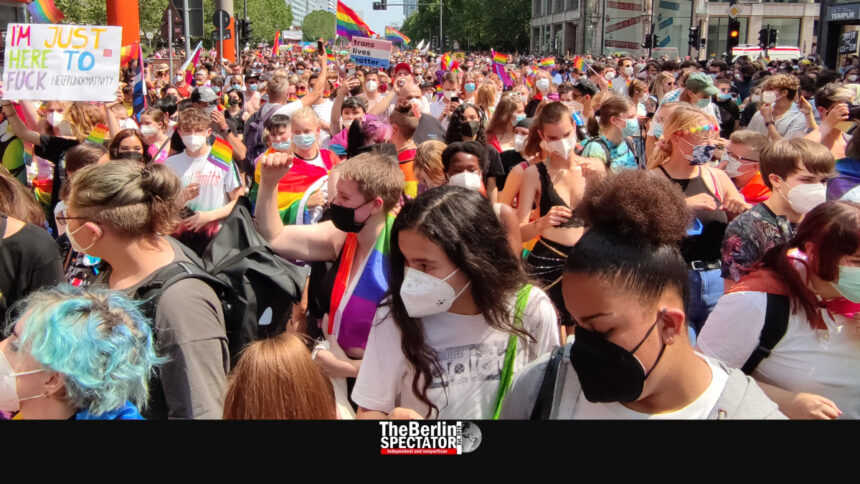
Berlin, July 17th, 2026 (The Berlin Spectator) – Berlin is preparing for what organizers are calling the largest Christopher Street Day in the city’s history, as the annual pride celebration expands to a two-day format for the first time this year, running Friday, July 24th, through Saturday, July 25th.
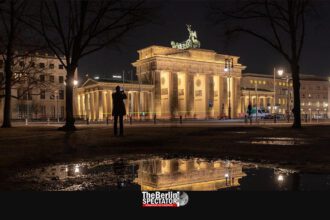
The festivities open Friday evening with what organizers are billing as a “democracy evening” in front of the Brandenburg Gate, running from 6 p.m. to 11 p.m. and featuring artistic performances alongside political speeches. The evening kicks off at 5 p.m. with a drag march, organized by the Order of the Sisters of Perpetual Indulgence together with Travestie für Deutschland, a nod to the long-running tradition of the New York Drag March.
The main event follows on Saturday, when the CSD parade winds through the capital along a route that has become familiar in recent years: Starting at noon at the corner of Leipziger Straße and Charlottenstraße, the march proceeds via Potsdamer Platz, Bülowstraße, and Nollendorfplatz to the Urania, then on to the Victory Column before reaching its final destination on Straße des 17. Juni in front of the Brandenburg Gate, where a closing rally and the Pride Village await.
“Having Backbone is Hot”
Thomas Hoffmann, a board member of Berlin’s CSD organization, said this week he expected hundreds of thousands of participants, roughly on par with recent years, when the march typically drew close to a million people along its route.
Does The Berlin Spectator have a newsletter? Sure. You can subscribe to it here.
This year’s slogan, “Haltung ist hot,” roughly translating to “having backbone is hot”, reflects a deliberate push by organizers to link the celebration to Berlin state election, scheduled for September 20th. The campaign is aimed in particular at younger voters, notably 16- and 17-year-olds, who will be eligible to vote in a state election for the first time. Organizers describe the slogan as a direct response to rising hostility toward queer people and mounting pressure on democratic values more broadly.
Ahead of the election, Berlin’s CSD has laid out six core demands for the next state government. They include backing for a Berlin bid to host WorldPride in 2032, protection and expansion of queer spaces and infrastructure, stronger safety measures against anti-queer violence, greater visibility and diversity in schools, expanded queer-competent health care services, and long-term funding guarantees for major queer events and the organizations behind them.
Stonewall Uprising
Christopher Street Day traces its name and origins to the Stonewall uprising of June 27, 1969, when patrons of the Stonewall Inn on Christopher Street in New York’s Greenwich Village resisted a police raid, touching off days of unrest that are widely regarded as a foundational moment for the modern LGBTQ rights movement.
Berlin held its first CSD, then known as Gay Pride, on June 30th, 1979, when roughly 450 demonstrators marched through West Berlin in what was described as a lighthearted, largely untroubled atmosphere, a notable contrast to the hostility that had marked earlier such gatherings. Admission to both days of this year’s event is free.
While the CSD is about tolerance, some participants in last year’s parade in Berlin did not want to grant it to another minority, namely the Jews. In late July of 2025, police ended a protest staged by antisemites and supporters of the Palestinian terror, even though the Hamas prosecutes and even murders gays (which is why critics call “Queers for Palestine” and similar groups “chickens for KFC”). Jewish CSD participants say they were excluded from the parade. Activists chanted slogans that were hostile to both Jews and Israel.
The English version of Berlin’s CSD website can be reached here.
The Berlin Spectator
https://berlinspectator.com/
Newsletter: Subscribe here
Our sister website (in German):
Berlin Minus
https://berlinminus.de/