

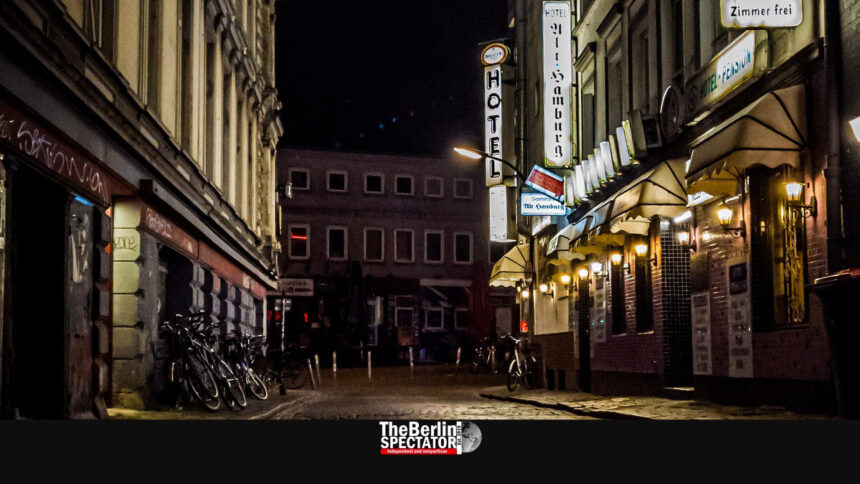
Berlin, July 28th, 2026 (The Berlin Spectator) – Hamburg’s most famous street was not born as a den of vice. It started out as a workplace for men who twisted rope for a living, and it took two more centuries before anyone thought to strip down on a stage there.
Around 1630, Hamburg’s rope makers, known as Reepschläger, packed up their tools and moved out of the city to a suburb called Hamburger Berg. Their old workspace near today’s Landungsbrücken had simply become too cramped. Making ship rope up to 300 meters long required long, straight stretches of land, called Bahnen, and the city center could no longer provide them.
So the rope makers set up shop just outside Hamburg’s gates, on a strip of land that would much later take their name: the Reeperbahn. Confusingly, the street did not actually carry that name yet. For a while it was called Altonaer Allee, and the “Reeperbahn” label only stuck once the road was properly laid out around 1820.
A Suburb Nobody Wanted
The area’s story goes back even further than the rope makers. Around 1247, a Cistercian convent settled near today’s Fischmarkt, giving the region its original name, Hamburger Berg, after a ridge that rose like a small hill. The nuns didn’t stay long, and by the early 1600s, the neighborhood had become something else entirely: a landing spot for people the city didn’t want inside its walls.
When Hamburg built its massive fortifications between 1616 and 1625 to protect itself from the ravages of the Thirty Years’ War, the area just outside the new walls was officially supposed to stay empty, kept clear for defensive sightlines. Naturally, that’s exactly where the unwanted crowd ended up.
Innkeepers, prostitutes, entertainers and a hospital for plague victims and the mentally ill all set up in the no man’s land beyond the gates, alongside craftsmen whose trades were too smelly, loud or messy for the city proper. The rope makers fit right in.
From Rope Yards to Red Lights
By the 1600s, the neighborhood already had a taste for entertainment, with a market square and fairground drawing crowds. Things picked up in the 1700s as city dwellers discovered the pleasure of a stroll along the fortress walls. In 1805, a wooden pavilion called the Trichter opened near the Millerntor gate, named for its distinctive funnel-shaped roof, and quickly became a favorite spot for light refreshments and even lighter entertainment.
Then Napoleon showed up. Under French occupation from 1806 to 1814, the neighborhood’s residents were ordered in December 1813 to clear out of their homes within four days. A French general leveled the entire suburb for military reasons, and in three days, 484 buildings and nearly 300 wooden stalls burned to the ground, the Trichter among them. Remarkably, the rebuilding happened fast.
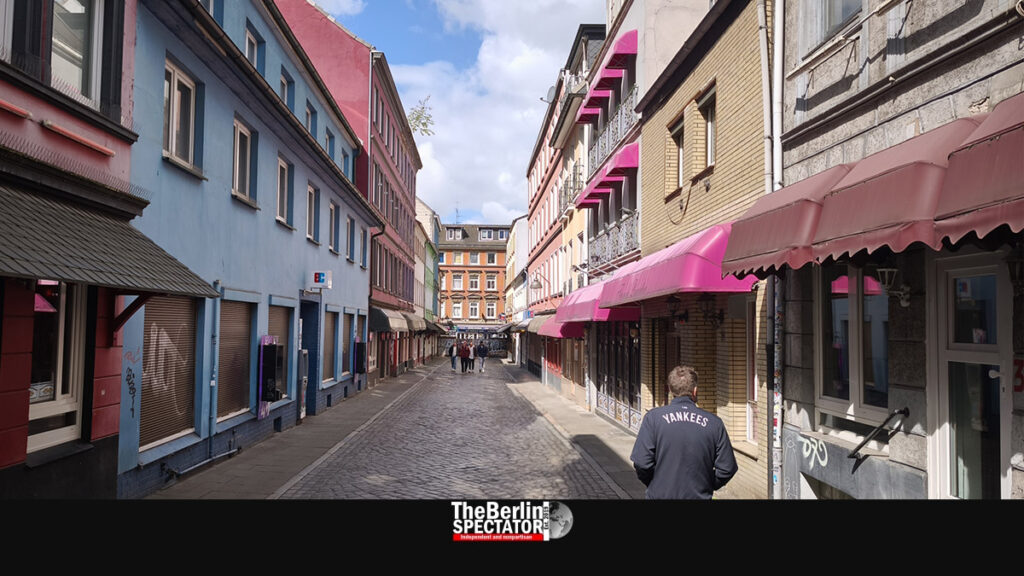
By 1820, the district looked better than before the fire, complete with snake charmers, animal tamers, ventriloquists, dance halls and reopened brothels. The Trichter itself rose again too, this time lit by oil lamps and centered around an enormous copper stove that served as its pride and joy.
The Roaring Twenties
In 1833, the suburb was officially renamed St. Pauli, after its church, though the old street name stuck around. It took until 1861 for Hamburg to lift its nightly curfew at the city gates, and once the Millerntor stayed open around the clock, the Reeperbahn’s nightlife really took off. Workers, dockhands, carpenters and traders filled the streets, and by 1894, when St. Pauli officially became part of Hamburg, roughly 72,000 people called the old Hamburger Berg home.
The interwar years brought the Reeperbahn its first golden age of glamour and scandal. The Alkazar theater, which opened in 1925, was the talk of the town, with stage sets that changed every fifteen minutes and a nightly grand finale featuring a giant chandelier lowered onto the stage covered in scantily clad performers. Meanwhile, at the Trichter, international stars like Josephine Baker performed, and Jazz began creeping into a scene that had until then been dominated by German cabaret tunes.
World War II hit the district hard. The 1943 bombing campaign known as Operation Gomorrha devastated the area, and it took until the 1950s and 60s for the Reeperbahn to find its footing again, helped along by a wave of foreign acts, most famously a scrappy young band from Liverpool.
Beatles, Bombs and the Bad Old Days
The Beatles played the Star-Club, the Kaiserkeller and the Top Ten Club nearby before anyone outside Hamburg had heard of them, and the area around Grosse Freiheit still carries their name today. But the Reeperbahn’s postwar reputation wasn’t all rock and roll nostalgia.
The 1970s and 80s brought a genuinely dark chapter, with turf wars between pimps, drug trafficking, contract killings and the notorious serial killer Fritz Honka giving St. Pauli a reputation as a byword for violence. Add the arrival of AIDS and the rise of internet pornography, both of which hurt business along the strip, and it’s no surprise that well into the 1990s St. Pauli ranked among the poorest neighborhoods in Europe.
The district has worked hard since then to reinvent itself while keeping its rebellious streak intact. The central Spielbudenplatz square went through decades of failed redevelopment attempts, including cramped 1960s pavilions that turned into a hygiene and safety headache, before the city finally settled on a proper redesign in 2004, unveiled in 2006 at a cost of 9.7 million Euro.
Showcase for New Music
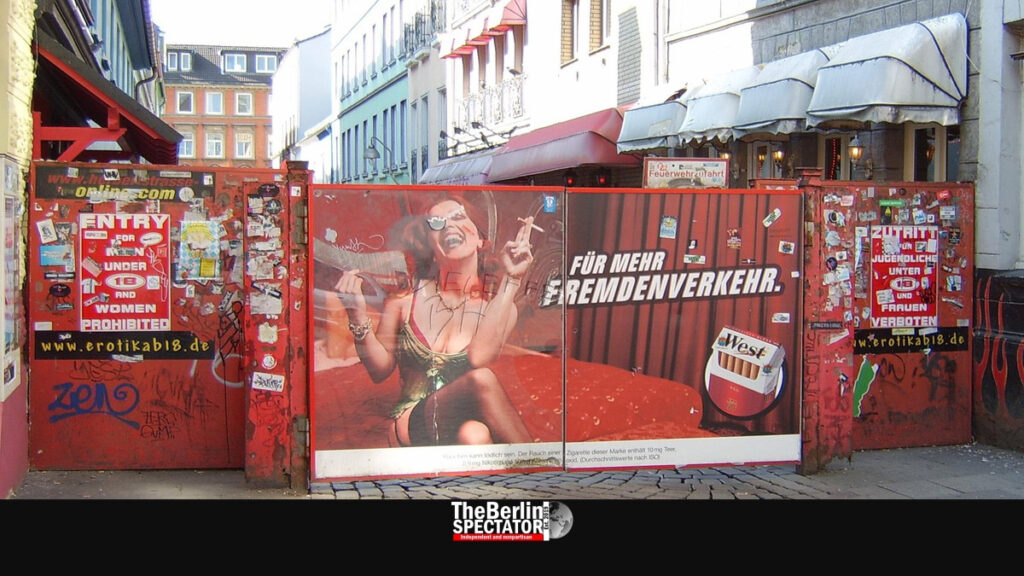
Today the Reeperbahn stretches about 930 meters from the Millerntor to the Nobistor, still lined with bars, clubs and the notorious Herbertstraße brothel alley tucked just out of view.
Musician Udo Lindenberg has his own star embedded in the pavement, modeled on the Hollywood Walk of Fame, and the annual Reeperbahn Festival has turned the old red-light strip into one of Europe’s bigger showcases for new music. A weapons ban imposed in 2007 and a glass bottle ban added in 2009 have tried, with mixed results, to calm things down.
Four hundred years after the rope makers arrived looking for nothing more exciting than open space to twist their ship lines, the street they left behind has become one of the most storied party miles in the world. Not bad for a neighborhood that started out as the place nobody else wanted.