

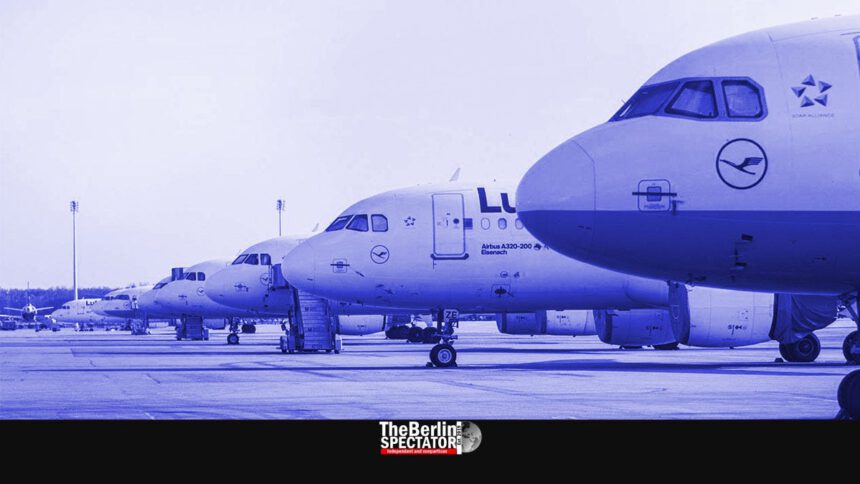
Berlin, August 5th, 2026 (The Berlin Spectator) – Costly kerosene and strikes by the airline’s own crews took a toll on Lufthansa’s early summer business. Despite higher ticket prices, the group’s adjusted operating profit for the second quarter collapsed by 56 percent to 383 million Euro, the company reported. Passengers shouldn’t expect cheaper fares in the second half of the year either.
CEO Carsten Spohr now says a decline in full-year profit can’t be ruled out. In its revised guidance, the MDax-listed group now projects an adjusted operating profit of between 1.7 and 2.2 billion Euro — down from earlier expectations that it would clearly exceed last year’s 1.96 billion Euro. Lufthansa shares dropped sharply after the figures were released.
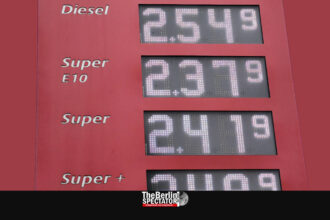
The company said the war in Iran drove up its kerosine bill by roughly 750 million Euro in the second quarter alone, even though more than 80 percent of its fuel needs were hedged through financial instruments.
Smaller Profit Decline
Strikes by sectoral unions around the airline’s 100th-anniversary celebrations in April cost the company an additional 150 million Euro. The technical-services and cargo divisions, by contrast, again contributed positively to the results. European rivals Air France-KLM and IAG (British Airways’ parent) reported smaller profit declines by comparison.
CFO Till Streichert said roughly 60 percent of the higher fuel costs had been offset through higher ticket prices, and fares are expected to keep rising in the second half of the year — even as customers increasingly book at shorter notice.
Spohr suggested the travel market has proven less price-sensitive than the industry expected: “People want to fly, and they can afford it even at higher prices.”
Fuel Supply Situation Eases
Spohr said the fuel-supply crunch triggered by the outbreak of war had eased over recent weeks, as refineries ramped up capacity and new supply chains — including from Nigeria — came online.
“The world has adapted and gotten the challenge under control,” Spohr said, adding that the risk of flight cancellations due to fuel shortages had further diminished. Even so, full-year fuel costs are still expected to rise to 8.7 billion Euro — though that’s 200 million Euro less than the airline projected back in May.
Lufthansa did benefit from the Iran war in one respect: Middle Eastern rivals such as Emirates and Qatar Airways had to temporarily shut down their Gulf hubs during the fighting, driving significantly higher ticket revenue for European carriers on Asian routes.
Now that the Gulf carriers are flying at full capacity again, Spohr said, they’re competing aggressively on price — a strategy aimed mainly at price-sensitive leisure travelers, while business customers continue to prefer direct connections. Many companies also bar their managers from booking layovers in the Gulf region.
Long-Haul Growth Ahead
Looking forward, the Lufthansa Group wants to focus growth on long-haul routes. The airline is currently weighing a further one-percent cut to its European flight offerings. Total capacity is now expected to stagnate this year, a sharp reversal from the board’s original guidance of growth up to 4 percent.
Amid the strikes, the group shut down its regional subsidiary Lufthansa CityLine earlier than originally planned, scrapping around 20,000 European flights from the summer schedule. Partly as a result, the number of passengers group-wide fell four percent to 35.6 million.
Quarterly revenue nonetheless climbed eight percent to 11.1 billion Euro. Net profit, however, collapsed by 88 percent to 123 million Euro — a drop also driven by a favorable tax effect in the prior-year period and current-year charges.