


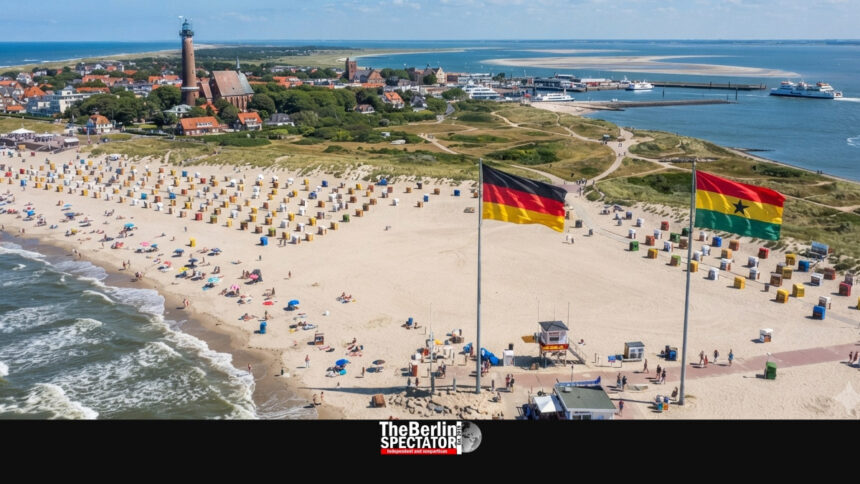
Berlin, August 7th, 2026 (The Berlin Spectator) – For close to a quarter of a century, Nancy Mensah was part of the fabric of Borkum, the small North Sea island off Germany’s coast. She held down a steady job at a rehabilitation clinic, paid her taxes and social security contributions, cared for a partner with a disability, and was, by all accounts, woven into the island’s community. On July 14th, none of that mattered to the authorities. She was deported to Ghana, as local and regional dailies reported.
The Leer district’s immigration office had rejected Mensah’s application to extend her residence permit back in February, citing a lack of legal grounds. After a deadline for voluntary departure passed and an urgent appeal to the Oldenburg Administrative Court failed, police came for her the following day, July 13th — reportedly picking her up at home just after she had returned from work to look after her partner.
According to reports from the outlet “Borkum Aktuell”, she was given no chance to say goodbye to her partner, her employer or her friends before being taken to the mainland and put on a flight out of the country. She is now staying with her sister near Kumasi, without a working bank card, an income, or health insurance, and dependent on financial support sent from Germany.
Room to Maneuver
Officials have maintained that neither her length of residence, her employment, nor her long-term relationship — including a planned but not yet finalized marriage — amounted to a legal basis for her to stay.
The response from advocacy groups has been sharp. The Refugee Council of Lower Saxony called the deportation impossible to justify “even if it may have been legally permissible,” arguing the district had room to maneuver and could have opened a path for Mensah to stay rather than remove her. The organization is now pushing the state government to review the case and to set binding rules for how authorities handle people who have lived in the region for years — supporting them toward secure residency rather than deporting them.
Andreas Behr, editor-in-chief of “Borkum Aktuell”, opened his own commentary on the case by invoking a line from the German rock band Die Toten Hosen — that anyone who has lived somewhere long enough should be allowed to stay — to capture his dismay at what he called the district’s ruthless handling of the case.
Professional and Social Integration
Locally, the fallout has been just as pointed. Christina Schmock, head of the Kur & Reha Borkum clinic where Mensah worked in cleaning and housekeeping for years, said losing an experienced, well-integrated employee was a particular blow given how hard the island already struggles to find workers. Borkum’s Greens described the deportation as a “fatal signal” and a failure of policy, while the local Social Democrats called for residence law to give more weight to professional and social integration.
The practical consequences fell hardest on the people Mensah left behind. Her partner, who has health limitations of his own and lives on a small pension, is now relying on relatives and friends to help manage day-to-day life, and the couple’s shared apartment may not be sustainable without her income. Whether Mensah has any further legal claim to residency in Germany remains unresolved — while the emergency motion against her deportation failed, the main proceedings in her case are still pending. It’s also unclear whether the district properly informed her of her right to apply for a hardship case exemption before carrying out the removal.
Supporters have since launched a fundraiser, aiming to raise 5,000 Euro to cover legal costs and explore whether Mensah and her partner might marry in Ghana — a step that could eventually open the door to her return to Germany through family reunification.