


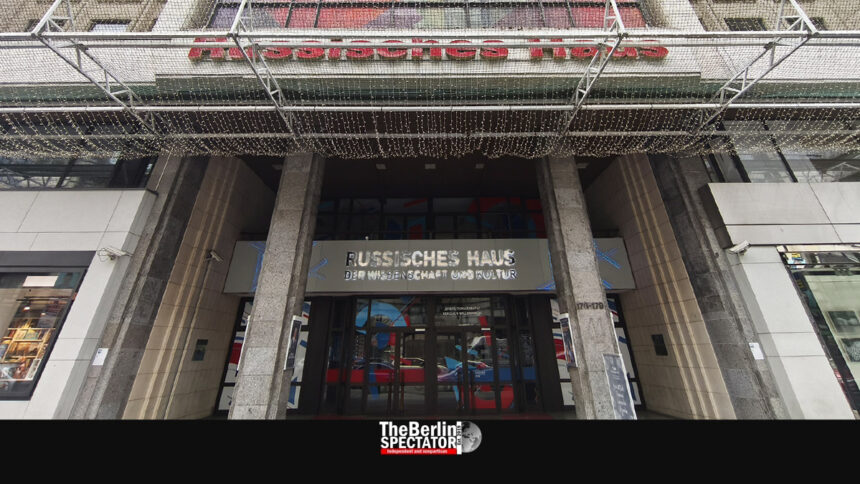
Berlin, August 18th, 2026 (The Berlin Spectator) – The Russian House of Science and Culture in Berlin, long viewed with suspicion by security experts, is facing renewed political pressure after a French intelligence assessment described the building as cover for Russian intelligence operations.
According to documents obtained by broadcaster WDR and the “Süddeutsche Zeitung” daily, France’s Interior Ministry made the claim in an expulsion order against Xenia Fedorova, the former head of the French branch of Russian state broadcaster RT. Paris regards the 45-year-old as a Kremlin propagandist who has spread disinformation aimed at dividing European societies. A French court has upheld the government’s decision to expel her and freeze her assets for six months.
The ministry’s order states that Fedorova recently sought the directorship of the Russian House in Berlin. It goes further, alleging that the institution “is used as cover by Russian intelligence services.”
Escalating Controversy
The Russian House, opened in 1984 on Berlin’s Friedrichstrasse, has drawn scrutiny for years. It is run by Rossotrudnichestvo, a Russian government agency under the Foreign Ministry that the European Union sanctioned in 2022 over Moscow’s invasion of Ukraine. The agency has been accused by the EU of promoting the Kremlin’s hybrid influence abroad, including the organization of pro-Russian rallies in Germany.
The institution describes itself as a cultural center that introduces German visitors to Russian culture and helps Russians living in Germany maintain their national identity. Reached for comment, its management insisted on the center’s purely cultural character, pointing to a bilateral agreement between Berlin and Moscow, and said it had no information suggesting Fedorova was in line to become director. It also denied any wrongdoing when approached separately by the “Tagesspiegel” daily over the espionage allegations, calling itself “an exclusively cultural institution.”
German domestic intelligence, the Office for the Protection of the Constitution, has not publicly linked the Russian House to Russian intelligence services, unlike the Russian embassy and consulates, where agents posing as diplomats are known to operate under diplomatic immunity. Asked whether it shared the French assessment, the agency said it does not comment publicly on matters touching on intelligence findings or activities.
Federal Funds Keep Flowing
Despite the sanctions on its operating agency, the Russian House has not been forced to close. Its account at Germany’s central bank remains frozen for anything beyond basic upkeep, and transfers require approval along with proof of purpose. Even so, Berlin continues to send public money to the property: 70,000 euros are earmarked for 2026 to cover land tax, a step the Foreign Ministry says fulfills obligations under a 2011 cultural agreement between Germany and Russia that also covers the Goethe Institute in Moscow. A separate 99-year property agreement governs the site and cannot be unilaterally terminated.
The building’s former director, Pavel Izvolskiy, stepped down abruptly in the spring and left Germany after nine years running the institution. His diplomatic status, granted by the Foreign Ministry, expired this year and was not renewed. The Russian House called his departure a routine organizational matter. His deputy is now running the institution on an interim basis. Fedorova, meanwhile, is unlikely to take over. Her lawyer says she is currently abroad and does not plan to return to France until her expulsion order is lifted.
Does The Berlin Spectator have a newsletter? Sure. You can subscribe here.
Adding to the unease, the Federal Ministry for Digital Affairs and State Modernization quietly opened a satellite office on July 1st directly next door to the Russian House, on Taubenstrasse, according to reporting by the “Tagesspiegel”. Two of the ministry’s six departments now work out of the building, including one responsible for the security and resilience of public telecommunications networks and another covering artificial intelligence and digital identity policy, areas that could plausibly interest foreign intelligence services.
Security Risk
According to the latest “Tagesspiegel” story, a ministry spokesperson said the location was chosen because the building is federally owned and suited to the ministry’s space needs, and that all relevant security agencies were involved from the outset with recommended protective measures in place. The spokesperson would not say directly whether proximity to the Russian House was seen as a security risk.
CDU foreign policy lawmaker Roderich Kiesewetter called the choice of location a sign that “risk awareness is clearly lacking” and described the Russian House itself as a security risk Germany can no longer afford to underestimate. He has also pointed to what he calls the building’s unusually high electricity consumption relative to the roughly 100 residents registered there, suggesting it points to technically demanding equipment on site.
The French allegations have reignited a long-simmering debate in Berlin over what to do with the Russian House. Green lawmaker Robin Wagener wants federal funding cut immediately, arguing it would be a scandal if German tax money continued to support what he calls a propaganda center and instrument of Russian information warfare. He said his party would push in the budget committee to strike the relevant funds.
“So Be It”
Marie-Agnes Strack-Zimmermann of the FDP, who chairs the European Parliament’s security and defense committee, went further, telling the newspaper “Welt” that “the enemy of freedom” sits in the middle of Berlin while Germany looks on, calling the situation intolerable. She and others are calling on the government to terminate the underlying cultural agreement with Russia that allows the Russian House to operate.
The Foreign Ministry, for its part, has struck a more cautious tone. A spokesperson pointed to the interlocking bilateral agreements covering the Russian House and the Goethe Institute in Moscow, saying the two were directly tied to one another and could not easily be separated. Officials in government circles have said privately that the ministry fears Moscow could retaliate by shutting down Germany’s remaining Goethe Institutes in Russia if Berlin moves against the Russian House.
Kiesewetter, for his part, is unmoved by that argument. Speaking to “Welt TV”, he called the Russian House a symbol of German weakness and Russian influence, and said that even if closing it meant Russia shut down the Goethe Institutes in response, so be it.