

Berlin, September 19th, 2026 (The Berlin Spectator) – Germany is bracing for a weekend of state elections that could reach far beyond the two states voting. On Sunday, Mecklenburg-Western Pomerania and Berlin head to the polls, and the results may determine whether Chancellor Friedrich Merz can hold on to his job.
In Mecklenburg-Western Pomerania, the latest ZDF poll puts the center-left Social Democrats (SPD) of state premier Manuela Schwesig at 37 percent, three points up from the previous week. The extremist right-wing AfD has slipped a point to 36 percent, putting Schwesig’s SPD narrowly ahead after months of trailing. The far-left “Die Linke”, junior partner in Schwesig’s coalition, lost a point and stands at 9 percent. The center-left Greens and the left-wing populist BSW are both hovering near the 5 percent threshold needed to enter the state parliament, at 5 and 4 percent respectively.
The bigger shock in that poll is the Christian Democrats’ collapse to just 6 percent, putting the CDU at real risk of falling out of the state parliament altogether. That would be the party’s worst result in a state election since the CDU’s founding, worse than its previous postwar low of 9 percent in Bremen in 1951.
In Berlin, the race for the mayoralty is just as tight. The Left party, which harbours antisemites and terror supporters, leads with 22 percent, just ahead of the CDU’s Stefan Evers at 20 percent, according to the latest polls. The AfD follows at 18 percent, the Greens at 15 percent and the SPD at 12 percent, while the BSW is polling at 4 percent.
Should the Left’s Elif Eralp win, she would become the first Left party politician to lead Berlin’s government. None of the possible two-party coalitions reaches a majority, according to recent polling, which makes a three-way alliance, either CDU, Greens and SPD or Left, Greens and SPD, the more likely outcome. No mainstream party is willing to govern with the AfD.
What It Means for Merz
The stakes go well beyond two state governments. Merz has faced a rocky few weeks since the CDU’s defeat in Saxony-Anhalt, where the AfD won 43.8 percent, its strongest result yet, though it fell short of an outright majority. At a press conference following that defeat, Merz declared “giving up is not an option for me”, and the CDU’s eight state premiers have since closed ranks behind him. But their statement of solidarity did not mention Merz by name, and many in the party reportedly see the gesture as lukewarm at best.
Should the CDU perform badly on Sunday, particularly if it drops out of the Mecklenburg-Western Pomerania parliament while also losing power in Berlin, pressure on Merz is likely to intensify sharply. A representative Civey poll for Welt TV found that 56 percent of respondents consider it unlikely Merz could remain chancellor if the CDU fails to clear the 5 percent hurdle in the north. Only 25 percent believe he could hold on in that scenario.
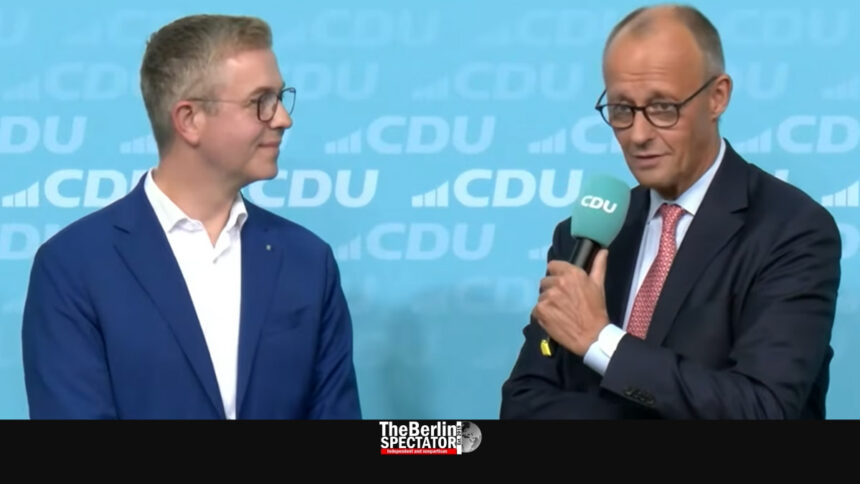
Party leadership will gather at the CDU’s Berlin headquarters as results come in Sunday evening, and Merz has taken the unusual step of calling a formal meeting of the party’s executive board, a sign of how seriously the leadership is treating the vote. He has also called off a planned trip to the United Nations General Assembly in New York, originally scheduled for Tuesday.
Should Merz survive the weekend politically, he would likely remain in what insiders are already calling a probationary chancellorship, one in which he would be measured above all on his ability to push through the coalition’s reform package against resistance from the SPD. A separate YouGov poll of 1,611 respondents found only 31 percent believe Merz will still be chancellor by the end of the year, while 48 percent expect him to be replaced by then.
Should things go badly enough, CDU insiders point to the abrupt resignation of Jens Spahn as parliamentary group leader earlier this year as a cautionary precedent, a reminder of how quickly internal pressure can force a leadership change once the party base turns.
Possible successors are already being discussed informally, chiefly North Rhine-Westphalia’s Hendrik Wüst and Bavaria’s Markus Söder, with Hesse’s Boris Rhein mentioned as a fallback option. The three are not known to be especially close, and Wüst in particular is said to be reluctant to take on the chancellorship now, given that he faces his own state election next April.
For now, all sides agree on one thing: The CDU’s public infighting of recent weeks needs to stop. National polls already show the party dropping below the 20 percent mark, and some within its own ranks are describing the moment as an existential struggle.