


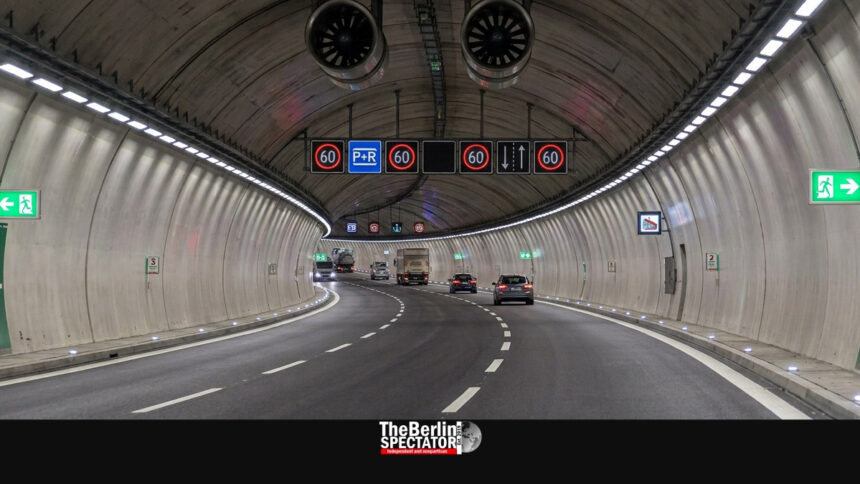
Berlin, October 11th, 2026 (The Berlin Spectator) – Chancellor Friedrich Merz (CDU) got caught up in a closure of the Tiergarten Tunnel last Wednesday and arrived late for an appointment. His delay has drawn fresh attention to a chronic problem, as the “Tagesspiegel” reports. The tunnel beneath the government district and the Tiergarten park is shut down again and again because there are not enough people to carry out the legally required monitoring.
About 50,000 vehicles use the tunnel every day. When it is closed, they have to take surface streets through the city center. The structure cost 390 million Euro. It is not closed permanently, but repeatedly for several hours at a time, and no complete record of the downtime exists so far. The “Tagesspiegel” covered closures in January, February, April and now October. Many of them happen at night.
According to the Senate Administration of Transportation, closing the tunnel on weeknights from 8:50 p.m. to 6 a.m. is a deliberate decision made in coordination with the public transport provider BVG, because traffic is lightest then. Still, the BVG had to adjust two bus routes. During nighttime closures, the M41 is rerouted between Potsdamer Platz and the main station, while the M85 is shortened and ends at Potsdamer Platz. If the tunnel is closed during the day, both lines are cut short.
Control Room
Tunnels longer than 400 meters must be monitored around the clock from a permanently staffed control point, and that is where the system is failing. Of eight positions in the operator pool, only five are filled. Two employees are on long-term sick leave, one is still being trained, and another has just called in sick. Without the required staffing, closing the tunnel for safety reasons is the only option.
Technology can support the work, but under current rules it cannot replace the people responsible for the control room. In an emergency, someone has to decide whom to alert, whether access roads must be blocked and whether the tunnel has to be sealed off.
Administration spokeswoman Petra Nelken was quoted by the German-language newspaper. She explained that the operators also keep an eye on lighting and ventilation. That matters, as last year showed, when one direction was closed to heavy trucks for weeks after several fans failed. The remaining ventilators could not have handled the smoke from a burning truck or bus. Nelken said shifts in the control room are kept short to keep operators alert, and she stressed how demanding the work is, saying that people should “not underestimate this job”.
The paper traces the problem in part to a change of responsibility. Until the end of 2025, the Autobahn GmbH ran the monitoring from its control center in Tegel. According to a reply to a parliamentary inquiry from September 2025, personnel problems forced twelve closures between early 2022 and mid-2025. Starting this year, responsibility has been passed to the state of Berlin step by step. The city set up its own monitoring in the traffic control center in Tempelhof, and the technical equipment was finished last year.
In September 2025, the administration said five of six planned positions had been filled and mentioned no staffing troubles. Since then, the number of planned operator jobs has risen to eight, which raises the question of whether the need was underestimated at the outset.
The Autobahn GmbH currently covers the tunnel from Friday at 7 p.m. until Monday at 5:30 a.m. Further help is not planned, the agency said, adding that Berlin has not asked for any. Twenty-five of its employees are training for tunnel monitoring, but the weekend duty already requires “considerable” personnel and organizational effort. The agency’s staff and facilities are designed for its own tunnels and for traffic management systems across Berlin and Brandenburg.
The administration is in talks with the BVG about temporarily moving employees from its control center to tunnel duty in shifts. They would have to be trained first. Suitable additional staff is not available on the job market, officials say. The administration expects to staff the monitoring in two shifts again starting in the middle of October. Whether that will end the nighttime closures remains unclear.