

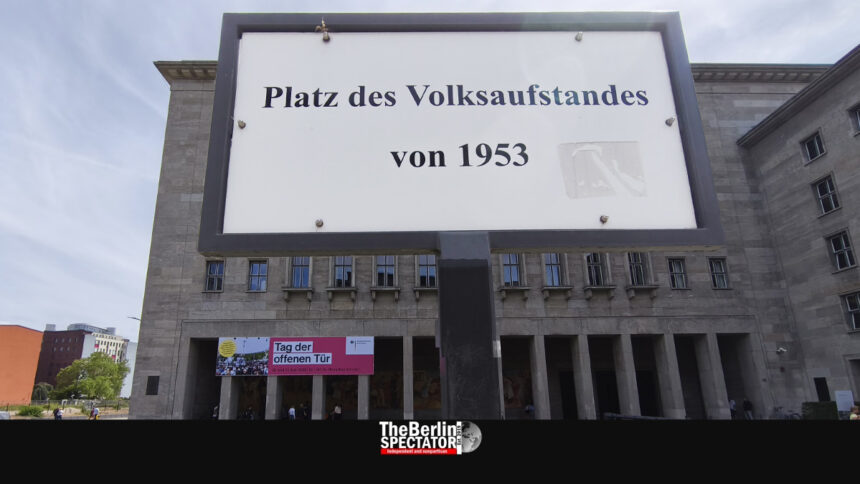
The victims of the uprising of June 17th, 1953, in the GDR will be commemorated on Wednesday. “They remind us that democracy, freedom, and self-determination cannot be taken for granted”, Governing Mayor Kai Wegner said on the eve of the memorial day.
June 16th, 2026 (The Berlin Spectator) – Sixty-seven years ago today, on June 17th, 1953, citizens of the communist ‘German Democratic Republic’ (GDR) staged walkouts and protests against the state’s leadership. The uprising was crushed by the Soviet Army. Dozens of protesters and uninvolved spectators died. So did five security officers.
The participants rejected the kind of socialist system the GDR’s leadership was setting up after being ordered to do so by Moscow. It was the so-called ‘Sovietization’ of their state. Before the protests, farmers and business owners had been pressured to turn over their property to the state.
The police got more powers while military spending increased. Due to several mistakes the leadership of the ‘Socialist Unity Party of Germany’ (SED) made, the food supply for the GDR’s citizens was not secured.
Street Battles
Due to the shortage of fruit, meat and other kinds of food, GDR citizens had to wait in long lines on a regular basis, in order to get the food they needed. At the same time, representatives of the churches were jailed. The ongoing dispossession wave did not make the citizens happy either. Neither did the fact that the economic problems in the communist state increased further.
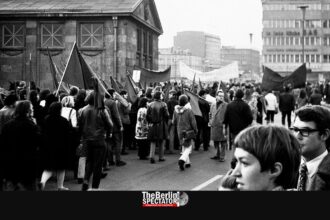
In the morning of June 17th, 1953, workers at factories all over the GDR started a strike. Protests took place in the centers of the state’s larger cities, smaller ones in hundreds of towns and villages. Some city halls and police stations were occupied by protesters. In the town of Gera, even a jail controlled by the infamous State Security was invaded. Street battles between protesters and police took place in East Berlin.
Anywhere between 400,000 and 1.5 million GDR citizens participated in the protests. Historians have not been able to establish the exact number.
Martial Law
On this day in June, the GDR’s leadership was protected by the Soviets. The latter declared a state of martial law in the early afternoon. Sixteen Soviet Army divisions came in. When the tanks arrived, the protests ended in many areas. Both the Soviets and the infamous State Security started arresting people they called provocateurs.
In commemoration of the victims on the day of the uprising, the Federal Republic of Germany observed an official annual holiday on June 17th, until the reunification of Germany took place in 1990. But the date is still a memorial day.
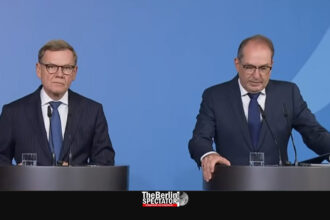
Seventy-three years later, Berlin’s Governing Mayor Kai Wegner (member of the conservative CDU), stated: “The popular uprising of June 17th, 1953, shapes our city’s history. And it reminds us that a life in freedom is not something to be taken for granted.”
Freedom and Self-Determination
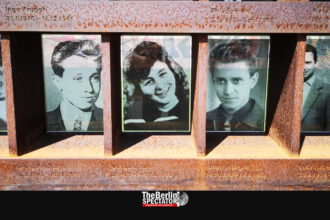
On the eve of this year’s June 17th commemoration, Wegner said, back then, thousands had taken to the streets in East Berlin and other East German cities. “What began as a labor dispute over increased work quotas quickly turned into a popular uprising against the GDR regime. More than 50 insurgents lost their lives, and the SED regime subsequently imprisoned around 15,000 citizens, sentencing thousands of innocent East German citizens, in some cases to multi-year prison terms.”
“The victims of June 17th, 1953, remind us that democracy, freedom, and self-determination cannot be taken for granted”, the Governing Mayor stressed. “We will defend our democracy, our freedom, and our peace — against enemies from within and without. We owe that to the victims of June 17th.”Several commemorative events are scheduled for Wednesday. The central memorial ceremony takes place at the Monument to the Popular Uprising at the Seestraße cemetery in Berlin’s Wedding borough, with speeches and a wreath-laying. There are also district-level commemorations.
The police have issued a general decree banning assemblies and processions around the memorial site for Poland’s 1939-1945 victims at Platz der Republik. The reason: This same date also marks the 35th anniversary of the German-Polish Treaty of Good Neighborship.