


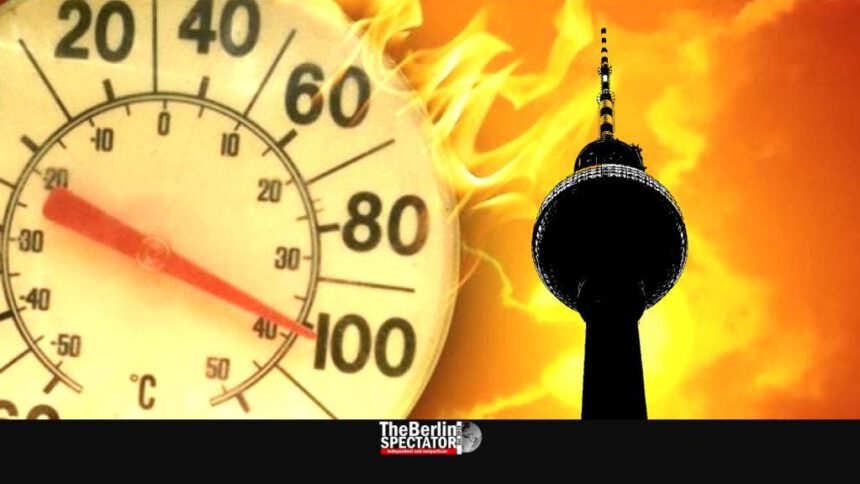
Berlin, June 29th, 2026 (The Berlin Spectator) – Germany has experienced one of its most extreme heatwaves in recent years, with temperatures rising above 40 degrees Celsius (104 degrees Fahrenheit) for several days, causing record-breaking heat, transport problems, health emergencies and a series of deadly swimming accidents. The relief finally arriving is expected to come in the form of thunderstorms and heavy rain, as German-language media reported.
The German Weather Service (DWD) recorded a preliminary national temperature record of 41.7 degrees C (107 degrees F) on Sunday afternoon in Neissemuende, Brandenburg, near the Polish border. It was the third record-breaking measurement in Germany within just a few days. On Friday, the previous high of 41.3 degrees was measured in Saarbrücken-Burbach, followed by 41.4 degrees at the same location on Saturday. Later that day, temperatures reached 41.5 degrees in Möckern-Drewitz in Saxony-Anhalt.
The heat was also felt during the night. In Kubschütz, eastern Saxony, temperatures did not fall below 29.4 degrees, making it the hottest night in Germany since records began. The previous record of 27.2 degrees, measured in August 2003 in Rhineland-Palatinate, was exceeded by more than two degrees.
Heat Affects Transport and Daily Life
The extreme temperatures caused serious problems for infrastructure. Deutsche Bahn and other railway companies advised passengers to avoid non-essential long-distance and regional travel during the weekend. On Saturday evening, more than 600 passengers were stranded on a train in Brandenburg’s Prignitz region after a storm brought down a tree onto an overhead line. Three people had to be taken to hospital because of circulation problems. The train’s air conditioning system was not working.
Road traffic was also affected. According to the automobile association ADAC, several freeways across Germany were subject to closures or speed restrictions because the heat caused road surfaces to expand and buckle in some areas.
The high temperatures also increased the risk for people seeking relief at lakes and rivers. At least 15 people died in swimming accidents during the heatwave, including children, teenagers and adults.
Two Men Drown in Berlin
Among the victims were a six-year-old child who drowned in the Rhein-Herne Canal in North Rhine-Westphalia, a 27-year-old man who died in the Neckar River near Heidelberg, and a 30-year-old man who drowned at a lake near Mannheim. In Berlin, two men died in separate incidents: a 42-year-old man was found lifeless in Jungfernheide Lake, while a 51-year-old man was discovered in the water at Tempelhofer Hafen.
Other fatalities occurred in several German states. A 17-year-old was recovered dead from a quarry lake near Peine in Lower Saxony, while a 76-year-old man died after being found unconscious in a swimming pool in Kassel. A 14-year-old who had gone missing at a lake near Düren in North Rhine-Westphalia was also found dead after a multi-day search.
The heat also triggered emergency responses elsewhere. In a youth summer camp near Eilenburg in Saxony, around a dozen children and teenagers suffered circulation problems and needed medical treatment. They were taken to hospitals. Police launched an investigation into the circumstances surrounding the incident, including the suspicion of negligent bodily harm.
Severe Storms Expected
Experts have warned that extreme heat can place particular stress on children, older people and people with existing health risks. Sudden jumps into cold water during very hot weather can also put additional strain on the cardiovascular system.
The heatwave is now moving eastward, but the change in weather is expected to come with severe storms. The DWD warned of potentially dangerous thunderstorms, including heavy rainfall, hail and strong winds. Some regions could see up to 40 liters of rain per square meter.
Temperatures were forecast to fall significantly, with highs between 25 and 29 degrees C (77 to 84 degrees F) on Monday, although some areas in eastern and southeastern Germany could still reach around 32 degrees C (90 degrees F).
Climate Change Increases Heat Risks
Scientists say the intensity of the current heatwave is closely linked to climate change. Researchers from the World Weather Attribution initiative said such extreme temperatures in Western and Central Europe during this time of year would have been “virtually impossible” 50 years ago without the influence of global warming.
According to the World Health Organization (WHO), heat is already contributing to a significant increase in deaths across Europe. WHO Director-General Tedros Adhanom Ghebreyesus described heat stress as a “silent killer” and said Europe is warming faster than any other continent, with temperatures rising at roughly twice the global average rate.
Germany has already warmed by about 2.5 degrees C compared with the pre-industrial period, according to climate data. The DWD says rising temperatures are contributing to more frequent heatwaves and drought periods, increasing risks for agriculture, water supplies and forests.
The June of 2026 is expected to rank among the warmest June months ever recorded in Germany. The DWD said the month has also been unusually dry and sunny, highlighting a broader trend of increasingly frequent extreme weather events.