
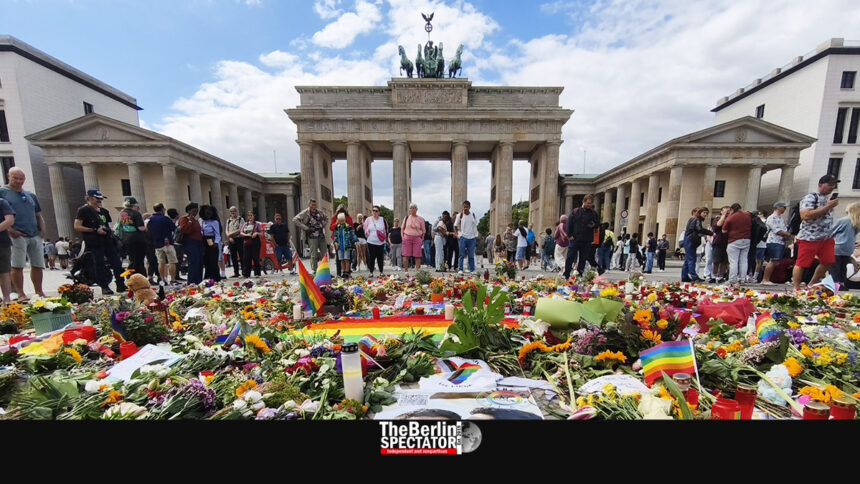
Berlin, July 30th, 2026 (The Berlin Spectator) – More than twenty Jewish, Muslim, LGBTQI and civil society organizations issued a joint declaration calling for German society to confront Islamist extremism directly, arguing that the Islamist terror attack on Berlin’s Christopher Street Day (CSD) parade demonstrated that the threat “concerns all of us.”
The signatories expressed deep sympathy for the woman killed in the attack, the injured, their families, and the LGBT community, and stated that Islamism “is not a problem that arises outside our society.” Rather, they wrote, it “is part of its reality — and must be treated as such.”
The declaration argued that while German society has come to recognize far-right extremism as a homegrown threat, Islamism is still too often dismissed as a marginal or imported phenomenon. The fact that German citizens themselves have carried out Islamist attacks, the groups said, shows that radicalization “happens in our society, in our cities, in our religious and cultural communities, in our digital spaces.”
Fight Against Islamist Ideology
For that reason, the organizations stated, the fight against Islamism can no longer be outsourced or externalized — neither can the problem be pinned on any single social group, nor can the solution be left to security agencies alone.
The statement noted that the CSD attacker believed he was acting on behalf of Islam, and argued that Muslim communities and religious organizations must also confront the question of how to effectively fight Islamism. The signatories pledged their support to those communities in that effort. Most Muslims in Germany reject Islamism, the declaration stressed — which is precisely why it is so important for Muslim communities to push back firmly against Islamist ideology from within their own ranks, and to jointly reject, in word and deed, the exploitation of religion for extremist ends. “That is what it means to be part of society,” the groups wrote.
But responsibility does not end there, according to the declaration. Schools, universities, social work, youth work, religious communities, politics, security agencies, the judiciary, media and civil society all share responsibility for recognizing radicalization early, strengthening democratic values, and depriving extremist ideologies of the ground in which they take root.
No Blanket Suspicion
The fight against Islamism, the organizations said, “begins with prevention.” It also requires consistent criminal prosecution and effective sanctions, they added, as well as an open societal debate — one that neither downplays the threat nor paints with too broad a brush.
Crucially, the signatories emphasized that criticizing Islamism does not mean placing Muslims under blanket suspicion. On the contrary, they noted, Muslims are among the most frequent victims of Islamist violence worldwide, and in Germany are often the first targets of intimidation and religious absolutism.
The declaration warned against two opposite failures: those who avoid naming Islamism clearly out of fear of being accused of anti-Muslim bias leave the field open to those who defame Muslims wholesale, it said — while those who dismiss any criticism of Islamism as “anti-Muslim racism” make the democratic fight against what they called “a misanthropic ideology” harder.
“The fight against Islamism is neither left nor right,” the groups wrote. “It is a task for the democratic center” and an opportunity, they added, since a society that resolutely pushes back Islamist ideologies simultaneously strengthens freedom, equality, the rights of LGBTQI people, Jewish life, religious freedom, and the safety of all people.
The declaration was signed by, among others, Ärztinnen und Ärzte gegen Antisemitismus, Dykes, Women & Queers against Antisemitism, Honestly-Concerned, the Ibn Rushd-Goethe Mosque, the Israelite Cultural Community of Fürth, the Kahal Adass Josroel Jewish Community, the Jewish Forum for Democracy and Against Antisemitism (JFDA), the Young Forum of the German-Israeli Society, the Kurdish Community in Germany, the regional associations of Jewish communities in Lower Saxony, Hesse and Saxony-Anhalt, Maccabi Germany, the Mideast Freedom Forum Berlin and the Werteinitiative.