
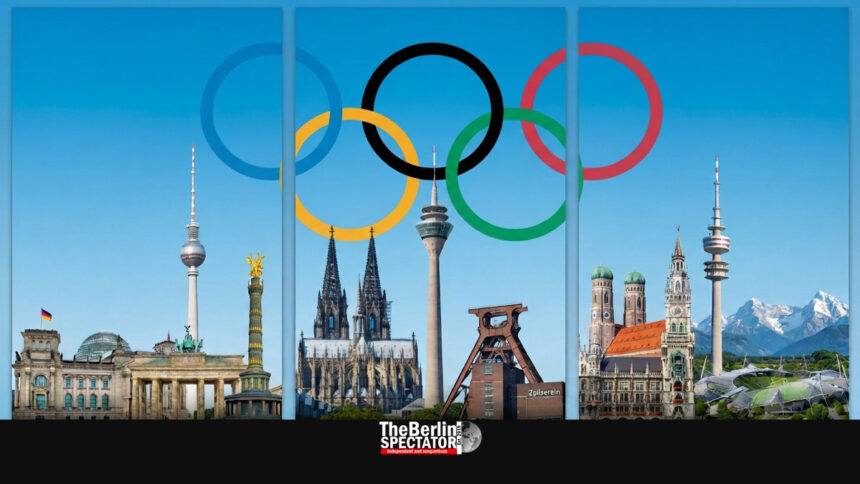
Berlin, September 23rd, 2026 (The Berlin Spectator) – Germany’s Olympic hopes come down to a single choice this Saturday. At an extraordinary general assembly in Baden-Baden’s Kurhaus, the German Olympic Sports Confederation (DOSB) will decide which city or region represents the country in the race to host the Summer Games in 2036, 2040 or 2044.
The contenders are Berlin, Munich and the Rhine-Ruhr region, anchored by Cologne. Hamburg dropped out of what was originally a four-way contest after residents rejected a bid with nearly 55 percent opposition in a referendum held in late May.
The vote itself follows a specific structure. Germany’s 42 top-level Olympic sports federations each hold three votes, which they must cast as a block rather than splitting between candidates, giving them 126 votes combined. Eight individual members, among them professional footballer Leon Goretzka and Olympic field hockey champion Moritz Fürste, get one vote each, as do DOSB board members. That brings the total to 144 votes, with an absolute majority required and multiple rounds possible if no candidate clears that bar on the first try.
Final Concept
Regional sports federations and non-Olympic federations such as the German Chess Federation or the German Karate Association have no vote, and the German Disabled Sports Association is excluded as well, even though the Paralympic bid is being decided in parallel.
Each candidate submitted a final concept by early June, which the DOSB then evaluated together with the Olympic federations using a shared scoring matrix. That evaluation weighed factors including the odds of success in international competition, public and regional backing and operational readiness such as travel times, hotel capacity and athlete accommodations. Delegates are free to follow the evaluation commission’s recommendation, but they are not bound by it.
German President Frank-Walter Steinmeier will announce the decision starting at 1:45 p.m. on Saturday, broadcast on ARD, alongside DOSB President Thomas Weikert. Steinmeier will not be the only well-known face in the room. Tennis legend Boris Becker, swimming icon Michael Groß, equestrian star Isabell Werth and Olympic weightlifting champion Matthias Steiner are also expected to attend.
Public Support
Munich is widely seen as the frontrunner, largely because of strong public support, experience hosting major sporting events and backing from the CSU-led Bavarian state government. About two thirds of participants in a referendum last October voted in favor of a Munich bid, a level of support matched in the Rhine-Ruhr region, where 66 percent backed a bid as well.
Berlin’s parliament also voted in favor, but that vote came under the CDU-SPD coalition, which German voters ousted in Sunday’s state election. With the Left party now the strongest force in Berlin and the Greens also opposed to a bid, a Berlin candidacy carries real risk of collapsing before the International Olympic Committee even makes its decision, even though the capital would likely offer the greatest international visibility of the three.
Whichever city wins Saturday’s vote, Germany’s real work starts afterwards: presenting detailed plans and financial guarantees to the IOC. A first shortlist for the 2036 Summer Games is expected by March 2027, followed by a phase of strategic negotiations running through the end of 2028, before only the strongest contenders remain in the running ahead of the IOC’s decisive session in mid-2029.
Germany may also have to wait its turn. India and Qatar are considered possible contenders for 2036, and if the IOC favors an Asian host, Germany’s chosen candidate would likely need to wait at least another four years, through 2040. The DOSB does not intend to reopen the selection process in that case. Instead, the candidate chosen this weekend is meant to represent Germany whenever Europe’s turn comes, whether that is 2036, 2040 or 2044. Other European bids in the mix include Budapest and Istanbul, while Madrid, the north of England and Tuscany are also weighing potential bids.