

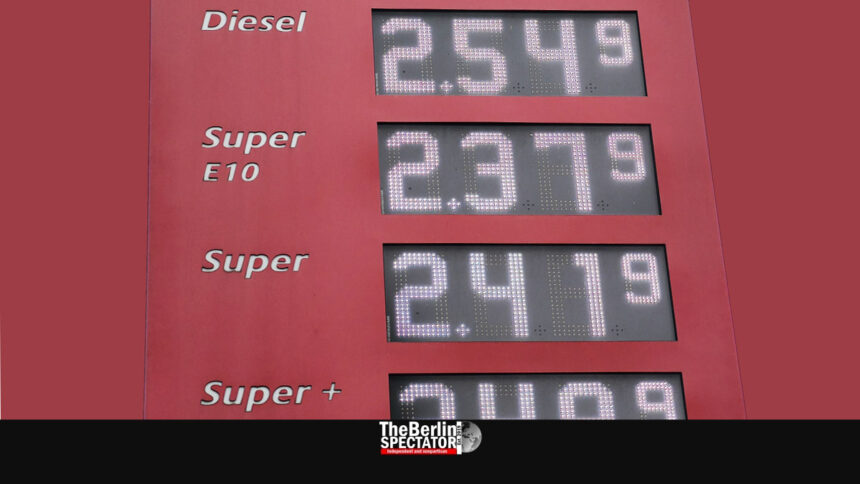
Berlin, September 26th, 2026 (The Berlin Spectator) – In Germany, fuel prices have hardly ever been this high. At a local gas station in Berlin’s Friedenau neighborhood, Diesel was sold for 2.55 Euro per liter, E10 gasoline for 2.38 and high-octane super cost 2.49 Euro on Friday afternoon. Converted to the gallon price, we would be at 10 to 11 U.S. Dollars, depending on the kind of fuel.
Due to the ongoing standoff between the Tehran regime and the United States and the fact that this situation has been dragging on for months, the German government wanted to give people some relief. So, it pushed its fuel rebate through both houses of the parliament, the Bundestag and the Bundesrat.
But will the relief package decrease gas prices substantially? It will lower the energy tax by 14 Euro Cents per liter. Including the automatic VAT reduction that goes with this measure, the price will be decreased by 17 Cents. At this moment, this would mean Diesel would still be 2.38 Euro per liter, E10 fuel 2.21 and high-octane Super fuel 2.32 Euro.
“Noticeable Difference”
While there is a noticeable difference, low gas prices look different. During the Corona crisis, there was a moment at which a liter of Diesel cost 99 Cents. At some point in late June of 2026, it was 1.72 Euro.
Filling up an empty 50-liter tank of some vehicle with high-octane Super costs 124.50 Euro (142.50 U.S. Dollars or 107.58 Pounds Sterling) at this moment. With the rebate, it would still be 118 Euro (135.11 Dollars or 101.98 Pounds). The savings would be enough for purchasing 2.5 additional liters of fuel. Depending on the car, this would be enough for driving between 25 and 50 kilometers or 15 to 31 miles.
But there is more: Chancellor Friedrich Merz’ administration also intends to set a price cap on fuel. The plan is to take into account several aspects, including the crude oil price, the costs for storage, transport, insurance costs and loss. A little profit for the mineral oil companies is supposed to be included as well. That way, the rebate will actually be a rebate. This part of the package will apply from January 1st at the latest, for as long as the crisis in the Middle East continues.
“Targeted Measures”
The rebate will be in place from October 1st to the end of the year. In case the fuel price situation does not improve substantially by then, Berlin wants to consider “targeted measures” designed to prolong the relief.
In order to save time, the government added the relief package to another law it was going to pass. That way, no time was wasted for debates at the Bundestag. Consumers are supposed to feel the price decrease ASAP. If President Frank-Walter Steinmeier does not have any objections to the new law, the relief package can go into effect within days.
This is not the first fuel rebate. A similar measure was in place in spring. Back then, an issue popped up: The oil companies did not pass on the complete rebate to the consumers, for whatever reason. Maybe they just felt the inner urge to keep a chunk of the pie. It remains to be seen what they do this time around.
Oh, we almost forgot: The relief package does have a price tag itself. And who is supposed to cover those 2.5 billion Euro (2.85 billion Dollars or 2.15 billion Pounds)? The federal government and Germany’s federal states, meaning the taxpayer. Yes, the person who fills up his or her car at the gas station around the corner pays for the rebate he or she is happy to receive.